Trekking the largest cave in the world: Hang Son Doong, Vietnam, part two.

(This is part two of a multi-part article. View part one here: https://shorturl.at/iqQT1)

The echoing din of thousands of nesting swiftlets reverberates through the vast cavern, their frenzied chirping mingling with the soft, diffused light of dawn trickling in through the cave’s arching aperture to act as a reveille, calling us from our tents at 6am. Our jetlag lingers despite having already been in-country for five days, and we are bleary-eyed and in dire need of coffee. Despite our extreme fatigue the night before, sound sleep lasted for only five or six hours before a restless dozing took over the remainder of the night. Regardless, the swiftlets and the yawning maw of the colossal cave provide a surge of adrenaline as we’re reminded where we are and just what’s in store for us today. After more than a year of planning and yearning, today we will finally arrive at the legendary Hang Son Doong and bear witness to its grandeur.

With the dawn’s first light slipping through the cavern’s towering entrance, the crew is already a flurry of activity. Porters deftly pack away tents while the two camp chefs, Tu and Luan, have their kitchen humming, aromas of breakfast wafting through the cool air. Two safety assistants tend a pot of boiling water, carefully preparing pour-over coffee and steaming mugs of tea. We meander over and grab a mug of our preferred brews before settling around the crackling charcoal fire.

Sipping our beverages, we watch in awe as thousands of swiftlets dart frenetically in and out of the murky darkness high overhead. The cave is humming with their activity and I use my hand to cover my mug for fear of some unwanted creamer dropping into my coffee. From this very spot, in 2015, Good Morning America made a live evening broadcast to millions of waking American viewers, showing drone footage of Son Doong while the host recounted her trek, and the incredible effort to bring the mountain of equipment required to execute a live broadcast has since paid off well for both Oxalis and the Vietnamese locals who now rely heavily on tourism for their livelihood.

Hang En and the incessant chirping of the thousands of swiftlets that call it home.

Tha and Hieu join us, energetic and friendly, brimming with barely withheld energy despite the early hour. Tha recounts tales of his early life as well as of the more than fifty treks he’s led through the legendary Son Doong cave. 

Coincidentally, Tha was born in 1990 – the very year Ho Khanh first discovered Son Doong’s hidden entrance. As a child growing up in a poor village, he often spent his days searching for ordinance from the war, both unexploded and the exploded shrapnel, which he would play with for hours before turning over to adults to sell for scrap metal. Fortunate to attend university, he studied English and geology before intense guide training that led to a government guide certification. After working as an Oxalis assistant guide for five years, immersing himself in every aspect of the operation and learning the skills needed to flawlessly execute a trip as complex as this, Tha underwent specialized caving instruction from British experts. A probationary year followed, each tour meticulously critiqued by seasoned guides, until he finally earned certification to lead the extraordinary adventures upon which we are now embarked.

All 26 members of the guide team answer to Tha, though he only rarely has to intervene or give direction. Each of them is completely competent and knows their job very well, and Tha is free to spend most of his time with us, the clients, eating meals with us and hanging around the fire to tell stories and answer our questions. Telling tales of floods that have halted tours, Tha focuses his bright flashlight up to a point far above the cave floor on the wall. There, nestled well over 200 feet up in a crack in the limestone is a red bucket, and he tells us that flood waters reached that high a few years back, jamming the bucket into a crack where it remains unretrieved. Imagining the mild-mannered creek that flows lackadaisically below us as the raging monstrosity it would have required to toss that bucket to that height is almost impossible, but the mere presence of the bucket in that crack lends truth to the far-fetched tale.

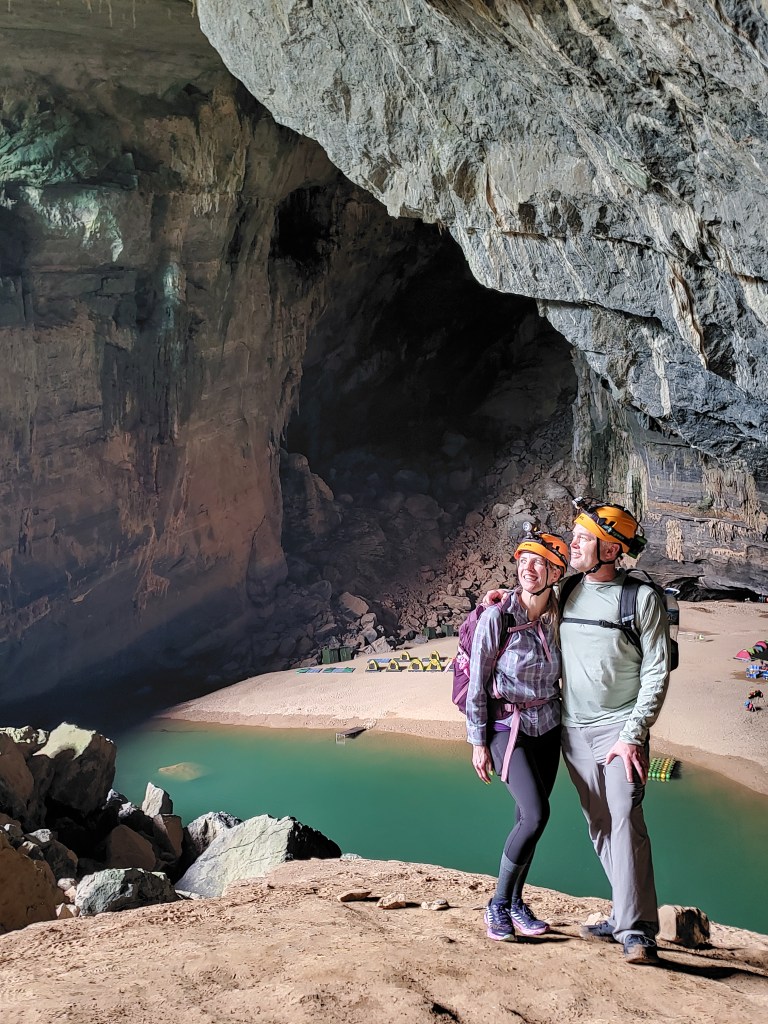
At 0730 exactly, breakfast is served. Another cornucopia of choices awaits, and we stuff our faces with eggs, bacon, soups, breads, rice dishes, and various fruits weighted toward mango and dragon fruit. At 0900 we don our helmets and cave lights, slip back into our boots which, overnight, have miraculously managed to not lose even a gram of yesterday’s accumulated water, and climb the rockfall behind us to a point high above camp where we gather to take in the magnificent views and pose for pictures.

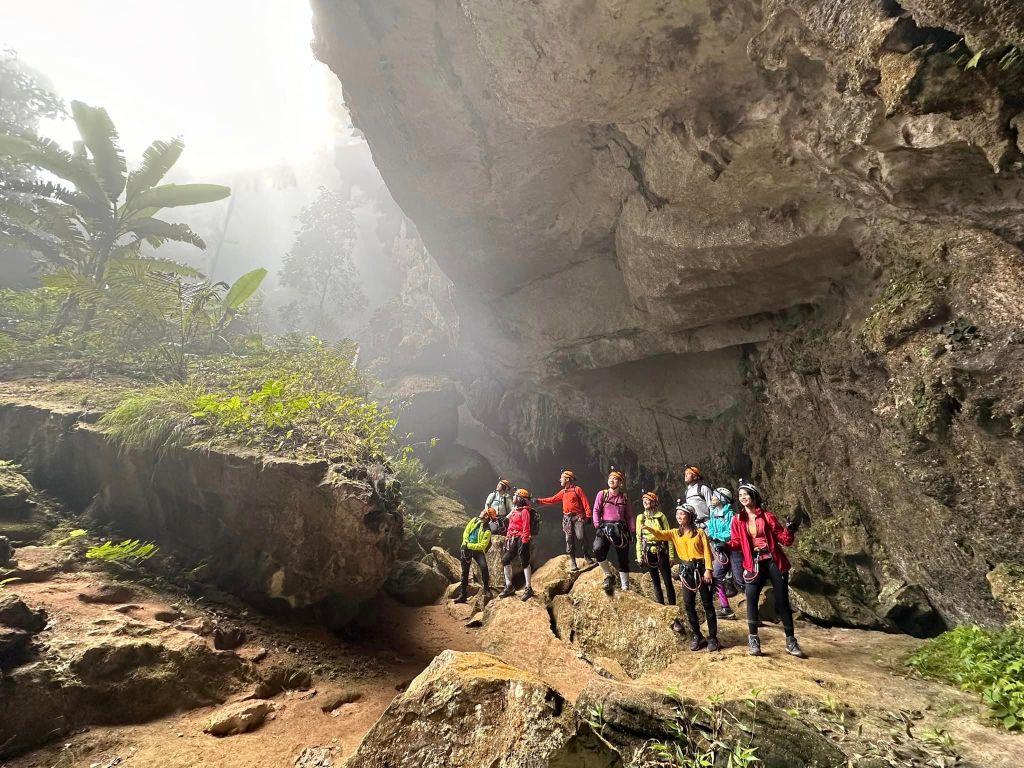
A morning climb up the rockfall behind camp for a magnificent view of the large main cavern of Hang En.

Dropping back down to camp, we slip into our packs and head out just ahead of the team of porters who fall in behind us. After marching across a sandy swale and crossing the knee-deep creek, we climb out of sight of the entrance light and into the reach of beams of sunlight from the exit. The trail branches and we continue to climb while the porter team with their gargantuan packs take the lower trail. We cross through a boulder field of car-sized rocks and past some towering, flowing calcite formations, beautiful in their unique intricacies. At the top of a rockfall, a splendid view of the exit of Hang En opens in front of us. The arching maw of the cave exit reaches hundreds of feet above the burbling creek, and as we sit to languish in the views, the porter team pops out below us, a well-rehearsed and flawlessly executed maneuver that allows us to fully appreciate the scale of what we’re seeing. Without the humans marching out of this magnificent cave while we perch on the rockfall high above them, the magnitude of the arch would be vastly underappreciated, and Oxalis has timed everything to perfection.
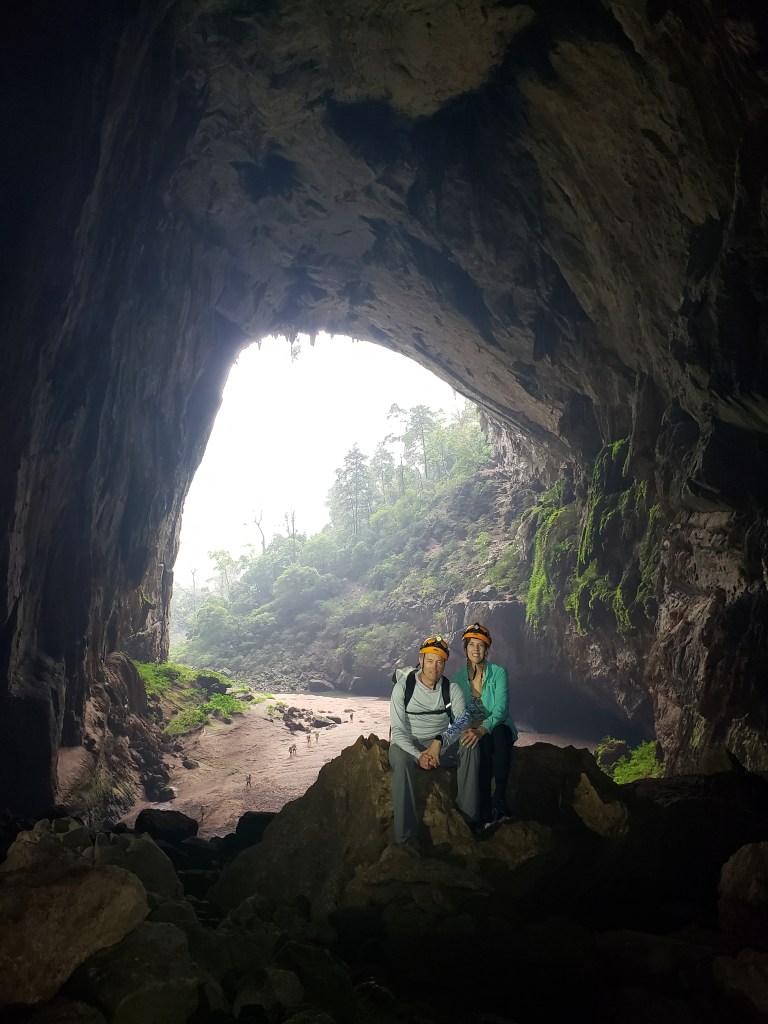
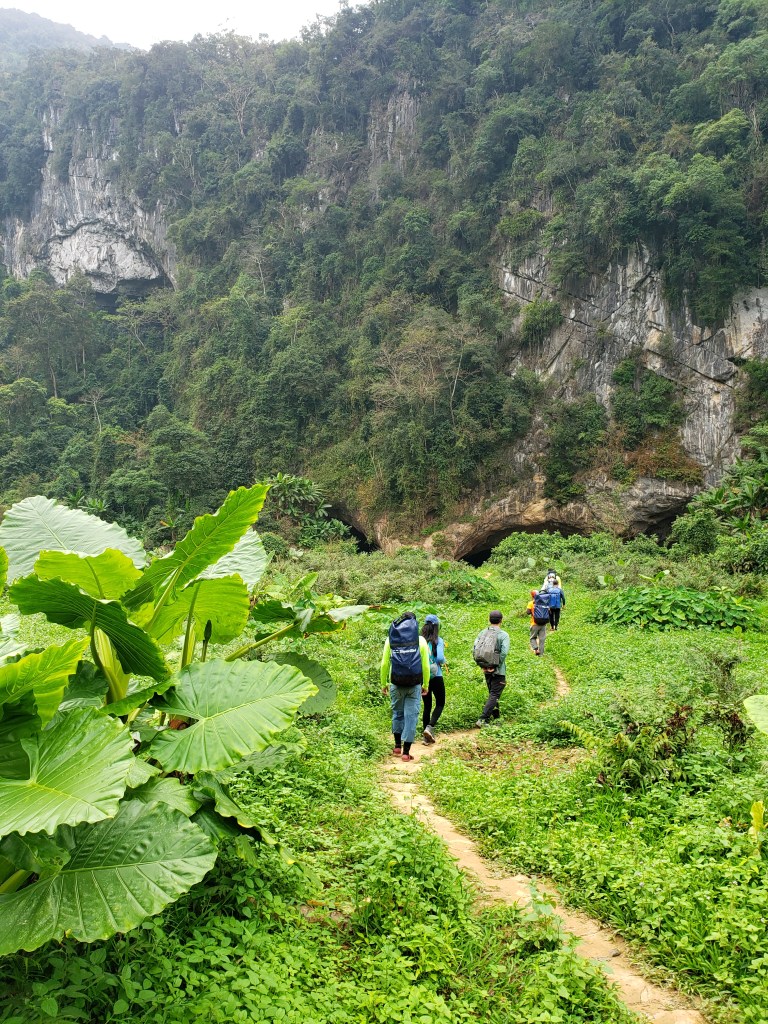
Trekking toward the exit to Hang En, day two of the Son Doong tour.
Approaching the massive exit to Hang En, as seen in the movie, Peter Pan.
The exit of Hang En, porters marching away for scale.

After marveling at the breathtaking views from our lofty perch, we reluctantly climb down to rejoin the creek below, wading once more through its cool shallows. Exiting the cave’s sheltering embrace, we find ourselves once again immersed in the verdant, steamy jungle that so enthralled us the previous day. We’ve crossed under the mountain that stands between the remote village and the entrance to Son Doong, and the river that carved this magnificent passage is but a shade of that which it is capable during the monsoon seasons.

Wading through the river upon exiting the massive Hang En.

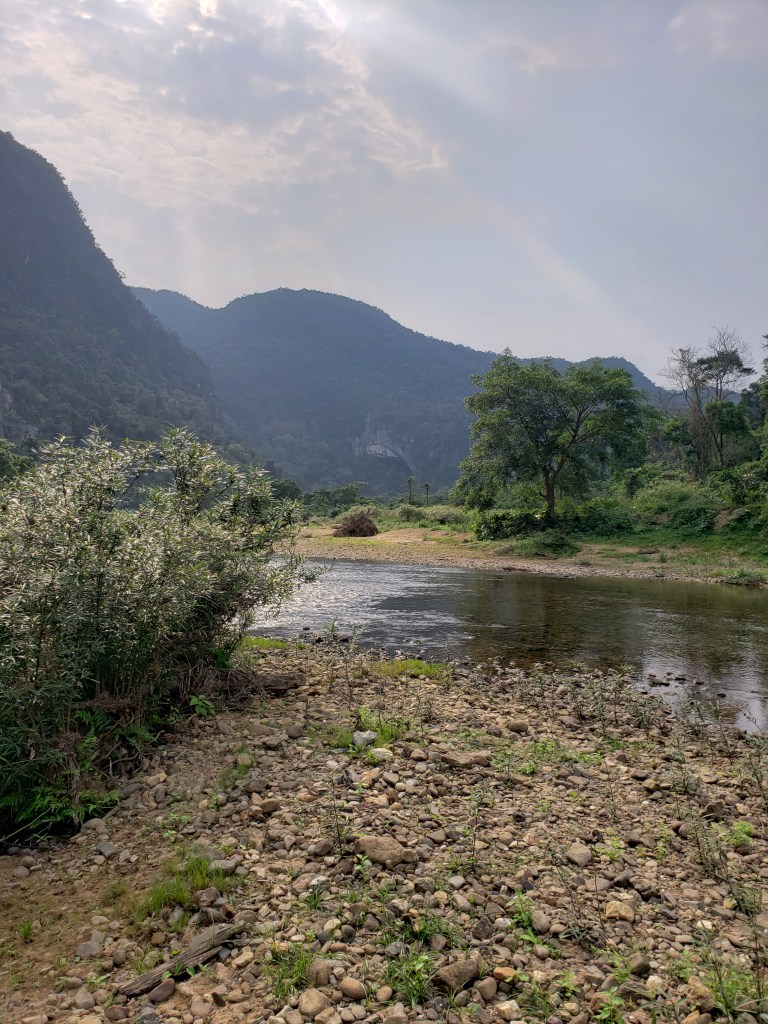
Our path now follows this meandering and lazy river, at times trekking along its banks, at others wading directly through the waters that range from knee to waist deep. Towering limestone cliffs surround us on all sides, their craggy tops disappearing into swirling mists high above while the merciless Vietnamese sun is kept temporarily at bay by the shrouds of precipitation. Tha regales us with tales of leading tours during the sweltering summer months when temperatures often soar past 100 degrees Fahrenheit. The thought sends a shudder through me as I tip my hat into the creek, letting the refreshing waters cool my head, providing temporary respite from the already balmy low 80s heat. The lush jungle closes in around us as we press forward, while the ever-present humidity amplifies the sweat that trickles down our brows. There is a wild, primordial beauty to this rugged landscape that rejuvenates us, and we can feel the call of Hang Son Doong, its dark and mysterious entry passages awaiting our arrival.

A rare toll road in Phong Nha-Ke Bang National Park.

After an hour of trekking along the river, it bends around a corner and disappears from site, a muted roar that seems to reverberate through the surrounding rock letting us know that it has not formed a placid lake, but is instead taking a tumultuous tumble underground. Logs and rocks present an impenetrable barrier, and beyond them, a towering limestone cliff bars our passage. Tha now warns us that we are about to ascend the steep slopes to our right, and that this is the spot where we’ll most likely encounter leeches. As we pause to drink water and prepare for the arduous ascent up the side of the mountain, a scream rings out. The safety assistants all turn and rush to the source which is coming from Ly who is grasping at her side in a blind panic. Fears that she has encountered a deadly snake are dashed as she manages to choke out, “leech!” as she makes repeated plucking motions at her side. Despite the advice that an encounter with an attached leech should be dealt with by simply spraying it with bug spray, an act that kills it almost immediately, Ly is panicked, and successful in plucking it off her skin which now bleeds freely. Tha sprays a disinfectant on her, wipes away the blood, and applies a bandage while one of the safety assistants finds the offending creature and crushes it.

The leeches here are generally very tiny, and we are told that they carry no disease risk, so their presence is much more of an annoyance than anything of which to be fearful. This encounter in the river bottom would be only the first of many in the next hour of hiking.

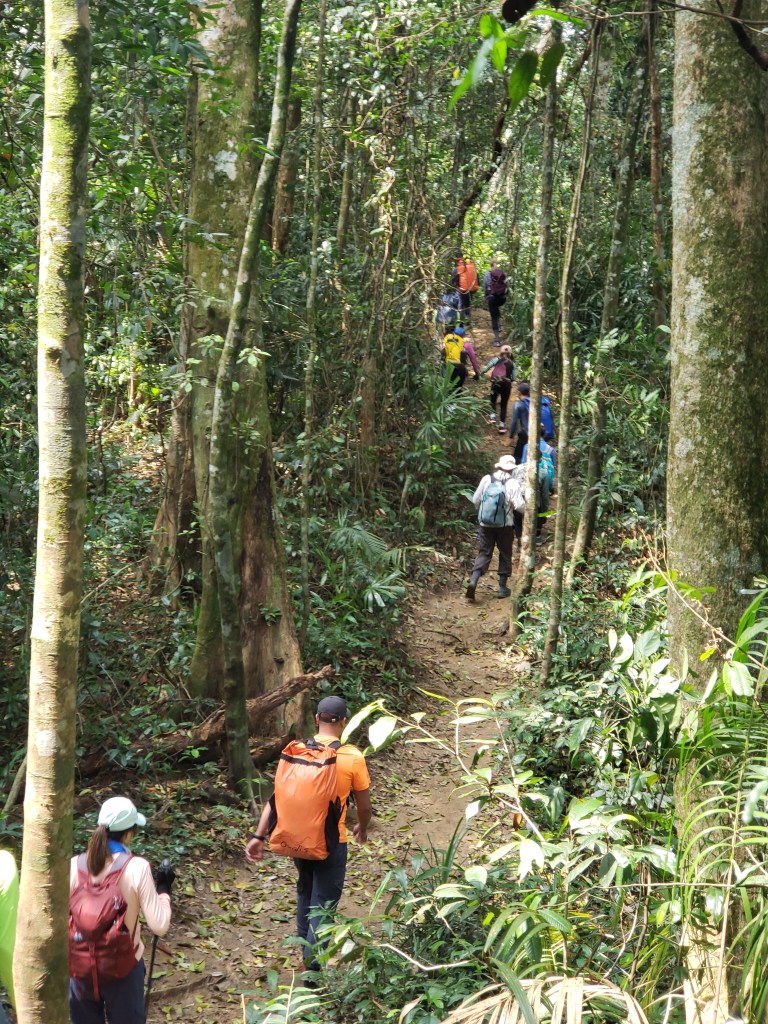
We ascend a narrow and rugged path up the side of the cliff, working our way both upward and forward as the thick jungle closes around us. The path is muddy, and leeches are legion. Awakened from their slumber by the footfalls ahead of us, they are attracted to the warmth of our passing feet, grasping on and moving upward like Slinkys in their desperate search for flesh.

At this point, I should note that the suggestion for this tour was long socks and long pants that could be worn tucked into the socks. I had never planned to wear long pants, bringing only one pair with me almost as an afterthought, and planning instead to wear shorts most of the time. At the safety briefing on the first night, I was surprised to learn that long pants were not a mere suggestion as I’d thought, but were in fact compulsory for all of the hiking time, only optional while in camp. Unfortunately, I’m considered huge in this culture, and Oxalis, while having a vast selection of long pants for purchase, could only find one pair in my size. Since I’d planned to wear shorts most of the time, I had also failed to bring long socks, which meant that even though I now had long pants, I could only barely stretch my socks up far enough to tuck the fringes of the pants into them. This left me quite vulnerable to leeches as my socks, made of cotton and stretched upward, left them permeable to the slippery, slimy, probing leeches which are capable (as it turns out) of slithering through the gaps in the stretched cotton.

Now, with each step, I envisioned the slithering pests probing the thin fabric, seeking any minuscule passage to my vulnerable flesh. Looking down when I could, I plucked two of the beasts off my shoes as they were tumbling their way upward. I could feel an itchiness on my ankle, and then another on my foot, a sure sign that the parasitic stowaways had gained access, but I refused to slow down the group, ignoring them and marching on.

Hiking with hungry leeches far above the river valley as we approach Hang Son Doong.

After an effortful climb crossing sharp rocks on steep, muddy paths, we reach a shelf where the jungle opens up. Ahead we can see a plastic barrier which we are told is a snake barrier surrounding a lunchtime camp. Bathrooms and a cooking station are set up, and we all drop our packs and perform a leech check. I do indeed find leeches attached at the points where I’d felt the itchiness, as well as two other spots where they have bitten, one of the leeches still curled up in my sock. With the ones I’d plucked off my boots before they could make it to the promised land, this makes seven leeches in total that have been on my person. Nobody else in the group has any attached to them, and only one or two have been plucked off their clothing during the climb. Once again, it seems that the Vietnamese critters are enthralled by the rare presence of white meat in their midst. Or, once again, perhaps my feet are so disgusting that they continuously draw a stampede of hungry parasites.
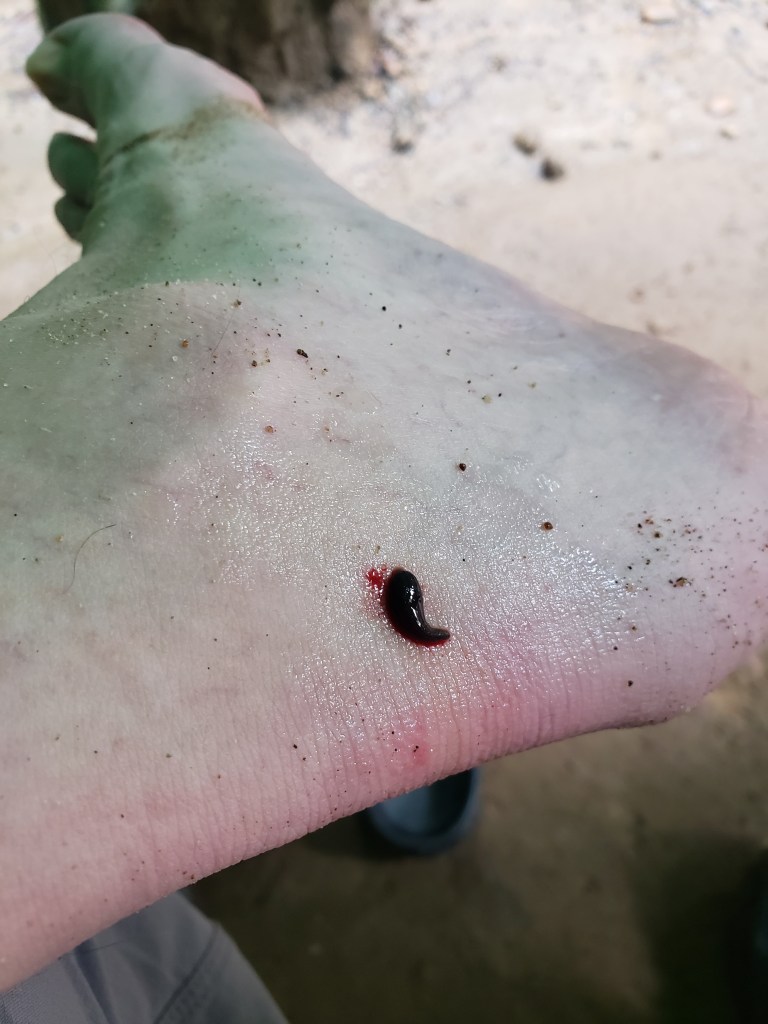
His last meal request was an all-white-meat blood buffet, and he gorged himself just prior to his execution.

Lunch is magnificent and filling once again, and Tha points from our camp outward into the valley where the mist is moving and curling. “The entrance to Son Doong,” he says. The same flowing mist that drew Ho Khanh to recognize a cave and a spot where he could shelter from the storms now beckons us, the eerie pale tentacles that blow outward and then curl back under seeming almost like fingers motioning us to its dark depths. We’re excited to finally be here and we don our soaked shoes, shoulder our packs, and follow Tha along the jungle path to our destiny.

When I first heard about Son Doong, it was hard for me to fathom how a cave of this size could exist without ever being discovered until 2009, or more accurately, only being discovered once before 2009. Surely some primitive local knew about this cave before now? Surely ancient hunters had stumbled upon it at some point? Well, perhaps that is true. However, laying eyes on the actual location of this cave makes it very easy to believe it had indeed never been seen prior to 1990. The jungle is dense, and other than the well-worn path we trod, laid down only for the purpose of tourism, there would be absolutely no plausible reason for anybody to have ever climbed to this point and fought through the thick jungle in order to stumble on this cave entrance. Were it not for the relatively recent desire of the Chinese for the rare trees that grow deep in the heart of the Vietnamese jungle, it is easy to believe that no human would have desired to set foot in this area for millennia.  Would the British Caving Expedition, who had been searching this area for caves for decades, and had actually spent years searching for this exact cave based on the disappearing river, ever have found it on their own? I don’t know, but other than the blowing mist that emanates from the entrance on occasion, this cave entrance is so well-hidden, it is now very easy for us to believe that Son Doong could have plausibly been hidden from human knowledge for a very long time.

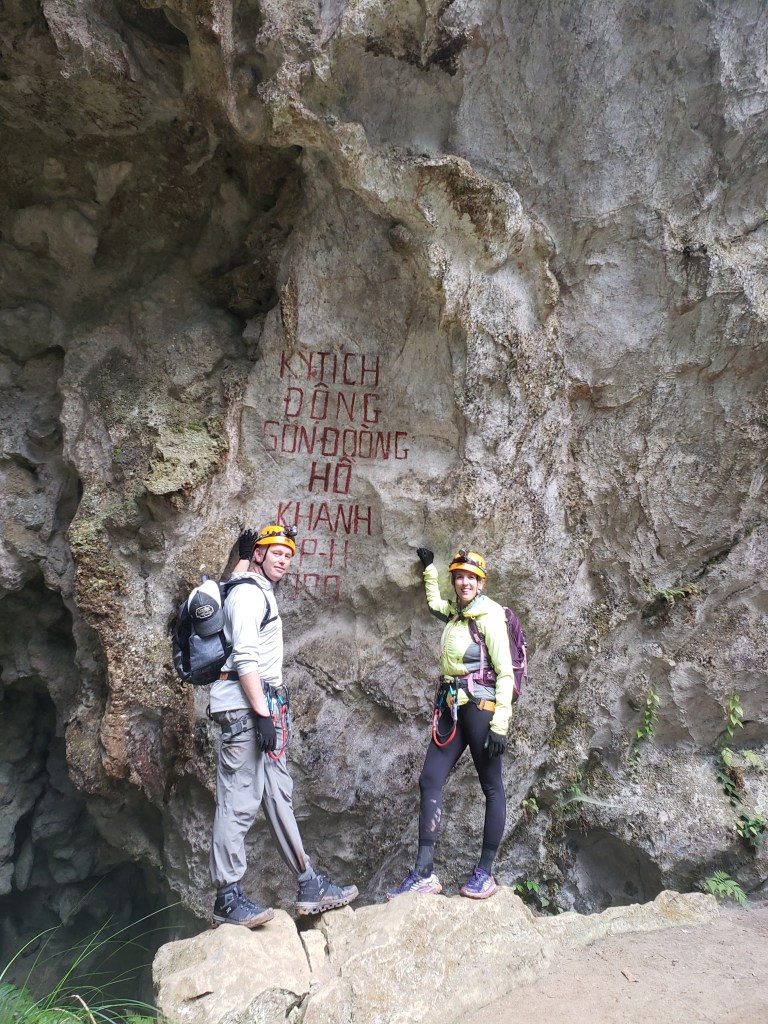
One of the safety assistants near the craftily hidden underwhelming entrance to Hang Son Doong.
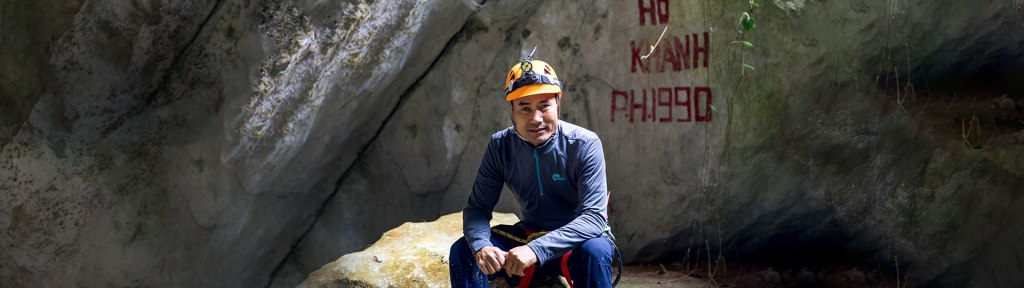
Saved for posterity, the etching of the name Ho Khanh who accidentally found the largest cave in the world.
“What’s that over there? Nothing? That’s okay, just hold that pose!” (Photo credit: Tha Tran)

We finally step around a bend in the thick, verdant jungle, and a pile of jumbled rocks awaits us, the cool air softly billowing out from between them. On the stone wall is a painted mural honoring Ho Khanh and his discovery, and we take pictures next to it while the safety assistants prepare our harnesses and strap us in. The entrance to this cave involves climbing over and around large boulders while descending steeply, a slope that approaches 60 degrees in places by my estimate. Ropes are strung along the path, and we clip in with a dual carabiner system that allows us to shuffle safely between rope systems. The stygian depths of the cave entrance seem bottomless, and our anticipation soars as we slowly work our way down, one-by-one. The safety assistants, who by this time have long ago identified the weaker, less experienced, and more timid of our group, hold to their charges, carefully helping them through the more technical or slippery parts. Nobody wants a fall here, which would likely end the excursion for that person.

The first stage of the long descent into Hang Son Doong. Ho Khanh waited out the storm right here in 1990 and went no further.
Ropes and carabiners for the rest of the descent on the 60+ degree slope into blackness.

Tha has informed me earlier that of all the trips he has led through Son Doong, on only one was he forced to send a client back, and that decision was made right here at the entrance. If you are terrified of this descent into the yawning black maw that opens below you, then you will struggle mightily with what’s yet to come, and this is the last easy place to send someone back. After this descent, we will be committed to the full trek through the cave.

The bottom of the rope section. Entertainment of the day was seeing who clipped into the last 4-foot section of unnecessary rope.
Safety assistants lighting up the slope we’ve just descended from the entrance to Son Doong.

Safely at what they call the bottom of the entrance, though we can still hear the river roaring very far below us, hidden beyond our site in the bowels of the rock, we begin our trek through the perpetual darkness. Tha stops to light up the fault line in the rock, the very weakness in the limestone that has allowed this cave to form. The fault line in Son Doong runs the entire length of the cave, more than nine kilometers from north to south and it is visible as a crack and discoloration in the rock at many points.

Time seems to stand still in the stygian depths of this cave that is deep underground, but after some amount of trekking, the river finally rises from its deep bed to meet our path. Ropes are strung across the river for us to hold onto lest we be swept away in the quick current. I would shudder to think of the effort it would take to find a body that fell here, as the river goes over a small, tumultuous waterfall only to disappear once more into the darkness.

Crossing the river for the first time inside the cave.

We safely traverse the river and then hike for a time through more boulder fields. Flying insects are everywhere, and we have to swipe them from the air in front of us to avoid ingesting them as we breath hard from the exertion. Bats flit about, buzzing our heads and darting in and out of the illumination from our caving headlamps, hungrily swooping up the flying bugs like in a futile, never-ending game of Hungry Hippos. We eventually reconnect with the river which has made a wide bend around the cave, and we cross it once more, the water swift and thigh deep on me, nearly waste deep on others.

The second and last river crossing before it plunges underground, still unexplored to this day.

The river successfully crossed, it dips down and away from us, and Tha informs us that here it goes deep underground. We won’t see it again for the remainder of the trek, and we bid it farewell as we march onward, its roar muting in the distance behind us. The UK caving team has made several attempts to follow the path of the river, including a few SCUBA dives in an effort to discover what they believe may be yet another cavern on a level below this one, however, success has thus far eluded them, the water too deep and too swift to safely explore. Tha tells us that they once reached a depth of 88 feet in their attempts to dive it, but that was the limit to their equipment and experience, and the effort ended there.

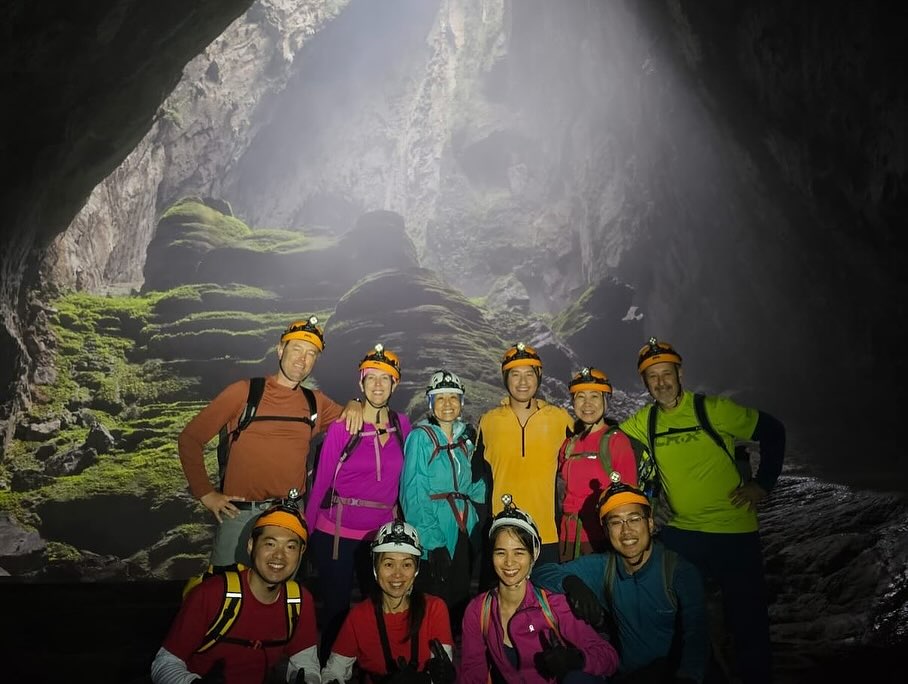
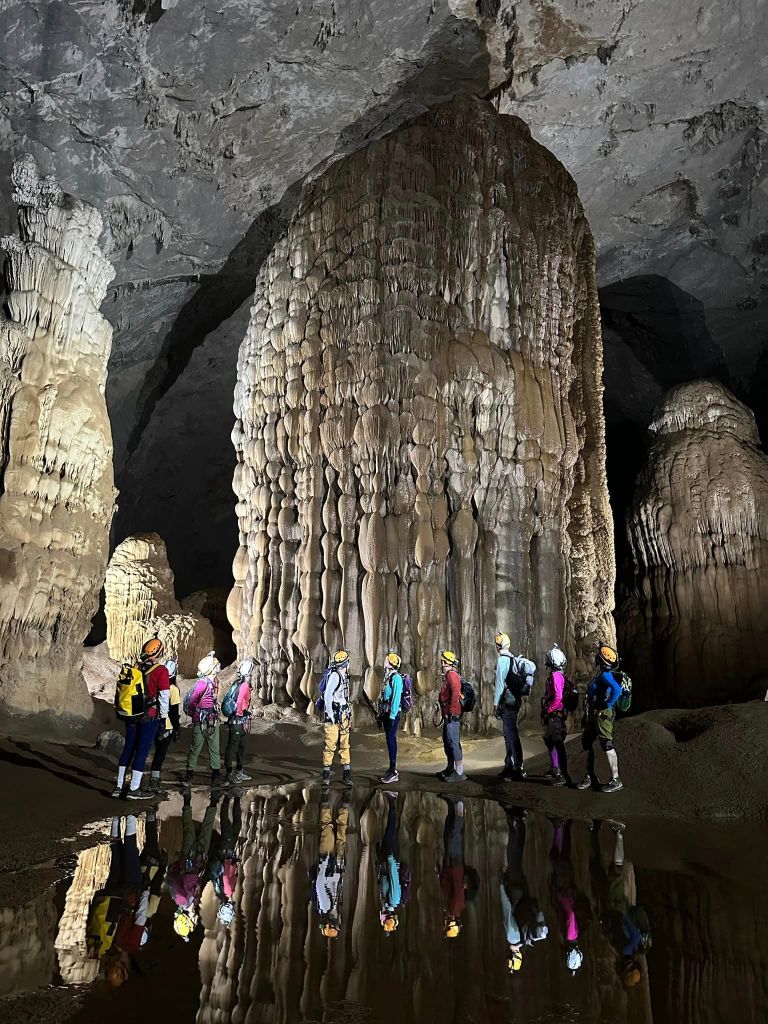
As we trek onward, Redwood-sized stalagmites greet us, their sides rife with rivulets and intricate patterns carved by flowing water. I’ve seen a lot of stalagmites, stalactites, and columns in numerous caving adventures over the years, but I have never seen any that come close to the gargantuan monstrosities that now meet my gaze. Formed by calcite mineralization in dripping water, its often said that the growth of these can be measured in millimeters per year. Tha tells us that the first time he entered Son Doong ten years prior there was a formation of stalactite and stalagmite that was only a few centimeters from connecting into a column, and in that time, it has still not connected. And yet, these stalagmites that we now brush up against and explore are sometimes more than 100 meters in height, with a diameter that oftentimes is more than 30 meters. The ceiling of the cavern often rises more than 200 meters above us, leaving most of the stalactite features out of the reach of our headlamps, even at their brightest settings.

Silhouetted far in the distance, a tour guide stands atop Hand of Dog. (photo credit: Kay Tran)
Our tour group, staring up in wonder at a Redwood-sized stalagmite, not posed at all. (Photo credit: Tha Tran)

Tha now sets us up for a view of the massive cavern we’re traversing by sending the safety assistants out with their bright, handheld lights, and theatrically calling for the lights to be turned on all at once to illuminate the cavern. Appropriate “oohs” and “aahs” follow, and we marvel at the breadth of this cavern. Far in the distance, a kilometer or more away, the distant light of the first doline can be seen. A doline, or skylight, is an area where the cave ceiling has collapsed, opening it to the light, and Son Doong has two of them, massive in size. Much more about this later.

A feature far in the distance is silhouetted by the light from doline one, and a solitary figure stands atop it, his helmet light turned on, a melodramatic setup, though absolutely magnificent in the effort and the effect. This formation he stands upon is called Hand of Dog, a misunderstanding during the initial survey where protocol dictates that once a name is recorded in the ledger, it is there for posterity, misunderstanding or not.

Finally almost to Son Doong camp one, nestled on a shelf below the massive doline one.

After resting, marveling, photographing, videoing, and an appropriate amount of awestruck reverence, we continue our trek toward doline one. Difficult at times, but never without constant wonders that leave us with sensory overload, we finally arrive at a promontory overlooking Son Doong camp one. It is 5pm and our stomachs are rumbling, the smell of cooking food already wafting up from the camp below. The porter team and chefs march around like ants in the gloom as they prepare for our arrival, no doubt looking up to see our approaching headlamps and making their final adjustments. The effort these guys put in is something that just can not be overstated, and we were all eternally grateful and impressed by how smooth this Oxalis operation was.

We work our way down the steep slope, daylight from the doline now helping to illuminate the path. Our tents are lined up, waiting our arrival, beckoning to us weary travelers for rest and respite. However, our day isn’t done yet. We’re hot, covered in sweat from the exertion and humidity, a sticky, exhausted mess, and Tha tells us that there is an opportunity to swim here at this camp, however, it will require a 15-minute arduous trek on a very steep path down, a trek we will have to reverse afterwards, meaning significantly more effort at the end of the day when we only want to relax. He also tells us that for this swim, it is mandatory that we swim in the very clothes we’re currently wearing, shoes and all, and that we will have to wear life jackets the entire time.

While none of this sounds all that appealing, I am a sticky mess, and the opportunity to actually wash some of that off me is irresistible, even if I will get sweaty again afterwards on the long climb back up to camp. I’m also unwilling to miss even one inch of what they will allow us to see of this cave, regardless of the effort involved.

We drop our packs at our tents and then the group splits up, with Justin, Ly, Phuong, Damien, Tracy, and I deciding to accompany Tha, Hieu, and three safety assistants to the swimming hole, and Anthony, Truc, Jeremy, and Kay electing to stay at camp and rest their weary limbs.

We leave camp, dropping off the large sandy shelf that contains our home for that night, and back into the dark depths of the cave, working our way across the massive chamber and toward the far wall. As we descend steeply downward, I begin to question my decision, imagining a quick dip in some stagnant lake followed by a tough, sweaty climb back up. After all, the river is deep underground at this point in the cave, supposedly lost in the bowels of the earth, so how could this swimming hole be anything of interest? I could not have possibly been more wrong. In my defense, Tha and the others were strangely reticent to share details of this upcoming adventure, an unusual taciturnity for the normally loquacious crew. That should have been a sign…

Passing many unique and interesting rock and mineral formations, as well as some fossilized crustacean remains along the way, the much less-trodden path winds its way deep into a crevice between the floor of the cave and the gargantuan wall, descending down far out of view of the light from doline one until it feels that we have traversed into another world entirely, dropping down toward Hades, or perhaps marching toward a date with an imprisoned Balrog. Stopping on a smooth but steep rock, Tha rechecks our life jackets, allows us to remove our caving helmets, and then leads us into a narrow passage through what seems to be uninterrupted rock until…viola! A narrow crack in the rock appears in the light of the guides’ handheld flashlights, hundreds of feet in height, the walls sheer and stretching upward to disappear in the inky blackness. The crack is filled with an aquamarine water, pools that are refreshed by floods of the river far below but remain almost hidden from all light for eternity. One-by-one, we slip into the frigid waters with whoops and shouts of joy, our weakness and soreness completely forgotten as the icy waters soothe our tired muscles and we swim away from the launch point, following the flooded crevice back along the length of the wall. The safety assistants turn on waterproof lights and dip them below the surface, revealing the deep blue-green of the incredible water. I scrub the accumulated sweat and silt from my head, reveling in the refreshing bath, and even Tracy, who normally loathes cold water, is enamored by the icy plunge.

The fully-clothed plunge into the deliciously icy waters hidden in the perpetual darkness of the far reaches of Son Doong.

The six of us clients plus Tha and Hieu gather at the far end of the pool where a rock shelf has dipped into the water allowing us to stand, and Tha shouts down to the far end for all lights to be extinguished. We marvel at the pure darkness that engulfs us, an absolute absence of light where one can truly see nothing, and in my head, I imagine trying to find our way back to camp if the lights fail to turn back on, a nightmare scenario that thankfully fails to come to fruition as they click the lights back on and we continue to frolic in the pure refreshment of this miraculous pool.

“The only question I have,” I announce to the others as we languish in bliss while some of the group begins to shiver in the icy waters, “is how do we tell the others who stayed behind, that they missed the best part of the trip?” Everyone laughs, but they all know that I’m only partially joking. This experience, if any readers are lucky enough to go on this tour, is an absolute must, not to be missed for any plausible reason.

Eventually, the frigid water drives us to swim back to the entry point where the safety assistants wait to pull us back up to the launch ledge. We squeeze through the narrow passage under the rocks and marvel at how this hidden oasis was even discovered in the first place as we reach the spot where our caving helmets and lights await. The long, steep climb back to camp in wet clothes does indeed leave us tired and a bit sweaty, but we all agree that the magnificent experience was worth every ounce of expended energy.

Dry clothes and a steam bath await us at camp, and we convey far less than the exuberance we feel in our description of the trek to our fellow travelers lest they feel they’ve missed something truly spectacular. Which they have. At this point, I’m exhausted, the cold water finishing off whatever energy hadn’t been used up in this day’s trekking. Dinner is served at 7pm exactly, another cornucopia of absolutely delicious meats, soups, vegetables, and various rice dishes. I honestly can’t tell if the food is so good simply because we’re exerting so much effort, or if the chefs are just that good, but it doesn’t matter, the fare laid out before us in at least seven courses is fit for the banquet halls of even the most prestigious kings, and we lay into it with gusto, once again failing to even come close to polishing it all off. The calorie burn of this trek should leave us all with a good amount of weight-loss, but I believe we’re probably easily replacing those calories with the magnificent feasts provided to us for each meal.

After dinner, we sit and relax around the charcoal campfire, watching as the light fades from the doline and darkness descends upon the camp. The chefs and porters clean up and then the porters retire to their area away from us where they play card games and lounge around relaxing. One of the chefs brings a grill top over to our charcoal fire and then loads it with sweet potatoes which bake over the coals, a delicious desert that is hot and bubbling 45 minutes later. I somehow manage to stay up until ten o’clock tonight, a record for the trip and an unexplainable achievement based on my exhaustion factor.

Sleep eludes me tonight for all of about two minutes before I’m dead to the magical world in which I’m enveloped.
Trekking the largest cave in the world: Hang Son Doong, Vietnam, part one.

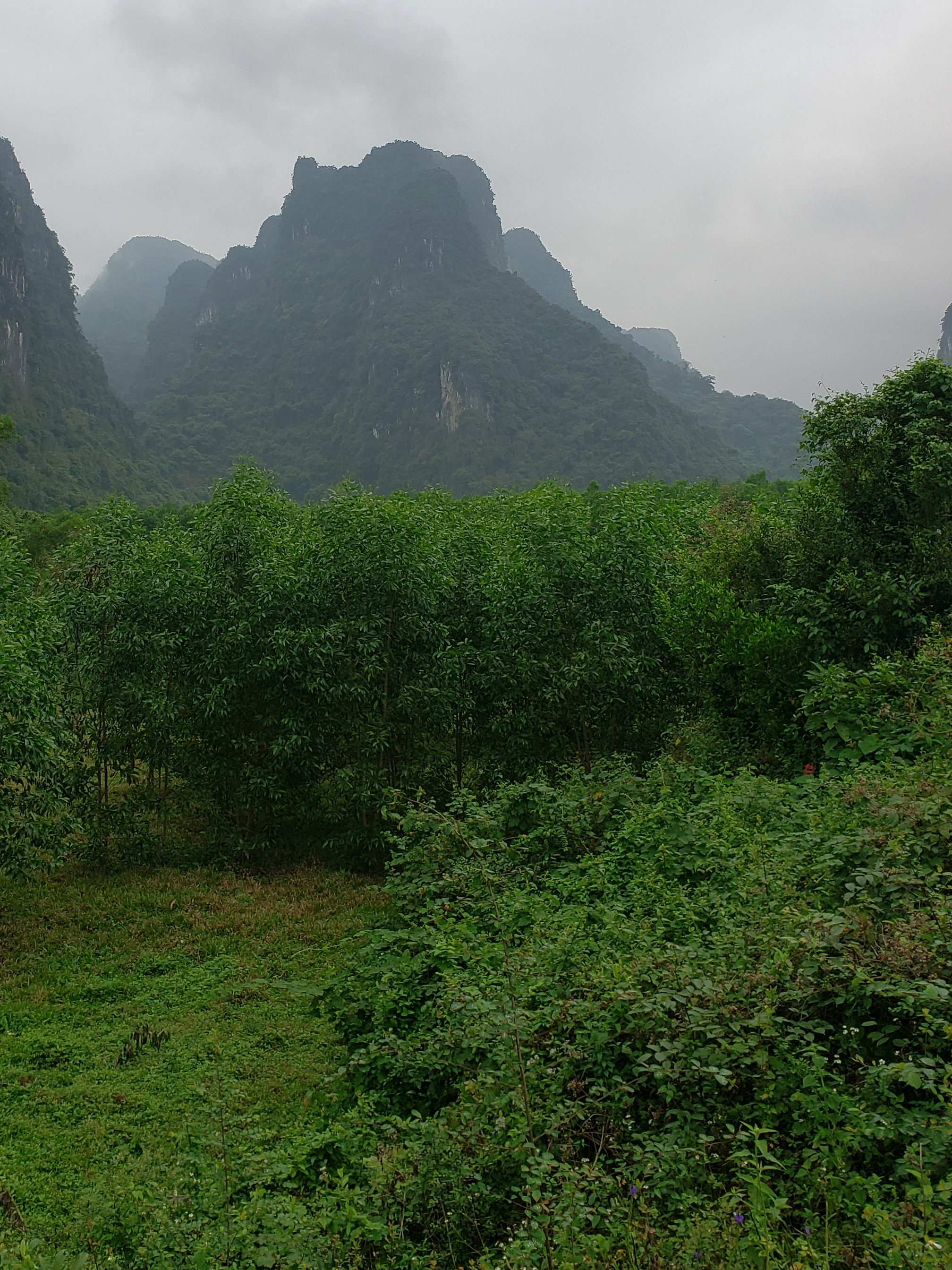
The thick jungle canopy provides a welcome break from the sweltering Vietnamese sun, casting a verdant shade over our group of ten as we trek along the narrow, slippery trail. We’re as out-of-place in this environment as newborn fawns, blinking and staring around with wide eyes and flaring nostrils at the unfamiliar terrain and the musky scent of the dense foliage. The air is thick with humidity, causing perspiration to soak our clothes despite the dappled shade. The cacophony of cicadas fills the air, their relentlessly loud chirping serving as a rhythmic backdrop to our trek. As we descend along the narrow trail toward a river bottom, the temperature rises, enveloping us in a warm embrace. Limestone cliffs spring triumphantly and majestically from the lowlands, their jagged edges and crevices a testament to the relentless erosion of both water and time. These towering monoliths dominate the valley, creating a stark contrast against the vibrant greens of the surrounding vegetation which climbs their flanks. Swirling misty clouds born of the thick humidity lazily circle their tops, occasionally dipping down their flanks invoking Jurassic-era vibes to the remote jungle.

The misty limestone promontories of the Vietnamese jungle.

With only brief pauses, we navigate the uneven terrain, descending steeply, stepping carefully over exposed roots and jagged rocks that threaten to trip the unwary. The soft thud of our footsteps mingles with the burbling of the river below, creating a symphony of nature that seems to envelop us entirely. One of our group slips in the mud and lands painfully on her back. A safety assistant rushes to her and helps her up. She’s okay, but the safety assistant stays close, ready to catch her if the tread of her hiking shoes fails her again.

We are alone in the thick, steamy jungle of the Phong Nha – Ke Bang National Park in the north-central part of Vietnam, very close to the Laotian border. Access to the park is carefully controlled by the Vietnamese government, and though the roads through the park are open to traffic, strict laws prohibit anyone from leaving the roadside without being part of an official tour group, operated by only one company in Vietnam, Oxalis, and strictly limited as to number of persons, both per day and per season. As if to emphasize these laws, a park ranger catches our group and plods past us, his nimble feet well-accustomed to the hazardous trail. He carries a heavy backpack that contains bags of rice poking out the flap and a thick green vegetable like a cucumber on steroids strapped to the top. We are told that he is headed to his post where he will stay for a week, guarding the jungle access against unauthorized visitors.

As we press on, the cicadas get louder until their drone becomes almost piercing, and the jungle canopy begins to open up. The absence of any breeze only adds to the stifling atmosphere, and the sun’s rays begin to pierce through the sparse tops of the tall trees, casting a golden glow upon the land around us. We keep a wary eye out for snakes including several types of vipers, a cobra, and a constrictor that are all native to this area. The scent of decaying vegetation and damp earth fills our nostrils, a welcome change from the smell of burning garbage and plastic that permeates the cities we transited on our way here. There’s a certain magic to this place; this humid jungle gives a sense of adventure and discovery that fuels our determination to press on and uncover its secrets.

After about 45 minutes of descending, we finally reach the river bottom, and our tour guide lead, Tha Tran, steps into the knee-deep water. The river is not wide, and rocks provide a platform upon which to leap and avoid getting our feet wet, but Tha, with a mischievous grin on his face, uses his staff to splash the rocks, turning them from dry and easily navigable steps into slippery instruments of chaos. Its time to get our feet wet, and Tha makes it clear that there is no avoiding the wading of the rivers that will become part of our very existence for the next four days.

Making our descent through the jungle toward the river bottom.

The ten of us, strangers until the previous evening, are gathered together here in this remote national park of Vietnam for one purpose: to explore Hang Son Doong, the largest cave in the world. This behemoth cave, created by eons of rushing water through the vast permeable limestone cliffs that inundate the landscape of this country, was only officially discovered in 2009 by members of the British Cave Research Association. Prior to the discovery of Hang Son Doong, the largest known cave in the world was Deer Cave in Malaysia. Deer Cave enjoyed this prestigious title from its survey in 1985 until the completion of the survey of Hang Son Doong in 2010 which would reveal a volume more than twice that of Deer Cave. An absolute monstrosity that lay unseen by human eyes for eons, its secrets waiting patiently to be mapped, and we were all giddy to be some of the very few who have had the pleasure of bearing witness to its glory.

The full story of the discovery of Hang Son Doong (Hang means “cave” in Vietnamese, so this is the Son Doong Cave) began in either 1990 or 1991—the literature is unclear, along with, perhaps the memory. In the rainy season of one of those years, Mr. Ho Khanh, a local villager who relied on illegal logging to support his family, was searching the jungle for aloe wood, also called agarwood, a very precious, very valuable, and very difficult to find wood which exists sparsely in the deep jungle. Here again, the story varies, as some, including our tour guide, Tha, tell us that Ho Khanh was actually searching for the Sua tree, an even more rare tree than agarwood, and one that is prized by the Chinese and that can sell for up to $1000 per kilo. Whichever account is accurate, what seems true is that Khanh was searching for a rare tree, and perhaps he was looking for either of these rare and valuable woods, something that seems quite plausible for an opportunistic and knowledgeable logger who risked illegally scouring the dense National Park junglescape in an effort to support his family.

Initially with two compatriots, Ho Khanh separated from the others and trekked through a massive cave called Hang En, following the river that flows through it, the easiest path through the dense jungle. After Hang En, the river disappears underground, and Khanh climbed above the valley, his eyes scouring the jungle for the elusive tree. Rainstorms appeared and began dumping on him, and his eyes noticed mist swirling and streaming from the side of a limestone cliff, a sure sign of a cave entrance. He worked his way over to the entrance, a cave he had never before seen nor heard of, and hunkered down just inside and out of the downpour. When the rain finally ceased, Khanh returned home and promptly forgot about his discovery. Caves are generally meaningless to the local people as with few exceptions, they provide nothing of value. This one in particular was of no value as the entrance was narrow and the cave descended steeply into a yawning maw of blackness where a cold wind rose from the inky, stygian depths, meeting the warmer and humid air of the jungle to create the mist that Khanh observed. That deep blackness and the accompanying roar of a great river in its mysterious depths held only nightmares and prehistoric limbic fear for the young man who wanted nothing to do with whatever monsters waited below.

Fast forward to 2007 when Howard Limbert of the British Cave Research Association fortuitously met Ho Khanh. A prodigious searcher of caves and a world-renowned caver with decades of experience, Limbert’s group had discovered and mapped hundreds of caves in the limestone cliffs of the Vietnam jungle over the previous decade. Ho Khanh had been engaged by the British caving team for the previous season to help them discover new caves, and his expert guidance had been fruitful with dozens of cave discoveries during his tenure. In 2007, the British crew enlisted Khanh’s help once more, and at the end of that season, Khanh met Howard. In their talks, Howard told Khanh that he was specifically looking for a cave that would connect the massive Hang En with another cave known as Hang Thoong. The river that flowed through both caves disappeared underground at some point in the impenetrable jungle, and Howard Limbert suspected there must be another cave hidden in that area. This description triggered the memory of the rainy night almost two decades past that Khanh had spent bunkered in the entrance of an unknown cave in that very area, a cave that spewed cold air from unfathomably stygian depths with swirling mist revealing its existence in the dense canopy, and Khanh led the group out in search of this cave he vaguely remembered. Their search was unfruitful, and the team returned to England at the conclusion of the season. The following season, in 2008, Khanh, wanting to impress the group he admired and that probably compensated him well, went out on his own, searching for the cave of his distant memory. This time, he found the entrance and marked it in his mind. The vast depths were too steep and dangerous for him to explore on his own, but he returned to his village to await the return of the Caving Expedition. When they returned in 2009, Khanh excitedly led them to the entrance. He was worried that this cave might be a dry cave with no special significance, its depths merely imagined, the subterranean river for which they searched located elsewhere. His worries were for naught though, as the British Cave Research Association stepped up to the tiny hidden entrance, unaware that they were on the brink of the greatest and most exciting discovery in their history, and arguably in all the history of caving expedition.

Jungleman Ho Khanh, original discoverer of Hang Son Doong.

In 2024, the new cave, named Hang Son Doong, or “Cave of the Mountain River” has become a carefully regulated tourist attraction, bringing cave afficionados from around the world who pay $3000 each for the privilege of being one of the lucky few to explore its depths. Joining Tracy and I on this adventure are eight others, the maximum tour allowable size, and we have all booked this tour at least a year in advance, so great is the demand for the limited number of annual slots. Shockingly, our group is composed entirely of Americans, though the majority are of Vietnamese descent, returning to the land of their parents to bear witness to one of the world’s greatest discoveries. Two friends, middle-aged wanderers and explorers Kay and Phuong have traveled from Orange County, California. Kay owns a successful travel and tour company that focuses on Southeast Asia packages and tours. Phuong is Kay’s lifelong friend, and she spent months preparing for the rigorous hiking and climbing we’ll encounter on this tour by hiking all over southern California. Along with Kay, Phuong is very involved with a charity called Hope for Tomorrow which provides much needed medical and dental support to the numerous struggling communities of Southeast Asia, a worthwhile and magnanimous endeavor.

Two sisters, Truc and Ly have traveled from Houston and Tampa Bay respectively. Joined by their boyfriends, Anthony and Justin they are the youngest of the group, in their twenties and thirties. Truc is an accomplished orchestra musician and violinist who was born in Vietnam but emigrated to America to study music. She was also once a contestant on a reality show, making her the celebrity of the group. She’s an adjunct professor at San Jacinto College teaching violin, quite an accomplishment for someone of her youth. Her older sister, Ly spearheaded their involvement on this tour, convincing Truc to join her on this once-in-a-lifetime expedition. Originally from Ho Chi Minh city, Ly moved to the United States in 2001 and works as a General Medical Technologist. She has the ambitious goal of visiting every American National Park, a goal that apparently was deferred by the importance of this trek in her native country. Anthony and Justin were friendly and bright, completely devoted to the security and comfort of their girlfriends while I often wasn’t sure if Tracy was still on the trail or had turned back. Justin is an engineer who was born in Hong Kong but grew up in Canada. He studied chemical physics and medical biophysics and works as a designer of MRI scanners. Along with elevating the collective IQ of our group, his other role was to carry a larger-than-normal backpack for most of the trip that contained not just his own gear, but also all of Ly’s belongings. Anthony, a commercial pilot who studied Geology at USF was fortuitous enough to be friends with Justin when Ly set up this trip. I say fortuitous, because two’s company and three’s a crowd, and when Ly invited both Justin and Truc to join her on this expedition, they needed a fourth, and with a flourish that would make a magician proud, Anthony appeared. When I talk about the formidable nature of this trek, I’m not exaggerating, and Anthony would find himself sick on day two, which could have spelled disaster on such an arduous endeavor. Although he had to rest on a couple of occasions while coughing up mouthfuls of gunk, never once did he complain or slow down the group. He accomplished this trek while sick and coughing and still managing to help Truc along and tend to her needs, and while that devotion may have made me slightly nauseous, I found myself in awe of his strength and fortitude.

Rounding out our ten are Damien, a Vietnamese-American finance specialist with a global oil and gas company from Houston and Jeremy, the elder of our group at the age of 65. Damien and Jeremy are polar opposites, Damien flashy, splashy, and swashbuckling, a jester who had us all in stiches on numerous occasions with his hilarious stories, while Jeremy is much more reserved, stoic, and conservative, an intellectual who spends his mornings engaged in meditation and yoga while the rest of us are still stumbling around looking for coffee. Jeremy is a dual-citizen American-Canadian Jewish expat currently living in Melbourne, Australia. The business success and intelligence of each member of this group is amazing, making me by far the least successful of the group, an inferior tagalong and an outsider, though this probably should be no surprise as the cost of this tour is a steep barrier to entry, drawing only those with a good amount of disposable income. Or significant others with such. Ahem.

Our trekking group, from left to right, upper row: Rick, Tracy, Kay, Damien, Phuong, Jeremy. Lower row: Justin, Ly, Truc, Anthony.

As disparate and diverse as this group is, we comfortably and casually chat and get to know each other as we journey along. We met for the first time at the mandatory safety briefing the previous night, where our shoes and backpacks were inspected by Tha and by our safety specialist, Hieu Ho, a local man who has worked extensively with the British Cave Research Association, and who has spent a remarkable two full years of his young life inside Son Doong Cave, with more than 150 unique trips into its depths. This briefing occurred at Oxalis headquarters in Phong Nha, a small town that has prospered with the plethora of tourism brought into the region by Son Doong and the many other magnificent caves that dot the national park.

The first river crossing complete, we rest a bit to dip our heads in the refreshing water and sip from our bottles to replace some of what we’ve lost in sweat. As we lounge, two trekkers pass us going back the other way. They are in the jungle illegally and they’ve been caught by the ranger who passed us earlier. He has sent them back out of the jungle and Tha tells us that they’re lucky they haven’t been arrested. Our break over, we sling our packs onto our sweaty backs and along with Tha, Hieu, and the six capable safety assistants who accompany us, we continue our venture deep into the heart of the Vietnamese jungle. Despite the weight of their heavy packs, loaded with safety equipment and emergency supplies like a satellite phone and several well-stocked first-aid kits, our guides navigate the terrain with effortless grace, their movements fluid and purposeful. Unlike the trekking boots and heavy-tread trail runners worn by our group, our guides (as well as the porters and chefs) all wear thin sandals, albeit sandals with a heavy tread. The sandals dry out overnight, and with new socks every day, keep their feet from acquiring jungle rot from repeated trekking tours. Our feet will be fine being wet for four days straight, but with shoes like ours, their feet would be wet perpetually.

The official uniform sandals of Oxalis trekking employees.

We continue on through the flatlands of the river valley, crossing and recrossing the river numerous times, a task we begin to find refreshing as the water cools our overheated feet each time. Tha takes the time to stop and teach us all about the flora of the Vietnamese jungle, paying particular attention to pointing out what he calls, “itchy plant,” officially Nang Hai, a devil’s club or poison ivy-type plant that is prodigious throughout the terrain. This plant looks innocuous and innocent, tough to discern from the similar foliage that surrounds it, and Tha and the other safety guides are quick to point it out when it intrudes on our path, the call of “itchy plant!” ringing out every few minutes. As terrified of this plant as the guides, who aren’t scared of anything we’ve yet seen, are, we all give it a very cautious, wide berth.

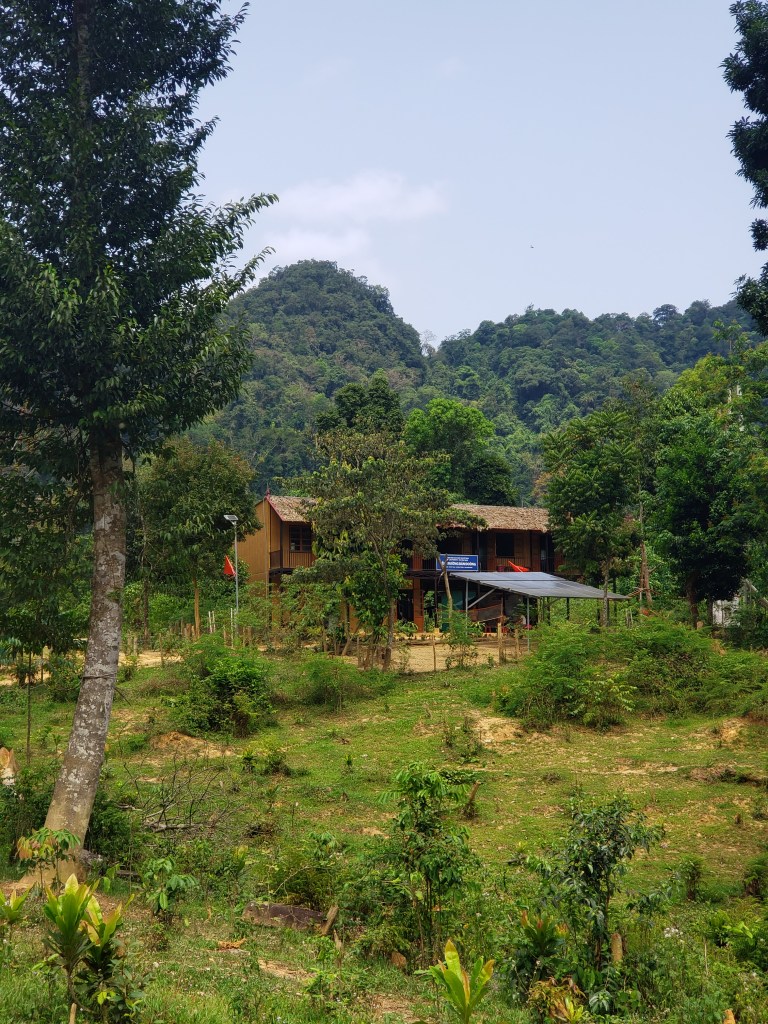
After a bit more trekking through the wide-open spaces, our bodies no longer protected by the jungle cover, we arrive at a remote village home to an ethnic minority Vietnamese community. The village is called Bru Van Kieu, and their simple dwellings and way of life stand in stark contrast to the world we’ve left behind, a testament to their isolation and self-sufficiency. At least this seems the case, until we encounter a device that looks suspiciously like a cell-phone tower. Tha confirms that this is what it is, however, the tower is solar powered and does not connect to any tower to the outside world, serving only to allow communication between the small villages that dot the bottomlands of the verdant valleys. 52 live in this community, and they are shy and reclusive. We get a few waves and shouted “hellos” from some children, and some curious stares from a couple adults, but we otherwise see nobody. In the heat of the day, the village seems to have embraced a languid pace, its inhabitants seeking respite from the oppressive sun. A quiet hush has fallen over the settlement, broken only by the occasional murmur of muted conversation, or the light, playful laughter of the few children. The few adults we do see glance our way and nod or raise a hand, their weathered faces etched with the stories of a lifetime spent in harmony with this remote and rugged land. We cross their cattle fences using small built-in ladders. Dogs languish in the shade, giving us barely a glance as we pass, and cattle and chickens likewise ignore us to go about their busy lives with no regard for our group of interlopers.

Bru Van Kieu village schoolhouse, built thanks to funds contributed by Oxalis and tourists like you.

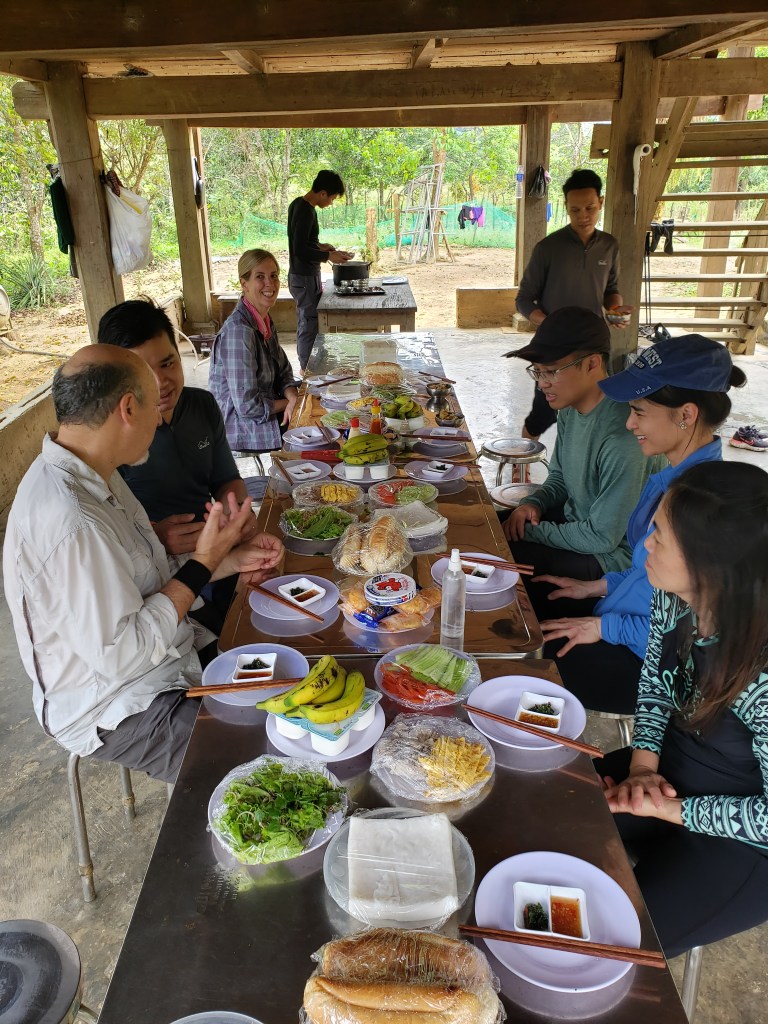
We stop at the home of the local chieftain where a lunch spread is laid out for us in the shade of his home. We see no sign of him, but the two chefs assigned to our group have spread out delicious fare, and a lot of it. We remove wet shoes and socks and lay them out in the sun for drying, a futile effort in the humidity. Camp shoes, a must for this trek, are donned, and we sit for a delicious lunch of rice paper wraps, hoagie rolls, meats, veggies, and large bowls of various Vietnamese noodle soups. Fruits, yoghurt, and cookies round out the dessert portion. Everything is delicious and there is plenty of everything except for the packages of Happy Cow cheese which Tha guards ferociously against my hungrily snatching paws, insisting that there is only one for each person. I play along like a good tour member eager for group harmony. For now.

Lunch at the chief’s home in Bru Van Kieu village.

Bellies full and spirits renewed, we don our wet shoes and bid farewell to the lethargic village, continuing our journey, winding our way through the lush, verdant valley. The wide expanse of the river basin stretches out before us, its meandering course beckoning us forward as we cross and recross the snaking channel numerous times. One of our eagle-eyed safety assistants, his vision honed by countless expeditions, suddenly motions for us to pause. With a deft gesture, he points toward a distant tree high atop one of the jungle-covered limestone ridges where a monkey perches, its form almost camouflaged by the branches of the tree in which it rests. We marvel at the creature as Tha borrows Damien’s cell phone, an Android with a 100x zoom camera. The monkey, a long-tailed lemur, comes into sharp contrast in the cell phone camera and we watch with joy as it swings its way out of the highest tree branches and out of sight.

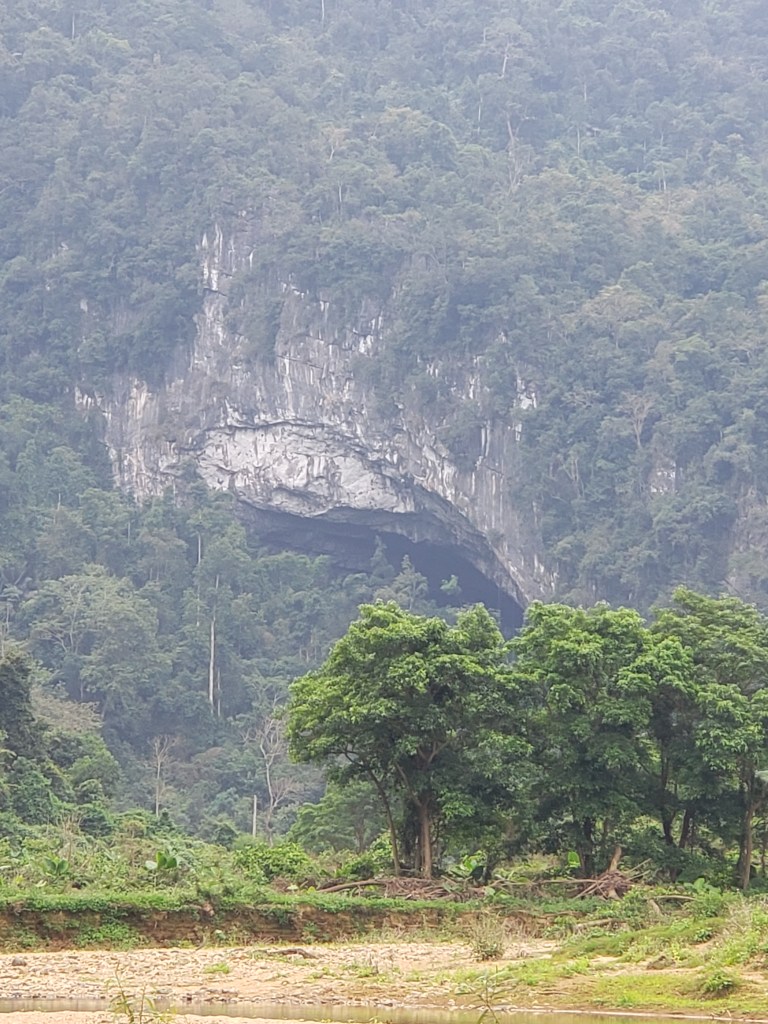
Onward we press, our path continuing to follow the serpentine river that carves its way through the valley floor. As we round a corner, our eyes, guided by the pointing finger of Tha, are drawn to a sight that leaves us awestruck. In the distance, camouflaged and partially hidden by the jungle foliage is a limestone cliff and the top edge of a gaping maw, a massive cave looming in the cliff side. Tendrils of mist curl lazily from the cavernous entrance, adding an air of mystery to the already imposing spectacle.

“Hang En,” Tha announces, his voice tinged with reverence for this ancient geological wonder. Although he’s seen this view hundreds of times, it is apparent that he understands the importance and magnificence of this site to our group. He also embodies a sense of pride in the wonder of these marvels that draw tourists from around the world to his small, battle-weary country.

Our first view of the magnificent cave, Hang En.
A closer shot of the mysteriously beckoning entrance to the massive cave, Hang En.

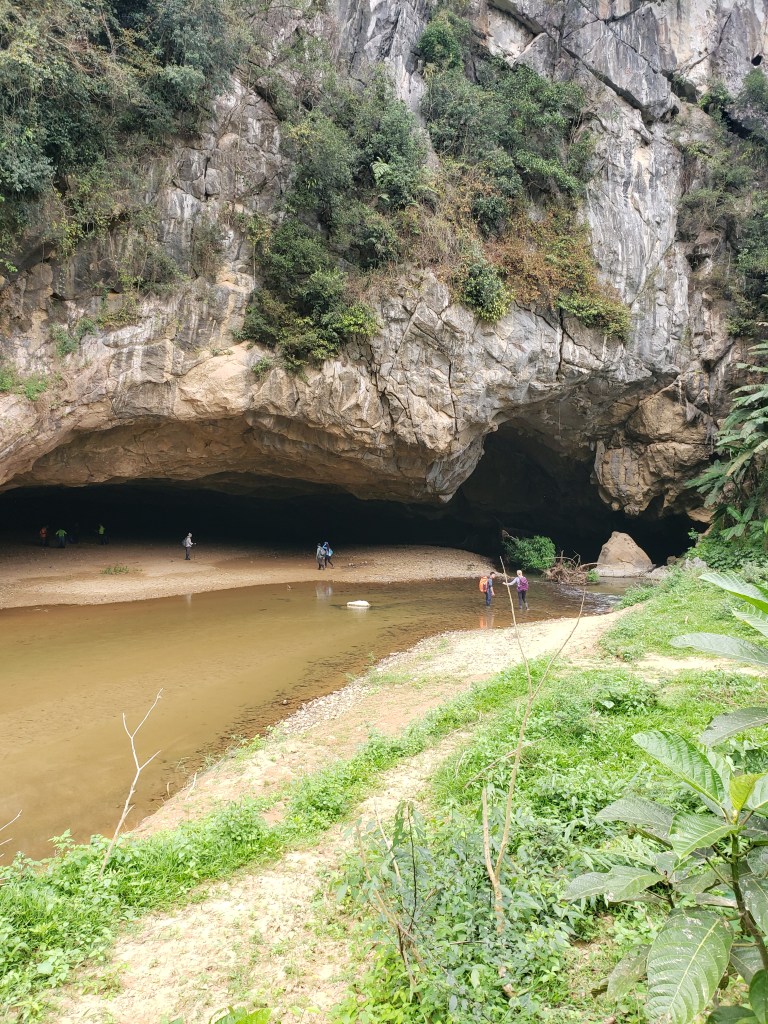
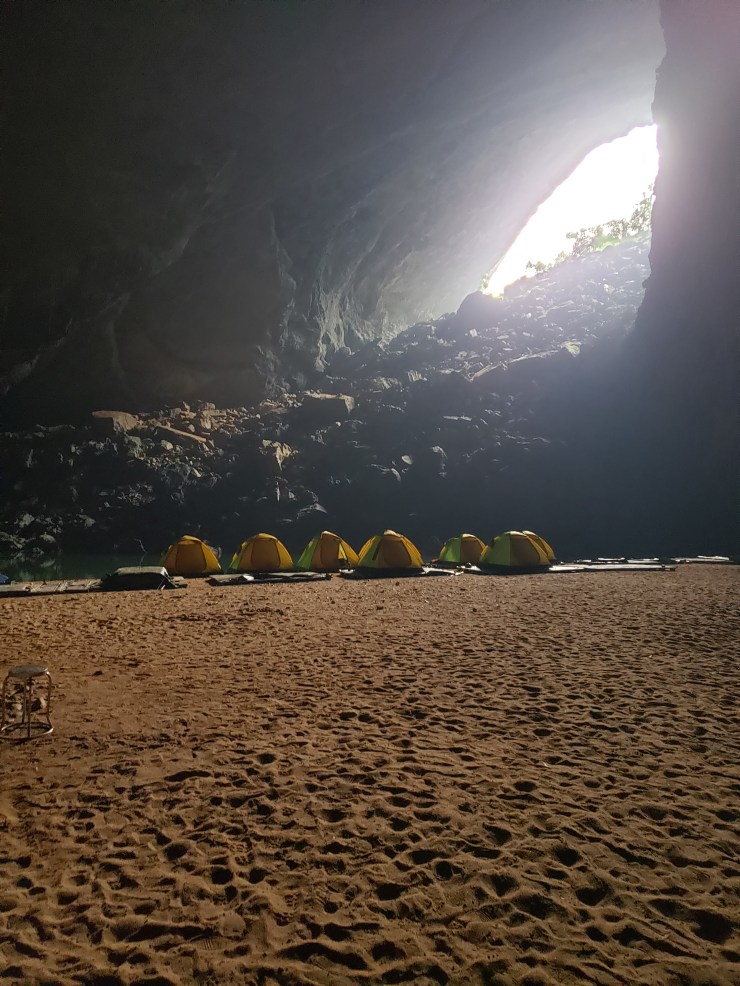
It takes an hour to close the distance, and as we draw closer, the sheer magnitude of this cave becomes increasingly apparent, its towering entrance arch dwarfing us with its immensity. We work our way along the river which flows out of this cave. We won’t be entering Hang En via the immense arch, but rather through a small entrance carved by the river with which we’ve become intimately familiar. We step into the shaded darkness, take numerous photos, and then don our caving helmets and caving lights which strap to the top of the helmets. With a sense of eager anticipation, we activate the headlamps, their beams cutting through the encroaching darkness. Leaving behind the vibrant jungle and its now familiar sounds, Tha leads us as we take our first steps into the inky blackness that lies beyond. The silence is eerie, punctuated only by the muted roar of the river and the sound of water dripping from the cavernous ceiling above our heads. We cross the swiftly flowing river holding onto a rope to avoid any slip and falls. A few steps further and we encounter a massive rock fall, boulders the size of cars that have fallen from the ceiling over eons. Tha leads us up a path, cautioning us in the slippery parts as we trek across the dominating rockfall. We are working our way upward toward the massive entrance that was our first view of this cave, and as we cross under an overhanging lip of rock, we crest one of the plateaus of the rockfall where a magnificent view meets our eager eyes. Our first camp for the night, sprawled under the dome of the largest cavern any of us have ever seen.

Approaching the lower river entrance to Hang En.
Crossing the river and entering Hang En via the lower entrance.
Leaving the darkness of Hang En and entering the light-strewn rockpile below the magnificent upper entrance.

Hang En is where we’ll spend our first night, and the camp has been already laid out for us via the efforts of the porter team that accompanies our group. 17 local Vietnamese men comprise the porter group, and if there are harder working, stronger and more capable men in the caving world, I would be shocked. These 17 men have carried a full complement of equipment and gear for our expedition, and they have beat us to the cave to have it set up for us when we arrive. I’ll talk more about this later.

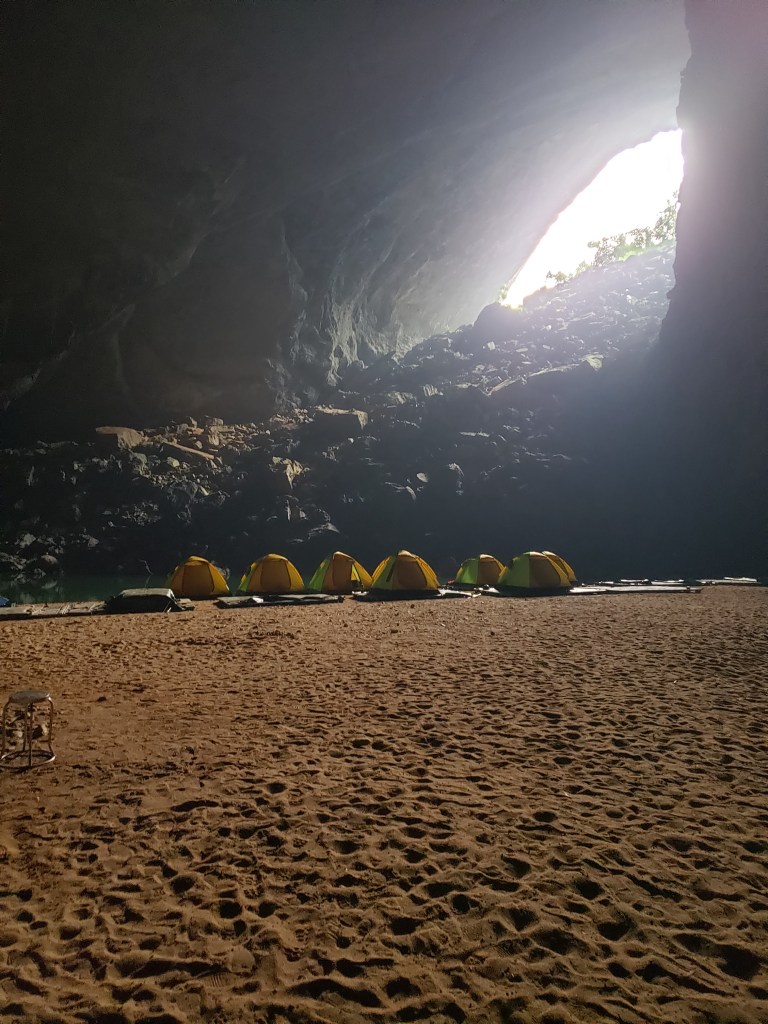
For now, we are perched like mountain goats on a house-sized rock far above our camp, and we look down at it in awe at the sheer magnificence of the scene below us. Cameras emerge, and we take time posing for photos. The river we’ve crossed deepens and widens below us, and a raft awaits to take our group across to the campsite which sits on a flat, sandy beach in the gloom of the cave. Light from the massive entrance is muted but bright enough for us to move about without fear of tripping or falling. Tha and Hieu lead us carefully down the sprawling rockfall and to the raft where we board and are pulled across the 50-foot gap via a rope that spans the length. On the shore, we find our tents and drop our packs. Our porters have carried half of our personal gear in provided dry bags, and we find our dry bags to gather our belongings, remove our wet gear, and don comfortable, dry clothes. Some of us choose to go for a swim instead, and I’m one of them, putting on swim trunks and grabbing a required life jacket to head back to the water. A signal is given to the safety assistants, and one of them brings a chair to the beach to act as lifeguard. The water is cool and refreshing, drawing a gasp initially as I dive in, but then warming appreciably in feel. I scrub the sweat from my body and then toss the offensive lifejacket back to shore as I commit to staying within the 15-foot limit from shore to go without. Tha joins along with a few of the group, and as we stand there chatting excitedly fish begin to nibble at my feet. A “fish foot spa,” Tha calls it, and I let the fish enjoy their feast of my objectively nasty, pruned and peeling feet. Surprisingly, nobody else is getting a nibble while I’m being swarmed by no less than eight hungry mouths, and I make a joke that these fish must rarely get to enjoy white meat. The reality is that my feet are probably just more disgusting—and thus yummy to fish—than most.

Our first view of our day one camp inside the magnificent cave, Hang En. This lake was wonderful to swim in after a sweaty day trekking.
The standard Oxalis photo requires that you pretend you see something amazing somewhere “over there.”

After the swim, we change into dry clothes and then sit around a charcoal fire as the light begins to fade over the cave entrance. Birds swarm above us, mistaken for bats at first until Tha corrects us. They are Swiftlets, and there are thousands of them. They nest in the ceiling of the cave, hundreds of meters above us in the gloom. Tha shines his intense flashlight up to the wall and points out what looks like sticks jammed into the rough-hewn walls. He informs us that this is rattan, a vine that grows in the forest and that he pointed out to us a few times along the trek. We’ve all heard of rattan furniture, a highly desirable and high-priced rugged export from the area. As we struggle to understand how the jungle vine came to be lodged into the rock walls of Hang En, Tha ends the suspense and tells us that prior to Hang En being a tourist destination, for centuries, the local villagers have scaled the walls of this cave to reach the Swiftlet nests in the ceiling, seeking the baby Swiftlets which are a delicacy to the tribes. Our mouths drop in disbelief as we try to fathom villagers climbing these walls with no safety equipment, jamming rattan sticks into cracks for handholds, hanging upside down hundreds of meters above the cave floor, and tossing baby birds down to their deaths for some delicious soup. I wonder at how many human deaths must have occurred alongside the Swiftlet deaths right in this spot from a slip by a young climber over the many centuries of this practice…

Dinner is ready at 6pm sharp, as darkness is descending on the campsite. Lights are produced, and we gather hungrily at the table as our bountiful fare is laid before us. Chicken, beef, and lamb, stir-fried vegetables and rice, both steamed and fried. Various soups, wok-fried eggplant, and eggrolls. Our eyes are wide as we pile the food into the small cups used by locals for every meal. We gorge ourselves by repeatedly refilling the cups, but put hardly a dent into the lavish bounty spread before us. Tha ensures us that the porters eagerly await our leftovers, so we don’t feel bad about wasting any food. Although they’ve already eaten their own dinner, the calorie-burn of the work they put in leads them to a ravenous hunger that is satiated by our untouched leftovers as a midnight snack.

View from camp one looking back at the upper entrance to Hang En. A person standing in that rockfield for scale is only barely visible in this photo.

After dinner and some light conversation over the charcoal fire, full darkness descends, and I can hardly keep my eyes open. I’m ready for bed at 7pm but hold out until 8:00, thinking that must be the earliest acceptable time to slink away without disgrace. I’m not the first to disappear though, many in our group still suffering the effects of jetlag from the 12-to-15-hour time difference from the U.S. and exhausted by the arduous hiking we endured. Tomorrow will be even tougher as we’ll transit through Hang En, following the route of Ho Khanh from a quarter-century earlier. We’ll make our way to the hidden entrance to Son Doong and tomorrow night we’ll sleep inside that magnificent cave. Although I am filled with trepidation and anticipation for the next day, I’m sound asleep by 8:05pm, mere minutes after laying my head on the pillow.