Pursuing a college degree as an adult: part four

I promised in the third part of this blog that I would delve into the cheating problem at college, but it ran long and I didn’t deliver, so let me begin this final part with that discussion.

In addition to all of the online resources that I mentioned in part two that are available to students, there are also, “homework helper” and, “study helper” websites, which are, in reality, thinly veiled cheating websites. The way these websites work, is that a student will take a publisher-produced exam, a test that is created by the publisher of the course textbook, which are the same books in universities all over the country, and then the student will screenshot each of the questions and upload them to the site. The site will then pay an expert to give the correct answer to each question, and for the low-low price of only $40 per semester, you can get access to all of these tests and answers. And, lo and behold, wouldn’t you know it, lazy professors all over the country use these exact same publisher-provided exams, EVEN IN ONLINE CLASSES.

Now, these professors have the ability, with the simple click of a button, to require students to use something called “lockdown browser” when they take these online exams. This is a browser that you have to use to access the test, and the browser “locks down” your computer, preventing it from using an external monitor or having any other web pages open or software running. This does very little to prevent cheating, of course, as this is the 21st century, and even Jed Clampett has more than one device that can access the internet. So, teachers also have the ability to have the exams proctored. This involves a requirement to activate your webcam where either an AI program, or an actual person, will watch you as you take the exam. These proctors require that you show the room to them before the test by swiveling your web cam around the area, and you must keep your face in the little display box the entire time. I guess they use some kind of detection device that tracks your eye movements as well, which will alert if you keep looking off the screen, but I suspect that is mostly nonsense meant to scare students, and that they do nothing but record that little window so the professor can come back later and review it if you suddenly turn from a Forrest Gump-type student into Rain man.

Anyway, despite these admittedly imperfect options that are available to the professors, almost none of them use any of them. Instead, what they do is, they alter the exams just slightl…no, no, that’s not it. What do they do? Oh, that’s right. Nothing. They do nothing at all. They post that the test is closed book and closed notes, and that it must be taken alone with no help, and then they post a test that was provided by the publisher and is the exact same test that has been used for years and is all over the internet, and then they preen when the class average is 89%, thinking that they are amazing professors with a teaching ability gift from God. It’s truly disgusting.

At this point in my college career, I had seen rampant cheating in many of my classes. I’m talking disgusting levels of cheating that wasn’t even clever or unique cheating. I at least could have tipped my hat to unique or clever cheating. But there was no need to be clever because so many of the professors just don’t care. I saw a fellow student write equations on his sock and then wear slides so that he could slip his foot out of the slide, see the equation, and slip it back in. I saw a student write answers on the underside of his calculator case. This was so unclever and primitive that he could have very easily been caught, had the professor bothered to look up from his phone at any point at all during the test. I was even asked, more than once, by students in the Discord chat room, if I would meet them in the library and take the online test with them. THESE ARE KIDS WHO HAD NEVER MET ME AND DIDN’T EVEN CONSIDER IF I WAS A PLANT OR A SNITCH, ASKING ME TO CHEAT WITH THEM.

Here’s an example of students using Discord to cheat on a final project, in a 400-level finance class where, not only did the professor clearly state that it was required they work alone and that sharing answers was cheating, one of the other students in the class warned them a few lines above this that asking for and sharing answers was cheating.
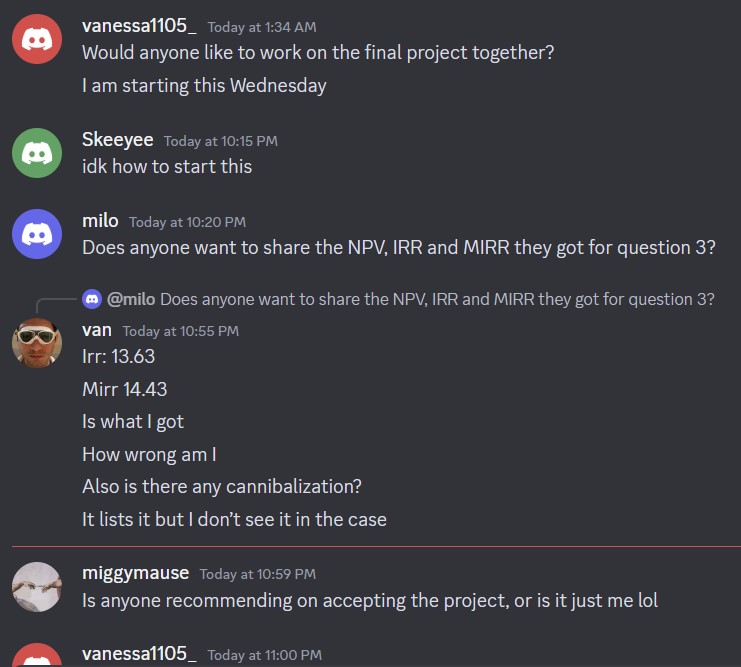
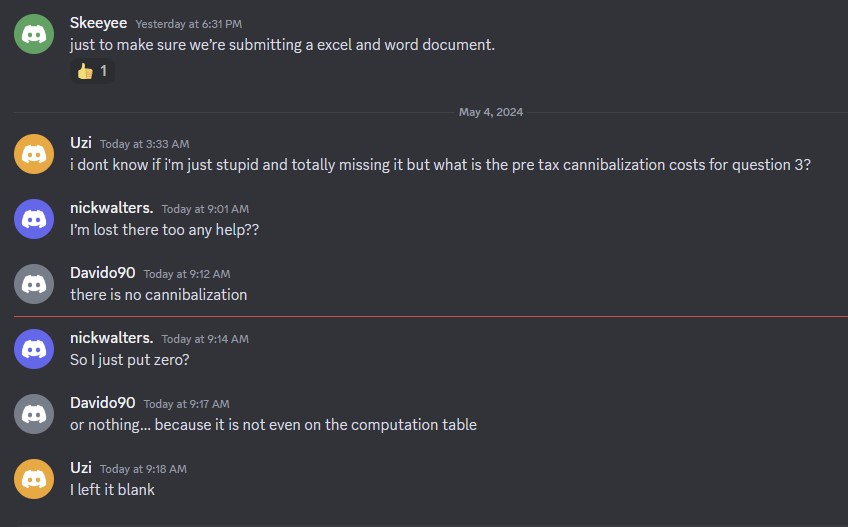
By and large, the plethora of cheating that I witnessed over three-and-a-half years was so shockingly rudimentary and uncreative that I was consistently sure they would get caught, and yet, they never did. And you know why? Because the professors just didn’t give a rat’s ass. They couldn’t care less. Here’s how I know:

Normally, cheating by my fellow classmates didn’t affect me, and so I didn’t care. If they wanted to cheat their way to a degree, what difference did that make to me? I was there to learn, and part of my thrill came from excelling and being the best that I was capable of. Cheating would have stolen that thrill from me, and so even when it was available and easy, I truly had no interest. I don’t pretend to be more moral than anyone else, cheating would have just robbed me of the pure joy I got from excelling at something difficult, and so it was of no interest for me. However, others cheating did affect me when the professor would curve an exam. Now, I have a lot to say about curving exams, but I’ll keep it short here. I don’t like it. It’s just another form of laziness. Write an exam that covers the material you taught, don’t make it ridiculously difficult as if to show off how smart you are, and then grade it appropriately. Why are you curving? If you need to curve an exam, its either because you didn’t do a good job teaching the material, or you put material on the exam that was too advanced for where the students are. Curving is lazy and apathetic, and really just insulting to the students.

In my Intermediate Managerial Finance class, the professor not only curved the exams, she used these very same publisher-provided exams which are all over the internet, and then asked students to take them on their honor. In my entire time back in school, I don’t believe I ever took a legitimate exam where I scored below the class mean score. And, I rarely, if ever, took an exam where I was below the third quartile of scores. So, when I ended up below the mean on the first test in this class, it was quite obvious what had happened. And, the mean score was so high that the professor didn’t curve the exam, so now, this was affecting me. Prior to this exam, I had been invited to take the test with a group of students in the library, where there are blocks of computers where numerous people can sit in groups and look up answers. I refused, of course, but after this first test, I asked for a meeting with the professor. I told her that there was rampant cheating happening on her tests, I showed her that the answers were available online, and I told her that I’d been invited to cheat. Her answer? “There’s not much I can do about it.”

Um, how about you write your own test instead of using a publisher-provided test that has been around for two years? How about you change the wording just slightly so that a different answer is right? How about you do anything at all instead of just telling me that you don’t care? This was infuriating to me, and I considered taking it further up, but I didn’t like the way this “snitching” was making me feel. And this wasn’t the only class where I had this problem. Far from it, actually. My last semester, my Econ 470 professor told me that he couldn’t release the correct or incorrect answers to the exam because it would “compromise the test for future classes.” I sent him a long email telling him that his exams were already compromised, then did a google search for the question I wanted the answer to, and sent him a screenshot of his very test question with the correct answer available online. I don’t understand how these professors can possibly be so naïve as to think that the tests they use over and over again remain uncompromised. It seems impossible that PhDs can be that stupid.

This is probably more than enough about cheating, but let’s just say that it is happening all the time, and it will continue to happen until professors actually decide to care about it. And, from what I’ve seen, very few do.

Anyway, back to the business of registering for my final semester at UNLV.

The UNLV business school has pretty strict requirements for the awarding of Latin honors, the “cum laude” honors that you see all the nerds getting and probably always wondered what they were. The top honor is Summa Cum Laude, and here at the Lee Business School at UNLV, that requires a GPA of 3.991 or higher. I did some math and figured out what this meant, and I believe that if you took a full 120 credits at UNLV, you could get exactly three A-minuses or one B, but not both. If you only took 60 credits here, meaning you started at CSN or some other community college and transferred, you could get one A-minus but not a B, so this is a very difficult honor to receive. I think that of my graduating class of ~550, only three students achieved this honor. Magna Cum Laude is next, and this requires a GPA of 3.9 or higher, and Cum Laude requires a GPA of 3.8 or better. I believe around 25 students from my graduating class got Magna Cum Laude, and somewhere around 50 earned Cum Laude.

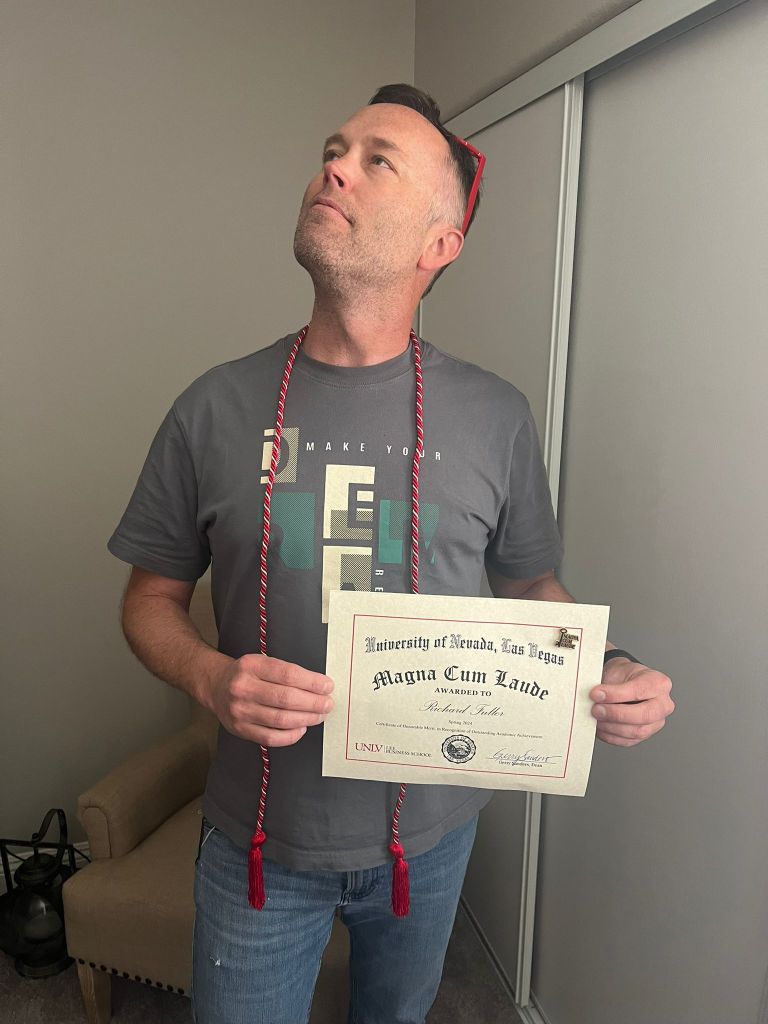
Why do I mention this? Well, when I started publishing this article, I began it with an absurd and utterly snobbish photo of myself holding my Magna Cum Laude plaque while I put on the snootiest airs I could conjure up. You probably remember. It was this photo:
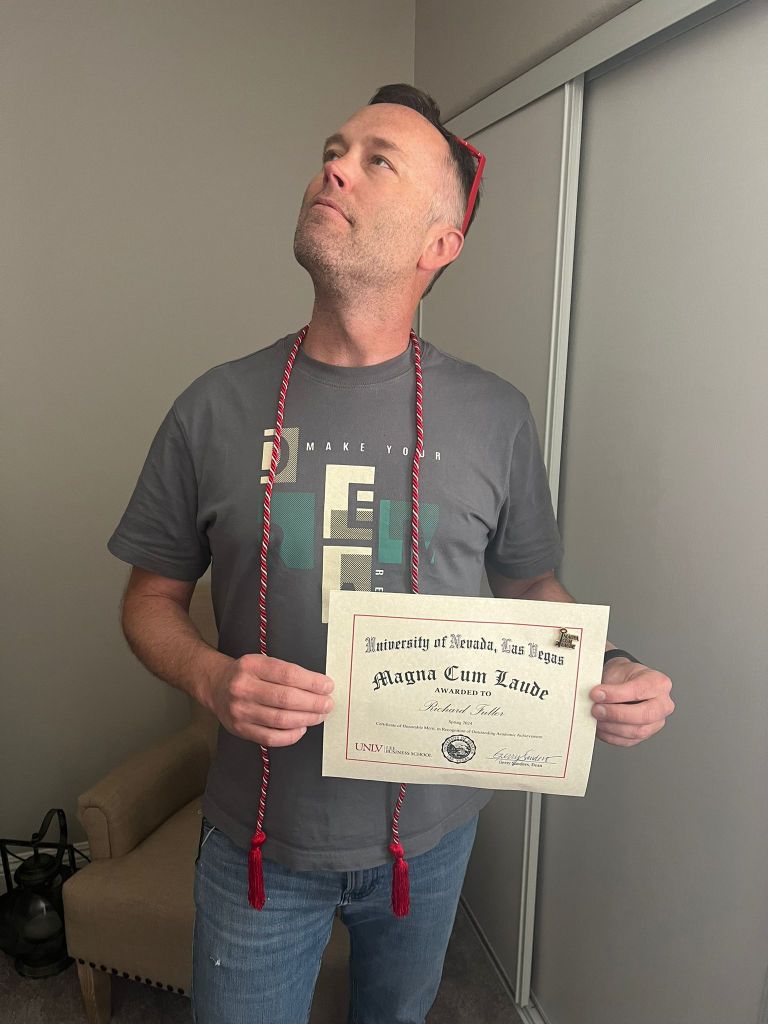
Not only do I look like a complete idiot in this photo, but I announced to the world that I had earned Magna Cum Laude, and yet, I hadn’t received my final grades. With a GPA of 3.958 coming into this semester, I had a little bit of wriggle room above the baseline 3.9 to actually get the Magna Cum Laude honors, but not much. And just because they gave me a nice certificate, did not mean that I had actually earned them. Not until final grades were in and my final GPA was still above a 3.9. So, why in the world would I possibly announce on a public blog that I had earned Magna Cum Laude, all while posing in such a way that I would look like a complete jackass were I to not actually earn those honors? I don’t know. I guess I’m an idiot.

To provide evidence for just how much of an idiot I am, let me tell you what classes I registered myself in for the spring semester. I had four classes remaining, only one of which was a required class. I needed two finance classes and two economics classes, and the only one that was mandated was Advanced Managerial Finance (Fin 405). I had some leeway with the other three, the only requirement being that at least one of my economics courses had to be 400 level, while the other could be either 300 or 400 level. For my second finance class, the Student Investment Fund (Fin 426) was a no-brainer. I explained this class in my previous post, a great class where the students manage an actual investment fund, making all the investment decisions for a fund that had more than $400k in real money. The university allowed students to take this class twice, and I was grateful to once again receive one of the 20 highly coveted slots.

For my two economics electives, I chose Economic Analytics (Econ 306), and Urban and Regional Economics (Econ 470). These all seemed like fine choices as they weren’t easy classes by any means, but they would sort of fill in the gaps where my economics instruction was missing a few things.

And then I did something stupid.

Graduation was fast approaching, and I really had no idea what I wanted to do once it arrived. I’d attended several sessions with guest speakers in finance who told the class all about what they did for a living, and without exception, I came to the conclusion that if I held any of those jobs, it would not take long for me to begin craving the sweet, sweet taste of a hollow-point bullet. I would always ask the presenters what was the most exciting part of their jobs, and, without fail, their most exciting days would have me wanting to stick a fork in my eye. I recognize that my attitude sucks, and I recognize that this sort of outlook probably makes me unemployable, but I just can’t see myself sitting at a desk figuring out ways to make other people rich. Not of any interest to me. Nope.

For economics, I was coming to realize that nobody is hiring an economist with a BS degree. It’s a BS degree, but it might as well just be regular old BS, because there really just aren’t economists out there who don’t hold at least a master’s degree, if not a PhD in economics. There are plenty of jobs in finance for someone with a BS, and in fact, I get solicited constantly through the UNLV job portal for finance degree related jobs. But, like I said, if I’m going to take one of those jobs then I probably should also be enrolling myself in Introduction to Noose Tying (Rope 201), because I’ll definitely need it.

Because I hate all the jobs I’ve seen in finance, and because there are no jobs in economics for someone with my level of education, I came to the realization that I should at least consider a graduate program in economics. I like economics and I seem to be pretty good at it, so if I want to work as an economist then I need to get a little more schooling. Of course, there are plenty of other jobs not in finance and not as an economist that I might find enjoyable. After all, I now hold two business degrees and those are probably worth something out there in corporate America. But I like to keep all my options open, and one of those options was a graduate program in economics.

Keep reading, the really stupid thing is coming.

Looking into some of those graduate programs, I discovered that they require calculus. Since I hadn’t taken calculus, that would have meant I would have to return to an undergrad calculus class at some point if I decided to go that route. I’m actually a little annoyed that the Economics BSBA doesn’t require calculus already. We have to take partial derivatives and full derivatives for marginal revenue functions and wage and capital equations anyway, and because calculus isn’t required, the professors all along the way have had to give us the shortcut to those equations instead of being able to make us derive them ourselves with calculus. I had found this rather annoying over the last couple of years of classes, and I felt that many of my professors also found it annoying.

As I mentioned, I like to keep my options open, so I decided I should take calculus this semester, in addition to my required final four classes. The problem was, I hadn’t even taken the prerequisite for calculus. Sure, I took precalculus one and I took finite mathematics, but neither of those met the prerequisite to register for calculus. It required precalculus II, which is basically trigonometry. I was at first dismayed, but after some digging, I found a work-around. I could test into calculus and bypass the prerequisites. Hooray!

Of course, the problem was that I didn’t know trigonometry. Oh, don’t get me wrong, I took trigonometry once. It was in 1990, and I think I got a C-. And, of course, I haven’t used a single thing from that class since. So, while a few things might seem vaguely familiar 34 years later I definitely wouldn’t know enough to pass the test. So, I decided to teach myself trigonometry during the Christmas break.

I found a great online class through Campus, and another at Khan Academy, and I spent the Christmas break teaching myself about tangent and cotangent and sine and cosine waves, and about the unit circle and the amazing vagaries of pi, and after three condensed and hectic weeks of instruction, I was ready. I took the proctored entrance exam and somehow, I passed. I was now eligible to take calculus!

This might lead you, dear reader, to ask, what kind of a fool takes his final semester, a nice, easy semester with just four classes, and voluntarily adds calculus when he didn’t even have enough classes to qualify to take calculus and just barely passed the test that allowed him to bypass those requirements?

This kind of fool.
So, into calculus I went, joining 55 mostly first-year students in a class that I would come to find out was taught by the most narcissistic, egotistical, holier-than-thou professor I’d yet had. I don’t want to drag this on forever, but this guy suuuuucked as a professor. Absolutely horrible teaching style, but beyond that, he felt the need to lord his intelligence over the students through both his words and his lecture slides, which were absolutely indecipherable and unwatchable. He did have the decency to post his lectures online so that his class, which was unbearable, could be skipped, but instead of posting the lectures to the UNLV system called Canvas, he posted them to YouTube where we had to watch a commercial every five minutes. Things were pretty awful, however, there was a saving grace. This is math. There’s nothing unique about math. An instructor teaching calculus badly, as this one was, is still teaching the same exact calculus as a great instructor somewhere else. And the internet is full of videos of people teaching calculus. All I had to do was figure out what the lesson for that day was, since although calculus is always the same, the order in which it is taught can vary pretty widely, and then find some online instruction that matched. Simple enough, right?

Not quite.

I’ve mentioned Khan Academy a few times, and I can’t say enough good things about them. They are an amazing resource, and I dove deeply into their calculus course, doing my best to match my instructor’s syllabus with the available videos on Khan Academy. I felt that I was keeping up well, and when I would attempt to watch one of this instructor’s god-awful videos, I would give up quickly and return to Khan Academy.

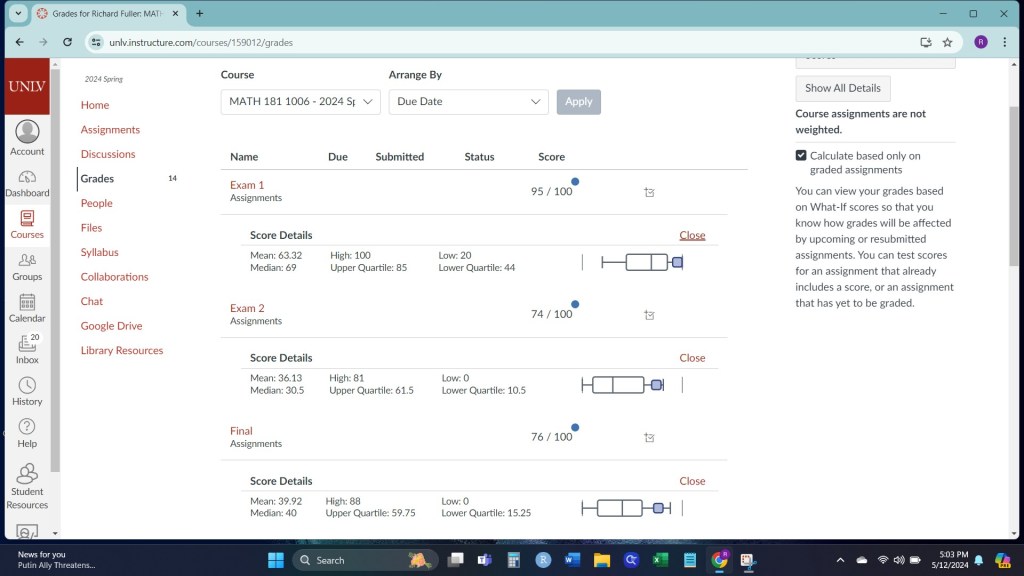
I felt confident going into the first exam, and it went well. I got a 95%, which was a solid grade, particularly when the class mean was an absolutely dismal 63.32% with a median of 69%. I’ll remind you that a passing grade at UNLV is a C, which most professors set at 70%, so more than half the students failed this exam. That is horrible, and an absolute testament to the terrible teaching style of this professor.

But it would get worse.

The grade for this class was based on three exams and attendance at the Friday lab session. This Friday session was really just a review of the material from that week, and while the class itself was not required attendance, the lab attendance was 15% of my grade. I had conflicts that I knew were going to require me to miss 2 of the 12 total labs (test days were also Friday in the lab but didn’t count as attendance credit), and so I would automatically be losing some points there. That meant I really needed to perform well on the exams in order to get an A in the class. I would end up missing 3 of the 12 lab days, which meant I would only get 75% of the 15%.

The first two tests were each worth 25% of the final grade, and the final exam was worth 35%, so with my 95% on the first test, I was sailing along smoothly in spite of the points I would miss for the required lab attendance. Then, along came the second exam.

If anybody reading this has taken calculus, I’m going to post one of the questions that were on this exam. Keep in mind, this is exam two of a first semester calculus class. Does this seem like a fair question to any of you? If you think it is, please let me know, I would love to discover that this sort of question is standard operating procedure instead of a jackass professor being super clever for his own amusement. Here’s the question. Also, keep in mind that each test has 10 questions and we have about 70 minutes to complete it, so a student can only really allocate about 7 minutes to each question.

For anybody who has not taken calculus, here is the answer to this question, as provided by the professor. If you don’t know calculus, then, looking at this answer, does this question seem reasonable to you for a first semester calculus class?
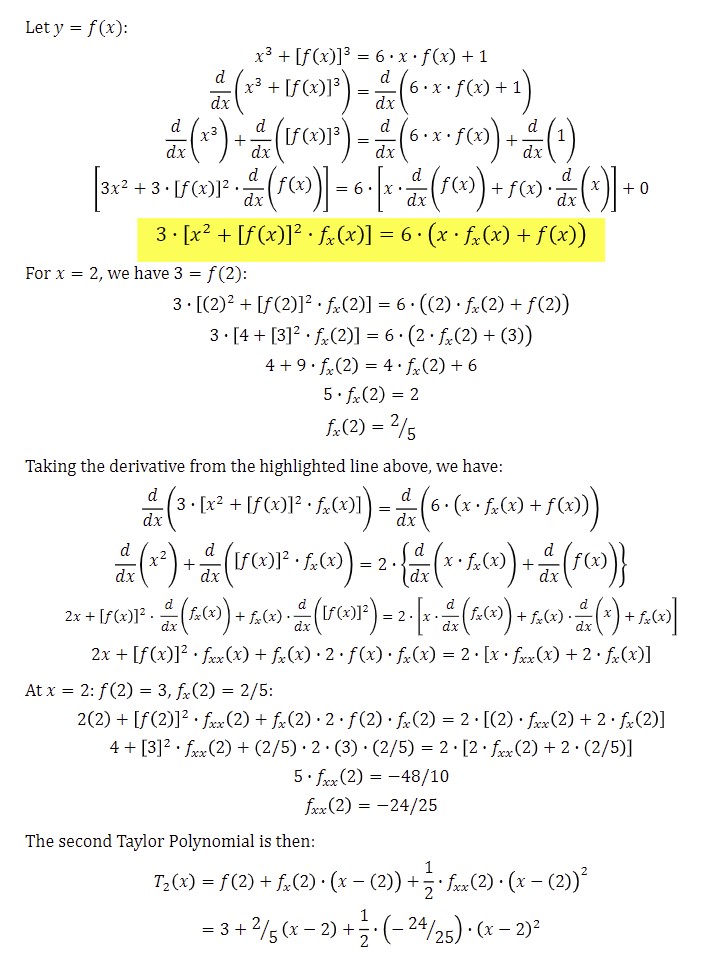
I am, of course, presenting the most difficult question on the test, however, the rest of them were not exactly easy. I did not do well on this exam. In fact, I got one of the worst scores on any exam in my college career. I got a 74% on this test, and suddenly, I was sweating this class. How do I know that I’m not just an idiot and a huge baby, and the test was perfectly fair? Well, of the 56 students in this class who took this test, the high score was 81%. The mean? 36.13%. The median? 30.5%. HALF OF THE STUDENTS WHO TOOK THIS TEST GOT 30.5% OR LESS. The third quartile was 61.5%, which meant that 75% of the students got 61.5% or less. WHEN 75% OF YOUR STUDENTS ARE SCORING 61.5% AND UNDER ON YOUR EXAM, YOU SUCK. This appalling scoring is not the fault of the students. It’s the fault of the professor, and I would challenge anyone who says otherwise.

The next class after these abysmal scores, I decided to actually attend for the first time since the beginning of the semester. I wanted to hear what he had to say about this horrible and appalling result. HE SAID NOTHING. NEVER EVEN ADDRESSED IT. He did send an email with a single sentence that essentially said he would adjust the weighting of the final exam if necessary so that students who currently would still fail the class even with a 100% on the final would not lose all hope.

So, on to the final exam. I studied my ass off for this exam. Although I was certainly in the top 5% of this class with my solid B, I wanted to do better. Not only did I punish myself thoroughly by watching every one of this professor’s unwatchable videos, I spent dozens of hours learning the intricacies of calculus with Khan Academy’s vast library. I was prepared. I aced the Khan Academy mock exams. I knew my calculus.

Until I showed up for the final exam and flipped over the test to begin.

Once again, this jackass decided to humor himself with questions that were so advanced that failure was guaranteed. I just cannot understand how this clown has a job. I will never understand a math department that accepts the failure rate that this professor shoves down their throats.

Although I was sweating this grade, I did some math (not calculus, obviously) and realized that I only needed to get 50% on the final exam to get a C in the class and pass it, and the C would not drop my total overall GPA below the 3.9 threshold for Magna Cum Laude. Whew! I knew I did better than 50% and so I was golden. As long as I got As in every one of my other classes – and after finals week, I felt confident that I was going to get As in all those classes. Of course, a C in calculus is terrible, but at least I was done with it and Magna Cum Laude was a lock. I wrote and posted the first blog, along with the picture I was about to deeply regret.

A day later, I wrote and posted part two. I was feeling cocky and happy, and I was thrilled with the viewership of my first blog. After I posted the second blog I went to bed and then suddenly woke up in a panic a few hours later thinking I missed something. I ran downstairs and redid the math. Oh dear God, I got it wrong the first time. (maybe I deserve to fail calculus after all?) If I got a C in calculus, my GPA would actually drop to 3.889. It was a four-credit class because of the lab, and I had done the calculation based on a three-credit class. A C and I would lose Magna Cum Laude. And I had just posted this picture for the world to see.

What an idiot I am.

I quickly calculated what I needed on the final exam to get a B in the class. I would need a 76%. I thought back to the test. That was going to be VERY, VERY close. I wasn’t sure I had made it. It was an absurd test, on par with the previous test where I got a 74%. I would need to do better on this one, and I didn’t think I had. And, this all assuming I got straight As in the other four classes, and I suddenly was getting cold sweats imagining scenarios where that didn’t happen. The Econ 470 class had the A-cutoff at 94%. 93.9% was an A-minus. (What even is this grade? Who gives minus grades, and certainly who sets the cutoff so high?) What if I got an A- in that class? What if I got an A- in Econ 306? His syllabus just said, “standard 10-point grading scale.” I had assumed that meant no minus/plus grades, but did it? What if “standard” meant minus and plusses? I was sitting at 92.88% in that class, was that actually an A-? If I got two A- grades, would a C+ in calculus pull me under the 3.9? I did the math. It would. What about a B-? Yes, it would. I perused the calculus syllabus. No mention at all of plus or minus grading. No mention of the grading scale at all, in fact. Typical assclown professor move. I was screwed. Why did I miss those lab days, particularly the one where I just simply didn’t feel like going? That was 1.25% for each day, 3.75% in total. I needed those percents now, and I’d so nonchalantly waved them off. What an idiot. YOU CAN’T TAKE IT AWAY, UNLV, YOU ALREADY SENT ME THE CERTIFICATE!!

But of course, they can.

Throughout the week, I watched anxiously as grades were posted. I held off on writing part three of this blog. I worked through all the scenarios and came up with the best way to post a retraction. My Facebook picture (I think you know the one by now) had over 100 likes. I had received dozens of congratulatory messages. How did I retract this and tell everyone that I’m an idiot, and I deservedly lost Magna Cum Laude because I’m retarded?

The grades began posting. Finance 426, (A). No surprise there, anything less would have been an absolute shock. Econ 470 (A). I faded the 94% A-minus cutoff, closing the class with a strong final exam and an overall 96.8%. Fin 405 (A). I got 100% on the final project while the class average was in the low 70’s so I should have been feeling great. Of course, I wasn’t. I only cared about the calculus grade. Would I get the 76% on the final exam which would put my final grade at 80.1%?

Econ 306 came in. I did worse than I thought on the final exam with an 85%, and had 92.88% for the class. I didn’t know if this was an A- or not, but was glad to see when he posted it that it was a pure (A). Thank you, sir. Four As in the books. If I hadn’t taken this optional calculus class, I would have closed my college career with straight As and a GPA that would have been in the 3.97 range, quite respectable under any conditions, and certainly under the double major program I’d put myself through.

Of course, the calculus professor waited until the last minute to post the grades. All the bad professors do this. I think they just decide that if they wait as long as possible there will be less time for the students to complain and try to finagle a grade change. I got the email that the grade on the final exam was in. I logged in and held my hand over it to sweat it like I was squeezing Aces at the poker table. The first number I saw was the class mean. 39.92%. The next was the class median. 40%. Well, he obviously didn’t do anybody any favors with a curve of any type. And yeah, the test was just as hard as I’d anticipated. My heart was in my throat. I needed 76%. I kid you not, I squeezed the number by blocking the screen with my hand. I’m not dragging this out just for you, I did it to myself as well. I moved my hand just enough to see the first number.

7.

Oh dear God. I was hoping to see an 8. I was dreading seeing a 6. I scored in the 70s. Six numbers (70-75) got me a C and an incredibly embarrassing public retraction. Four numbers (76-79) got me a B and the Latin honors I’d already announced to the world. I was a 3-2 favorite to have to start writing that retraction and making some phone calls to my family. I squeezed the last number.

6.

I got a 76. The absolute minimum number I needed. Did I miscalculate this?? I pulled up a calculator and crunched the numbers again. Yup. 76% meant 80.1% for the class. B or B-minus, it didn’t matter. I would be above a 3.9 GPA and all would be good. It turned out, of course, that he gave me a B-minus. Despite the fact that his syllabus makes no mention of minus grades. Because he’s a jackass and possibly the worst professor at UNLV.

The high score on the final exam was 88%, and the upper quartile was 59.75%. Once again, somewhere in the range of 80-85% of the students failed the final exam, and almost certainly somewhere north of 75% of the students failed the class entirely. How can you possibly take any pride as a professor with that kind of failure rate? How can a school justify employing a professor with that kind of failure rate? Does he simply tell them that all his students are idiots? Does it even get brought up at any point? I’ll just never understand. And lest you think I’m exaggerating or making this up completely, here are the exam scores.  
It was officially over. I finished my college career, or at least the undergraduate portion, with a GPA of 3.916. After one year and 29 credits at CSN, I raced through UNLV with 109 credits in just two-and-a-half years, a blistering pace, and now I was finally finished. So, now what? Grad school? A job? Something else entirely?

I don’t know.

As I mentioned when this all started, I want to do something that betters the world. I want to build something. I want to be a net contributor to society rather than a net drain. I want to feel good about what I do, and most importantly, I need to be challenged. I need a job that challenges me every day, because I get bored VERY easily. It’s miserable being me sometimes. Even exciting stuff bores me. I don’t know why, but I know that I want to work, and I know that I need something titillating. I’m smart, I’m driven, I’m energetic, I want to work, I’m willing to work hard, and now I have some schooling. Is it enough schooling though? What should I do?

Anybody out there looking to hire a recent 51-year-old college graduate?

Thanks for reading!

Final semester classes:

ClassCodeCreditsGradeCumulative GPA
Student Investment FundFIN 4263A3.96
Advanced Managerial FinanceFIN 4053A3.962
Economic AnalyticsECON 3063A3.963
Urban and Regional EconomicsECON 4703A3.965
CalculusMATH 1814B-3.916

Overall college courses, CSN and UNLV combined:

Stupid Gen Ed required classes:

ClassCodeCreditsGrade/GPA
Nevada HistoryHIST 2173A
Precalculus IMATH 1263A
EthicsPHIL 1023A
Chemistry (+lab)CHEM 1054A
Arabic IARA 1114A
AstronomyAST 1043A
Composition IIENG 1023A
U.S. Since 1877HIST 1023A
Critical Thinking and ReasoningPHIL 1033A
World Literature IENG 2313A
History of Rock MusicMUS 1253A
U.S. GovernmentURST 2413A
Calculus IMATH 1814B-
Totals 423.876

Business school required classes:

ClassCodeCreditsGrade/GPA
Financial AccountingACC 2013A
Intro to Information SystemsIS 1013A
Finite MathematicsMATH 1323A
Managerial AccountingACC 2023A
Business CommunicationsBUS 3213A
Business AnalyticsIS 3353A
Leadership & Management SkillsMGT 3713A
Principles of ManagementMGT 3013A-
Marketing ManagementMKT 3013B
Operations ManagementSCM 3523A
Business LawBLW 3023A
Tech and InnovationIS 3303A
Global Business StrategyBUS 4983A
Totals 393.900

Finance degree-specific classes:

ClassCodeCreditsGrade/GPA
Principles of Managerial FinanceFIN 3013A
Money and Capital MarketsFIN 3123A
Intermediate Managerial FinanceFIN 3033A
InvestmentsFIN 3073A
Student Investment Fund IFIN 4253A
Student Investment Fund IIFIN 4263A
Advanced Managerial FinanceFIN 4053A
International Financial MgmtFIN 3083A
Totals 244.000

Economics degree-specific classes:

ClassCodeCreditsGrade/GPA
Beginning MicroeconomicsECON 1023A
Beginning MacroeconomicsECON 1033A
StatisticsECON 2613A
Statistics IIECON 2623A
Intermediate MicroeconomicsECON 3013A
Intermediate MacroeconomicsECON 3033A
Intro to EconometricsECON 4413A
Economic AnalyticsECON 3063A
Industrial OrganizationECON 4553A
Urban and Regional EconomicsECON 4703A
Seminar in Economic ResearchECON 4953A
Totals 334.000

Pursuing a college degree as an adult: part three

On December 6th, 2023, at approximately 11:30am, a man in a trench coat entered Beam Hall, the home of the Lee Business School at UNLV. As is the case with the vast majority of universities in this country, UNLV is an open campus, and this man was unchallenged as he came onto the grounds. He walked past room 104, where students in Finance 308, International Financial Management, were just taking their seats. It was the week prior to finals week at UNLV, and this class would be a review session for the final exam which would take place seven days later. The man got on the elevator, went to the 4th floor where business school professors had their offices, and opened fire with a 9mm handgun. He would end up murdering three professors and wounding a fourth before exiting the building amongst panicking and confused students. On the front steps just outside Beam Hall, he would be confronted by a University Police detective responding to the shots fired call, and he would be killed in a shootout.

This would upend the entire university, and create massive changes to the remaining schedule of classes for the students, not just in the Lee Business School, but across the entire campus. Three people were murdered, and I am always appalled when people take a tragedy and try to make it about themselves when they were only peripherally involved, if at all. However, this did have a major effect on the penultimate semester of my university experience, particularly as I was scheduled to present my culminating research project in Economics to a panel of judges at the Undergraduate Research Symposium just three days later. The topic of my research paper was, “The Determinants of Gun Violence in America.”

I get ahead of myself though. The 2023 school year started 11 months earlier in January, and I was once again enrolled in the maximum allowable six classes. As a double major, I had so many required classes that I didn’t have any true electives to take during my entire time at UNLV. 120 total college credits are required to graduate, and I had well over 100 credits of required classes to go along with the 29 credits transferred from CSN, so any easy classes I might have had were still required classes, and those were all in my past. While some of my classmates were taking classes like Beers of the World, Bowling, and Intro to Kayaking, the very types of classes that had formed my negative opinion of a college education in the first place, I was force-feeding myself with the maximum allowable class load of study-intensive Finance and Economics classes just to meet the stringent requirements that accompanied the double-major.

My spring 2023 schedule consisted of four live classes and two online classes. The live classes were, Business Law (BLW 302), Intermediate Macroeconomics (ECON 303), Intro to Econometrics (ECON 441), and Money and Capital Markets (FIN 312), while my online classes were Intermediate Managerial Finance (FIN 303), and Investments (FIN 307), the latter of which, although an online class, had a mandatory scheduled lecture time where attendance was part of the grade, and would turn out to be taught by the worst professor I ever had.

Business Law was an interesting class, taught by a lawyer, and covering a very wide array of business legal topics including, labor law, contract law, and business case law. The instructor was stern and no-nonsense, his eagle-eyes identifying students using their cell phones during his lectures in the 100-seat auditorium like, well, like an eagle spotting a mouse in a large field of hay. He would stop the lecture and refuse to start again until the student put down the cell phone, an absolutely ridiculous show of unjustified irritability that would be very uncomfortable to witness, particularly for those of us on laptops playing Angry Birds.

This instructor was diligent about cheating, one of the very few I ever encountered. I’m going to talk more about this in a bit, but to prevent cheating, he would make two versions of each test, and then religiously ensure that no two students with the same version sat next to one another. He had two assistants in the room who would help him watch over us test-takers, and then he would check each person’s identification when we handed in the tests. I never had another class where a professor checked identification, and I had actually always thought that was strange, particularly in high-level classes where attendance isn’t required. You teach students for five or six weeks and start to get to know their names, and then on test day, a totally unknown person shows up and takes the test and you just accept that test without confirming who they are? It always seemed to me to be a situation rife for cheating, particularly with classes such as accounting which, unless you’re specifically an accounting major, wouldn’t be a class where information would build and you would suffer later by having an expert take your exam for you.

Anyway, there was another version of this Business Law class that was online with this same professor, and he actually caught more than half the class cheating on one of the exams. I never found out exactly how they did it…some version of taking the exam together from the same room, probably the library, where they all got exactly the same wrong answers. Being a lawyer which is a profession where integrity is burned into their psyche throughout their careers, this was a big deal to this instructor, and he called each of them in individually for interviews/interrogations. Many of them were failed out of the class or had to retake the exams with penalties. Again, this sort of diligence to combat cheating was incredibly unusual, and quite refreshing. Much more on this in part four.

The class titled Investments was one that should have been incredibly useful and very applicable to any sort of career in finance. It covered such topics as portfolio management, bond-equivalent yields, variance and standard deviation of portfolios, yield curves, the Sharpe ratio, duration and modified duration, the dividend discount model, and so many more important concepts. Unfortunately, the professor was horrible. Bottom three that I ever had easy, possibly the actual worst. He taught by reading from his notes in a thick accent and circling slides over and over until his scribbles crossed out the information you needed to learn. You were required to download the lecture slides the day of class…if you missed them, he deleted them, which served no purpose other than of a punitive nature toward anyone missing the lecture. He discouraged questions and made fun of students who did brave his wrath by interrupting him with a question. This material was dense and difficult, and he taught it as if this was a master’s level class, expecting students to absorb his words and understand his rambling, despite his lack of any teaching ability. He’s the only professor I ever saw have under a 1.5 rating on ratemyprofessors. He’s also the only professor I ever went to the chair of the Finance department to complain about. He curved exams, like most of the bad professors, for the simple reason that he was incapable of teaching the material. One of the exams we took required a 19-point curve to get the class mean up to a C-average. When your class average is in the 50s, that is not on the students, that is on you as a teacher. Sadly, I would experience much worse than this in my final semester here, but up to this point, this professor was the worst I’d ever seen.

Thanks to the curve, I got an A in this class, but I mourned the loss of information I thought was vital to a finance career, and it definitely required me to go out on my own and learn much of the material this class was supposed to teach me, lest I fall behind in later classes that built on this information. It’s sad that professors like this are able to achieve tenure at universities. I understand that good professors are hard to attract, and that administrators cannot always rely on student evaluations to rate professors as that would become manipulatable and hurt the sanctity of objective educational standards, but when professors such as this one get through the cracks, it is bad for all involved.

Both of my economics classes were incredible, and I found that I enjoyed the sub-field of macroeconomics more than its sister, microeconomics. Econometrics is the field of regression analysis, and this class continued my first immersion in this field from Statistics II. This class was taught by a phenomenal professor who also happened to be the vice provost. He is an absolute savant in the program R, an analytical regression program similar to STATA, which is the one I would become the most adept in as I moved forward. I would come to love conducting regression analysis on data, and this class was my first experience in that amazing sub-field of economics.

I finished the spring semester with perfect As, and my streak continued. I decided once again to take four classes during the summer sessions as I still had several business school requirements to get through, and, as I might have mentioned, I’m not exactly a spring chicken. I wanted to pound out classes as fast as I could, and these remaining business school classes were a thorn in my side. I didn’t want to take them, I had no interest in them, and yet they were required classes, so I had no choice. The only thing I could do was limit the pain by taking the super-condensed versions of them offered in the summer session, five-week long classes instead of the normal 4+ months. I enrolled in Tech and Innovation (IS 330) and Principles of Management and Behavior (MGT 301) for the first 5-week term, followed by Marketing Management (MKT 301) and Operations Management (SCM 352) for the second 5-week term.

I had no memory of taking IS 330 while writing this, and had to go back to my folder to see what it was. It was filled with nonsense like creating “empathy maps” and designing a new cell phone application. The kind of nonsense class that someone getting a marketing degree—the third worst, and mostly worthless degree offered by a university—would love. I hated it and was thrilled to only have to suffer the agony for five weeks instead of four plus months.

Management 301 was more nonsense involving abhorrent business concepts such as the six forces of the general business environment, the four approaches to ethics and values, Kohlberg’s theory of ethics, the corporate social responsibility pyramid, polycentric and geocentric management approaches, Hofstede’s model of cultural dimensions…it was five weeks of memorizing nonsense and attempting to regurgitate it for the test and then blocking it out of my brain forever. Perhaps my terrible attitude toward this type of instruction is why I got an A- in this class? Gasp. Yup. The 4.0 dream died by mutilation this summer with my first ever sub-A grade. By the way, what the fuck even is an A-? Why does this grade exist? Not all professors have this grade. Many don’t give minus and plus grades. I earned a 92.5% in this class. Why isn’t this an A? This nonsense pisses me off.

It wouldn’t matter in the long-run though, because I was going to do even worse in the next summer session. MKT 301 and SCM 352 were taught by the same professor back-to-back, so I had to spend three hours a day with him, five days a week for five weeks. He was a good instructor, but the problem was that he was a lecturer, not a professor. This meant that he had no leeway to adjust the curriculum—he had to teach what they made him teach. That meant that we went over a chapter each day, Monday through Thursday and then tested on Fridays. That meant memorizing a great deal of information and then taking a publisher-provided test, which tend to be rather more difficult. Because it was a live class and, as a lecturer, he didn’t even have the option to curve the grades, it was an incredibly difficult test each week, made even more difficult by the fact that both classes had almost the same schedule. So, I would be trying to memorize eight chapters of information in four days between the two classes. This was incredibly difficult, and my grades suffered. I managed in A in SCM 352, but got my first ever B in MKT 301. Have I mentioned how much I hate marketing? Did I mention it’s the worst degree offered in business school?

Entering the fall semester, I was forced to have amnesia toward my first non-As of my college career, putting them behind me and moving forward with my best foot. The good news was that the majority of the nonsense business school classes were behind me, with only the capstone class remaining. The other good news was that after consultation with an advisor, I learned I had only nine required classes remaining, which meant that I could split those up five and four. My semesters of maximum classes had come to an end.

I enrolled in five classes to start the fall semester 2023. Might as well leave my final semester as the easiest with only four classes, the normal class load that most students take. I enrolled in the business school capstone class, Global Business Strategy (BUS 498), Industrial Organization (ECON 455), Seminar in Economic Research (ECON 495), International Financial Management (FIN 308), and Student Investment Fund (FIN 425). Even though I still had a couple of economics courses to take, I had taken enough to take the capstone class which was Econ 495, so I would be taking two capstone classes this semester. The finance program at UNLV doesn’t have a capstone class, so this would be the last of those for me.

Global Business Strategy was probably the most interesting and enjoyable business school class I took, mainly because the professor was fantastic. For starters, his class was not mandatory and he posted the lecture notes online, so you really didn’t need to attend. Which meant that I never did. The material dealt with international business issues, and it was interesting. The projects were interesting, the final project was a group project, which I normally abhor, but I somehow found myself in with an amazing group of intelligent go-getters, and I really enjoyed our final project which was a business plan to bring Grey Goose vodka to the Saudi Arabian free trade city of Neom. One of my fellow students was Saudi, and he wore the full regalia for our presentation to the class. It all sounds like the type of nonsense I would typically despise, but for some reason, I really enjoyed it.

The Student Investment Fund class was phenomenal. Taught by one of the best instructors in the finance department, this class required an interview with the professor in order to enroll. He only took 24 of the best finance students for this class, and not having had him for any previous classes, I had to make sure that I impressed during the interview. I was lucky enough to get in, and it was an incredible experience. Somebody, many years ago, donated $100k to the school to start this program, and it’s been going ever since. The students manage the money as they would in any wealth management career, investing in equities and mutual funds as they see fit. The money is real, and when I entered the class, the total funds were just over $400k. We would pitch buy, sell, or hold presentations to the class, the class would vote, and if 70% or more approved the initiative, the professor would make the trade. We were assigned to sectors that matched the S&P 500 sectors, and we were solely responsible for managing the funds allocated to that sector. It was real-world wealth management, and the class became a socially cohesive bunch, including the old man of the class. (That’s me.) Pitches would come with often rousing and animated discussions, all moderated expertly by the professor, who would chime in with advanced finance instruction if we missed something, or were operating under false information. He otherwise stayed out of all discussions and deliberations. He let us succeed and he let us fail, and it was an amazing experience, not to be missed if you happen to be a finance program student at UNLV, or anywhere else that has a similar opportunity.

International Financial Management was really all about currency trading, and I found it very interesting, though quite a difficult class with a lot of dense information to learn. This is the class that was in session when the December 6th shooter opened fire. More on this in a minute.

Econ 455 was taught by a new professor to the school, and he was excellent. Another difficult class with a lot of dense material, but one I thoroughly enjoyed. Econ 495, the economics capstone class involved a final project using regression analysis. Students had to choose their topics, compile their own data, and run their own unique regressions. The build-up to this culminating project involved regression analyses using data provided by the professor. Incidentally, he was the same professor I had for Statistics II, which was my true introduction to regression analysis, and I wasn’t a huge fan of his. I respected him, and I thought he was quite knowledgeable and a nice guy, but as an instructor, I did not like his style. He was a tech philistine and taught by using a notepad and markers which he would project onto the screen, almost never looking up at the class. There was little-to-no interaction with the students, no attempts to be personable in any way…just start the lecture right on time, draw on the notepad the entire time, and end right on time. Anyway, he had a lock on this capstone class, and so there were no other options.

All my classes were going well right up until some bastard murderer who was mad that he didn’t get a job (by the way, kudos to whomever made the decision to not hire this guy. That was prescient of you.) decided to kill a few professors on December 6th. I wasn’t in class that day. I felt comfortable with the material for International Financial Management, and didn’t think I needed to be there for the review day, so I skipped. It wouldn’t have mattered had I been there—he wasn’t targeting students, he was targeting professors, the tiniest glimmer of a bright spot on a horrible day. While I look more like a teacher or a staff member than a student, the murderer had a plan, and I would not have been in danger even had I been there. Nonetheless, I felt fortuitous to have decided to skip that day.

This was pandemonium, of course, and the students all overreacted, if that’s possible in such a situation. Someone started a petition to make UNLV a closed campus. (This would be nearly impossible, BTW.) Another started a petition for administrators to denounce gun violence. (Huh? WTF is this going to do? And who doesn’t already denounce gun violence?) And, just about every single student in my Discord groups began immediately pretending that their lives were in danger, that they saw the gunman in the parking lot before he entered the school, that they were minutes away from death, that they’ll never feel safe on campus ever again, etc, etc.

I know that people cope with tragedy in different ways, and I understand that people desire to pretend that they were involved in some capacity more than they were in any sort of newsworthy event. It’s human nature, but I find it appalling and annoying nonetheless. People died, and I felt that students were more concerned with trying to finagle their way out of final exams than caring about the deaths. For the school, the timing was horrible. Finals were the next week, and they had to make some difficult decisions. While I don’t agree with the decisions they made, I do recognize that it was a very difficult spot to find a fair and compassionate resolution.

What they ended up deciding is that finals would be canceled. Professors could offer completely optional final exams that would be taken online (campus would be closed for the remainder of the calendar year, Beam Hall, the home of the Lee Business School where the shooting took place would be closed to students for the following semester as well.) and these finals could only help grades, they couldn’t hurt anyone who chose to take them. All assignments that had a due date after December 6th were canceled, and whatever the students’ grade was as of December 6th was his final grade if there was no optional final exam. Professors also had the ability to bump students up a grade if they felt the need or desire. Students who were failing at the time, or getting a worse grade than they desired, would be given the option of taking a pass/fail for the class so that no grade would negatively impact their GPAs.  

For me, and I suspect for most students, this had a huge impact on the semester. I mentioned earlier that my capstone project for the Econ 495 course was a regression analysis into the determinants of gun violence in America. Great subject, eh? Very topical choice, as it would turn out. Remember, this was a capstone course in economics. The culmination of the economics program. The opportunity for students to show that they learned something over several semesters of economics instruction. The professor had also generously back-loaded several assignments, moving the due dates to the last day of class to give us ample time to work on them. This meant that as of December 6th, we had turned in exactly one project, the remainder had been pushed back. And now, the edict had come down that any assignment due after December 6th was no longer due. The professor sent an email telling us that as these projects had been originally due prior to this fateful day, he still expected us to turn them in. Somebody must have complained though, because the next day he was forced to send a retraction, and the tone of the email left little doubt as to his feelings about the matter. Our economics capstone course would be graded on a single introductory project turned in months earlier. Kind of a travesty, really.

Some of my fellow students hadn’t even begun working on their final projects yet, and they were, of course, elated. I myself was dismayed. I had already put dozens of hours into my final project, and I had derived some very interesting results. I had volunteered to present my findings at the undergraduate research symposium, and I had been really looking forward to it. Even had they allowed this to proceed, would I have wanted to present “The Determinants of Gun Violence in America” to a group of professors who had just lost colleagues to gun violence? Doubtful.

I was currently getting an A in every class, and so I had no need of the optional final exam offered by my Econ 455 professor. However, I’m a complete suck up, I guess, because I took it anyway. I just really like to know if I’ve learned the material or not…

My business 498 professor pretty much just gave everyone in the class an A which left no need for him to provide any optional final. The Finance 308 professor bumped everyone up a letter grade and didn’t offer a final exam. I already had an A, so this did nothing for me. Finance 426 was finished anyway, there is no final exam in that class. The only thing remaining was this econ 495 final project, and I REALLY wanted to finish it. I was very interested in the conclusions, and I wanted feedback on the process. The problem was that I still had quite a few hours of work to do on it, and I didn’t want to do that work for no reason at all. I emailed the professor and asked him if I still turned it in, would he give me feedback on it? He had no reason to say yes, this would only be extra work for him, but he generously agreed, and told me that if the work was good, he would help me get it published. Elated, I spent the next week finishing the regressions and compiling the data, and then submitted it to him. I was bummed to not be able to present it to the symposium, but excited to actually complete a full regression analysis using data I’d compiled myself. *BTW, this paper is available here on my blogsite if anyone is interested in reviewing it.

After the shooting, UNLV canceled all finals except those in the Boyd Law School and the medical school. Those were finals that couldn’t be canceled, and so they made exceptions for them. I thought they also should have made exceptions for capstone courses. How do you grant a degree to someone in a field where they essentially didn’t complete the capstone course? This was especially true in my economics class where so many students never completed a thing other than the very first project. They are going out into the world with economics degrees, and many of them have never done a real regression project. There are other classes that required this type of work, but nothing of the nature and depth of the project for the capstone class. I thought that UNLV should have also made the decision to still require capstone work to proceed, but, as I mentioned, I certainly understood the difficult spot in which they found themselves.

ClassCodeCreditsGradeCumulative GPA
Business LawBLW 3023A4.0
Intermediate MacroeconomicsECON 3033A4.0
Intro to EconometricsECON 4413A4.0
Money and Capital MarketsFIN 3123A4.0
Intermediate Managerial FinanceFIN 3033A4.0
InvestmentsFIN 3073A4.0
Tech and InnovationIS 3303A4.0
Principles of ManagementMGT 3013A-3.990
Marketing ManagementMKT 3013B3.945
Operations ManagementSCM 3523A3.950
Global Business StrategyBUS 4983A3.951
Industrial OrganizationECON 4553A3.952
Seminar in Economic ResearchECON 4953A3.954
International Financial MgmtFIN 3083A3.956
Student Investment FundFIN 4253A3.958

In the final installment of this series, I’ll talk about my final semester at UNLV, the rampant cheating that takes place on today’s college campus, and admit to you how I came very close to looking like a complete jackass by beginning to publish this series of articles prior to the release of my final grades.

Pursuing a college degree as an adult: part two

When I made the decision to go back to school in 2021, I didn’t initially tell anyone. I had no idea if I would follow through; after all, I had made this same decision more than once in my life already. When I graduated high school in 1991, I was a terrible student. I think my GPA was something like 2.95, less than a B average. It wasn’t that I wasn’t capable of excelling, I just had no desire to try. I managed to score in the 1300s on the SAT test, and somehow that was enough, despite my abysmal GPA, to get me into the University of Washington in the fall of 1991.

At that time, I was 18 years old, had a full-time job working the night shift at a grocery store in Snohomish, Washington, and I was living in a small house with two close friends. I’m not sure I would describe it as a party house exactly, however, we did have a room just to store our beer, and our furniture was mostly milk crates and discarded chairs left on the side of the road, so you can be the judge. The University of Washington was an hour drive away, so I would get off work at 7:30am, rush home to change clothes, drive a half hour to my cousins’ house in Bothell, and then commute with them to the university where we would arrive just in time for 9:00am classes, and just in time for me to promptly fall asleep in the back of the massive lecture halls that held hundreds of students. This would describe a good day. A bad day had me bringing a pillow onto campus and skipping class for the library where they had these amazingly soft couches and I could sleep undisturbed, while my education slipped into the ether like the ephemeral dreams I was enjoying. Being pre-cell phone days, my cousins would have to come search for me so we could commute back north after they got out of classes. A really bad day had all three of us skipping class entirely so we could play poker in a smoke-filled back room at the bowling alley, Kenmore Lanes.

Needless to say, this sort of schedule was not conducive to academic success, and I quickly found my way onto the Dean’s list—not the good one, the bad one—and in danger of academic expulsion. I would never let an educational institution beat me in that manner though, so I quit instead.

Now, almost exactly 30 years later and unsure if I had what it took to be a good college student and focus for the nearly four years it was going to take me to get a degree, I approached with determination, but some trepidation. Unlike when I was a kid and I just wanted to get through the classes I took, I found that as an adult, I wanted to actually learn the material. As I moved from CSN to UNLV, I was fascinated with the courses in which I was enrolled, and with learning from professors who mostly had doctorates and knew what they were talking about. I won’t say that all of my instructors met these criteria. There were a few lecturers with master’s degrees and even grad students teaching some of the lower-level classes, but for the most part, the upper-level classes were taught by competent professionals in their respective fields. As a research university, UNLV requires professors to publish, and much of that work-in-progress would be presented to us during instruction, particularly in the economics department. I found this titillating, and I discovered that adult Rick was a faaaarrrrr different student than was young, idiotic Rick. Adult Rick loved learning and loved school, and I rediscovered my competitive edge, seeking to excel in every class that I took. I didn’t just want to get through the class, and I was incredibly annoyed by easy classes that didn’t challenge me intellectually. While most of my fellow students were thrilled just to pass class, or to get out of class early, or to have a professor cancel a class, I was annoyed, as I wanted the knowledge more than the grade.

There’s a saying in academia that the only customer who doesn’t mind being cheated is the student, and this would be proven true numerous times over the next few years. The favorite professors of most of the students would be the ones with lax grading and sharp curves, the ones that didn’t require students to put in effort. I got this, in a peripheral sense. However, from the viewpoint of someone spending a lot of money for every credit, I wanted value for that money. I didn’t want to be cheated, but I was far in the minority.

In my opinion, the key concept to know and embrace as an adult returning to school is probably just how much technology has changed education. When I was in school in the 80s and 90s and didn’t understand something, I was screwed. I would go home and study my textbook (assuming I didn’t forget it in my locker) and if I still didn’t understand, that was it. There was no viable mechanism or alternative to help me understand. Today, that seems ridiculous. YouTube is littered with instructional videos in every subject, and many of them are excellent. Khan Academy is a free online academy with instruction in all kinds of STEM fields, and other superb instructors lecture on both the mundane and the advanced on many platforms, all over the world wide web, for absolutely free. If you don’t understand a concept, there are dozens of alternative videos online where a knowledgeable person explains it in a different way that you might better understand. Want to know how good your professor is when you’re registering for classes? Ratemyprofessors.com, lets you look up any professor and see what other students think of them before you decide to go with that choice. You have to spend some time weeding through the comments because, as I mentioned, some students complain about a professor who assigns homework or doesn’t curve a test, but I find those professors to typically be above average. Others assign 5-stars to a professor who is lazy or grades very easy, and I find those to be a waste of my tuition. However, overall, the site is fantastic for weeding out and avoiding the truly bad professors…and there are a number of those, even at a research institution like UNLV.

In addition, for most classes one of the students sends out a Discord invite to the rest of the class. Discord is basically an online chat room. The value in that is reminders of assignments due, discussions of the material, and study groups that form for tests. Although I often had Discord muted, and was quite often annoyed by the whining and complaining from a select few classmates, overall, I found it a very valuable resource all along the way. Note-taking has mostly moved from pencil and paper to laptops and electronic tablets that can be drawn upon and uploaded straight into organizable folders. Professors email class lectures, and students can download them and make notes directly on them during the lectures. Office hours often come with online options, so students can increase access to their professors and maximize limited time. ChatGPT, which really became available to the public right about the time I was entering UNLV, has made searching for information and writing papers magnitudes easier and more convenient. Overall, technology has made education much simpler and eased so many of the burdens of the past. There is just little-to-no reason to be failing classes these days with all these available options, and I was in constant stunned amazement at how much easier school was today than thirty years earlier.

With some amount of trepidation, I entered the Lee Business School at UNLV as an Economics major and a Finance minor. Walking into these classrooms for the first time felt a bit awkward. The students look at you as if you might be the professor, but then you take a seat next to them and they carry on normally. It’s unlikely that they’re looking at you as a walking example of a screwup they hope they never become, but it can feel that way sometimes. College classes often require group projects, something they’ve implemented at every level recently in response to employer complaints about graduates who have no idea how to work with others, and so forced integration into group projects becomes the norm in many business school classes. Awkward at first, it didn’t take too long before I became quite comfortable working with kids less than half my age, and I found that when I treated them as equals, they reciprocated, and often looked to me for leadership and guidance, probably mostly because I cared so much about excelling and was willing to shoulder the lion’s share of the workload. Still though, it felt good to run nearly every group project in which I was involved, managing group dynamics and time constraints to get the best grade in the class. I found that as the semesters passed, I stopped considering or worrying about the age difference between myself and my fellow students, and as I advanced into the upper-level classes, it stopped mattering entirely as we all had the same objective and the worst students had mostly been weeded out.

Spring semester 2022 was all about completing the general education classes required of all students. Knowing that at my age, there’s no time to screw around with light loads, and still not fully mentally committed to following through with this, I went for it and registered for the maximum allowable six classes, three of them live classes and three online classes. English Composition (Eng 102), U.S since 1877 (Hist 102), and Information Systems (IS 101) were the live classes, while Critical Thinking and Reasoning (Phil 102), Financial Accounting (Acc 201), and Finite Mathematics (Math 132) were online. This would change a bit on the first day of live classes when the professor for the Information Systems class proffered to the class the option to move it online where all tests would be open-book, open-note, and he would drop the lowest score of the tests, or we could stay as an in-person class and all tests would be taken without notes and none of them dropped. This, in my view, was atrocious behavior as I wanted this class to be live, had intentionally chosen a live class instead of the online version, and the professor decided to arbitrarily make it an online class by offering a non-choice, holding students over the barrel with the disparate options, and holding a vote that was obviously going to be heavily in favor of the easiest option.

My U.S. history class also got off to a rough start when the instructor, a grad student rather than a tenured professor, handed out 3×5 notecards and asked us to all list our preferred pronouns. This is beyond stupid for a number of reasons, the least of which is that she had no idea who was whom in the class when we all piled the notecards on the desk in front of her. Beyond the fact that “personal preferred pronouns” are abject nonsense, how was she to ever know to whom each notecard belonged, and at what point was she going to actually refer to someone by their preferred pronouns in any classroom situation whatsoever? Because this exercise was silly nonsense, I chose my pronouns as “They/Them” and added underneath, “Because these make us feel omnipotent.” Isn’t it good to know that even in one’s late forties, churlish behavior can still overpower common sense?

Despite the performative wokeness of this initial assignment, I very much enjoyed this class which involved a lot of essays and writing assignments, something I enjoy much more than projects or tests. I also, perhaps rather surprisingly, found the teacher to be an excellent instructor. She was a doctoral history student at the time, and is likely now a history PhD, and I think she’ll probably make a great professor somewhere, particularly since when I came up to her at the end of the first class, after the notecard incident, and stated, “You and I are going to fight this semester,” her response was that although we might have some disagreements, she doubted we would actually fight and she looked forward to the debates. That was a perfect response, and I appreciated it.

One last note on this class was that I discovered about halfway through, that it didn’t qualify to meet my U.S. history requirement for the strange reason that classes that fail to cover the U.S. Constitution are not sufficient. Since this class only covered post 1877, it didn’t touch on the Constitution. This was annoying because it meant that I’d taken this class for absolutely no reason whatsoever, wasting time and money that I didn’t have. This was my own fault, and a good lesson in making sure to take advantage of the guidance counseling services that are completely free. A guidance counselor could have told me this information and saved me from having to be referred to as “They/Them” all semester.

The Critical Thinking philosophy class I barely remember, to be perfectly honest. I recall something about linked vs convergent arguments, and something about modus ponens and transpositions, but that is literally it. I couldn’t tell you what these things are today, and so the class really had no lasting impact upon me. Financial Accounting was an online asynchronous class, which meant that you could complete the coursework at your own pace, and I flew through it, finishing the entire semester in just a few weeks and knocking that one off my plate, a great feeling with a full load of classes like this. English Composition was another class taught by an MFA grad student who did a good job teaching a bunch of kids with zero writing skills, and I obviously skimmed right through this class with very little effort as it was entirely writing assignments where I feel quite confident. Finite mathematics was designed as a class to bridge the gap between precalculus and calculus, and I took it thinking that it would satisfy my math requirements, which was technically true, but overlooked something important that I’ll go over later. It covered matrices, networks, optimization problems, and probability, and I actually really enjoyed it.

As the spring semester wound down, I realized that I really needed to take summer classes if I wanted to be able to register for upper division classes in the fall, for the sole reason that I was missing one key class, Accounting 202, and there were no exceptions allowed. I would have to take that class to officially be accepted into the major and allowed to enroll in the 300-level courses, so unless I wanted to be a semester behind, I needed to take it during the summer. Since I would have to be there anyway, I decided to take a full load of summer courses, and I registered in the necessary Managerial Accounting (Acc 202), as well as World Literature I (Eng 231), History of Rock Music (Mus 125), and Government in the United States (URST 241), the class that corrected my earlier blunder and fulfilled my history requirement with its coverage of the Constitution. World Literature was very enjoyable as I got to read a couple of the classics that I’d never before read but had been interested in, such as Oedipus the King, The Odyssey, and The Epic of Gilgamesh. The History of Rock Music was a joke of a class but fulfilled some cultural requirement nonsense, and I was actually quite happy to pound through that one in a short 5-week summer session rather than have it drag out over an entire semester which would have been excruciating.

Qualified now to enroll in actual business school classes, and having completely fulfilled all of the nonsense courses required of all students, I entered the fall semester of 2022 excited to officially start business school. I once again enrolled in the maximum of six classes, this time five of them live and only one online. My live classes were Business Communication (BUS 321), Leadership and Management (MGT 371), Intermediate Microeconomics (Econ 302), Statistics II (Econ 262), and Principles of Managerial Finance (Fin 301). The lone online class was Business Analytics (IS 335).

The two econ classes were thoroughly enjoyable and reinforced the correctness of the decision of economics as my major as I found them intriguing and they made me want to learn more about economics. The statistics class introduced the world of regression analysis, which was entirely new to me, and I loved to work with STATA and different data sets to begin to learn this fascinating component of economic study. I remember precisely zero about Business Analytics. Looking at my work folder from that class, it seems we spent some time with advanced Excel learning and a program called RapidMiner which tabulates databases, but although this information is very valuable, this class was a joke and completely useless. The business communication class was nothing but busy-work as it involved very mundane group projects and presentations which I found to be rather painful. These types of business school classes are designed to teach kids how to grow up and become professionals rather than to teach actual material, and although I understand their necessity, as an adult, they are excruciating, probably one of the worst parts of going back to school at this age. For every one of these generic business school classes, I just lowered my head and did my best to charge forward and complete the work with a smile, looking forward to putting them behind me and moving forward toward the actual interesting classes in my degrees.   

The one standout to this semester was Finance 301, an Introduction to Managerial Finance. This class was taught by a CPA, another lecturer rather than a professor, but he was probably the best instructor I ever had. Smart and witty, he was tough but fair, and he conveyed information in a such a way that you could see he thoroughly enjoyed teaching and finding that ‘aha’ moment for each of his students. He didn’t give anyone an easy pass on this difficult material—in fact, I believe the final class grade average was in the upper 70s, probably lower than should be for a 300-level class, but even with lower-than-average grades and certainly some failures amongst the crowd, he achieved the remarkable with a pure 5-star rating on Ratemyprofessors.com, a testament to how good he was as an instructor. He did, in fact, make finance so enjoyable, that I made the decision right then to upgrade what was until that moment a finance minor into a second major, making this instructor the very reason for me achieving the double BSBA major. Of course, not all is ever truly rosy in the real world, and this great instructor would, early the following year, find himself embroiled in an investigation for sexual misconduct allegations, which would be founded and result in his termination. So, I guess not everyone found him to be a great professor after all… I don’t have any information into the allegations themselves, and I make no judgement as to their validity, and if they were true, then he had a darker side that I didn’t see, but the loss of one of the best instructors I would ever have in the Finance Department was a big one, and truly unfortunate for UNLV.

The end of this semester wrapped up my first full year at UNLV, and I managed to make it through with nothing but As in every class, though a couple came close. This is probably a good spot to talk about how different professors define the grading scale, because its pretty important to pay attention to that when you’re looking at the syllabus for each class, as there is rather wide disparity even in similar classes. For starters, UNLV, or at least the Lee Business School, requires a C for a passing grade. This means that a D, and even a C- if the professor gives that grade, are failing grades. So, if you’re sitting there with a 73%, its pretty important for you to know if that’s a C or a C-, and some professors use altered grading scales, so it can be even more complicated than that. There are professors who consider a C to be 75% and above, and others who say that 67% is a C. There are some who don’t give A- grades, considering 90%+ to be an A even if they give minus grades on the other letters. There are some who do give A- grades and the cutoff can vary between 92% all the way up to 93.9% for that minus grade cutoff. Needing to achieve 94%+ to get an A is quite difficult, and figuring out how to do that can require some work.

For me, what usually came into play with these various grading cutoffs, was what I needed to achieve on the final exam in order to get an A in the class. With six full classes each semester, study time for final exams was finite, and I had to allocate those hours carefully. If I was sitting at a 98% in a class and there was no A- grade such that an A was 90%, I would probably allocate very little if any time studying for that final exam. So, each semester, I would calculate the grade I needed on the final exam in order to get an A in the class based on all these different cutoffs. There were times when I needed to get only 50% or 60% on a final exam to get an A in the class simply because the final exam wasn’t weighted heavily enough to drag me into the B arena with even that low of a grade. There were times when I found I could completely skip the final exam and still pass the class, though that usually meant getting a C, which would have been unacceptable to me, but it was still nice to have no pressure for at least that one exam.

Then there were times when I was sitting at something like 87% or 88% in the class and I needed to absolutely nail the final exam or final project to get me up to an A. This is how I would allocate my study time in the last couple of weeks of class in order to get all these As and excel, and there were definitely semesters where I was sweating my final grade because I knew it was going to be close. I found that the more time I allocated to the class during the semester, typically the less time I would need to allocate to the final exam, but all the classes had different difficulty levels and required different allocations of time, so it was always a delicate balancing act. I assume that other students performed at least some version of this balancing act as well, often probably just trying to pass the class, not to get an A, but I don’t know. Maybe if you’re struggling just to pass you don’t have the wherewithal to think along these lines.  

Of all the classes this year, the only one that I think I really came the closest to not getting an A in was MGT 371. This was a very strange class, and the professor required a massive journal project with all kinds of stipulations on what needed to be in it, including very annoying requirements such as writing down things you’re grateful for and ways that you tried to be a better person each and every week. I, of course, am rarely grateful for anything, and I’m already about as good a person as you’d ever want to be, so this was a struggle for me, (this is a joke, calm down) and in fact, I didn’t really record anything at all the entire semester. When the end of the semester was nearing, I was sitting at a solid B- in the class and knew that I would need to absolutely nail this journal assignment to have any chance of an A, and even then, I would need the professor to probably weight it heavier than the 30% the syllabus suggested would be its weight. So, along those lines, I allocated the entire Thanksgiving break to conjure a journal out of thin air, and let me tell you, I hammed up that mf’er. I probably spent 40 hours on it, and I ended up turning in a 73-page journal filled with gratitude and good deeds, and then wrote four pages about how this assignment had made me a better person and turned my life around, making sure to point those pages out to him when I turned it in to ensure that he saw them and read them.

I got an A in the class.

The professor later told me that when he read that section of my journal, he told himself that he was giving me an A no matter what the rest of my grades looked like, so sometimes getting an A is really all about working the system and solving the puzzle of what the professor is looking for, rather than taking a rigid approach to the work itself. This is, of course, an outlier type of class, and this type of manipulation would get you precisely nowhere in many of the courses, especially in economics and finance where answers are finite rather than manipulatable, but solid performance, both in business and in school, is often about finding ways to succeed by analyzing the situation and thinking outside the box.

Here’s the full breakdown of my first year:

ClassCodeCreditsGradeCumulative GPA
Financial AccountingACC 2013A4.0
Composition IIENG 1023A4.0
U.S. since 1877HIST 1023A4.0
Intro Information SystemsIS 1013A4.0
Finite MathematicsMATH 1323A4.0
Critical Thinking & ReasoningPHIL 1023A4.0
Managerial AccountingACC 2023A4.0
World Literature IENG 2313A4.0
History of Rock MusicMUS 1253A4.0
U.S. GovernmentURST 2413A4.0
Business CommunicationsBUS 3213A4.0
Statistics IIECON 2613A4.0
Inter. MicroeconomicsECON 3013A4.0
Prin. of Managerial FinanceFIN 3013A4.0
Business AnalyticsIS 3353A4.0
Leadership & Mgmt SkillsMGT 3713A4.0

In part three, I’ll go over what the remainder of my time looked like at UNLV, and I’ll discuss the surprising amount of rampant cheating that occurs regularly in these classes. I’ll also talk about what happens when a gunman walks onto the campus and goes on a shooting spree, killing three professors right before finals week.

Pursuing a college degree as an adult, and why you should(n’t) do it!

Last week, I turned 51 years old. Tomorrow, I will graduate magna cum laude from UNLV as a double major with a BSBA in Finance and a BSBA in Economics. Why am I telling you this? It dawned on me that while someone my age deciding to go back to college is not all that novel, and my particular story not all that compelling or inspiring, few people my age who decide to get a degree actually write about their experience with the goal of helping others who might have similar ambitions. And let me tell you, there is a BIG difference between attending college as a teenager and attending college when you have kids older than most of your fellow students.  

First, let me explain exactly why I made the decision to go back to school. For the past 20 years, I have been a professional gambler. I mostly played poker for a living from 2004 to about 2015, at which point, I began focusing more on sports betting than poker. It was around this time that I became tired of the vagaries and swings of gambling for a living, and I began searching for something new. I find professional poker to be a somewhat toxic environment, and making a living off exploiting weaknesses in others began to gnaw at me. Poker truisms like “Don’t tap on the fishtank,” a saying that discourages the idea of telling other players what they’re doing wrong in order to ensure they keep losing money began eating at my conscience. Watching other professional players befriend rich people so they would keep playing with them and losing money, earning a living off the exploitation of the weaker gambling skill of others who build things that better our country or our world while I merely wait for them to drop crumbs in my lap…it all began to bother me. Poker is a very exploitative game at the professional level, and, upon close, objective introspection, it begins to feel parasitic when you do it for long enough. I wanted to do something that betters society, not be the leech feeding off the weaknesses of those who do exactly that. I wanted to be a builder, a contributor to the world rather than the degenerate, cannibalistic, backroom denizen I’d become. I wanted to stop “game selection,” which means searching for “fish” that are worse players than you so that you can take their hard-earned money. I wanted to stop being a contributor to problematic gambling and an industry that is a net negative to society as a whole. I wanted to stop identifying as one of a group of people who are, collectively, worse people than any random grouping of the general public. I’m not boorish enough to think that if I stop exploiting others they’ll stop losing money they can’t afford to lose, but I no longer desired to be one of the cogs in the great machine that I feel continually encourages those types of detrimental actions.

Starting in 2015, I began writing books. I have always felt that I was a pretty strong writer; I’d written quite a few articles for numerous poker magazines over the years, and I thought I would enjoy writing books. I have also always admired artists and writers for the enjoyment they bring the world through their works, and I felt that was a good way to contribute to society. I wrote and published six fiction novels over the next few years, and it was enjoyable. In fact, I loved writing books. The problem was that it is nearly impossible to break into the world of traditional publishing, and without the backing of the advertising arm of a major publishing company, the chance of financial success, especially for an indie author like myself, is near zero. I would consider a few of my books to be pretty good, and a couple of them to be pretty weak overall, but I know objectively that none of them are great. They aren’t strong enough in plot or style to be best sellers. I think with some work that I might have a chance to get there, but years of writing for a monthly income that is dwarfed by the average contents of the tip jar at Starbucks just sort of killed that dream. At some point, I need to actually make some money, and it didn’t seem that being a professional author was going to get it done.

I was interested in leveraging the skills I learned over decades as a professional gambler, skills like risk assessment, bankroll management, and a mind tuned toward probability assessments in nearly everything I encounter, with the skills I have as a writer, so I began searching for a job that would cater toward those skills and allow me to contribute meaningfully to society. I always felt that if I could get an interview I could manage to talk my way around my lack of an education, and I’ve always felt that a formal education was a complete waste of time and money. I’m a curious person, and I’ve spent a huge chunk of the last two decades seeking knowledge and education in many areas of interest, on my own and for free. I’ve written long, scholarly articles on numerous well-researched subjects ranging from rare earth elements to nuclear weapons to headboards, and I’m enthralled with learning. None of that matters in the real world though. All that matters is that you have a piece of paper from an institution that says you have learned the things they find valuable. And I was lacking that piece of paper. I was unable to get even an interview in any of the jobs I found to be of interest or that I felt would make me a net contributor to society. I was energetic, intelligent, motivated, driven to succeed, and unemployable.

I finally came to the realization that my only option was to go back to school and get a degree.

I’d attended college a couple of different times, many, many, many years ago, and I’d amassed quite a few credits during that time, and so I looked into transferring those to the community college here in Las Vegas, CSN, the College of Southern Nevada. Unfortunately, most of the credits I had amassed came from Everett Community College in Washington State, and that college works on a quarter-based schedule while this system in Nevada uses a semester-based schedule. That meant that my credits needed to be converted to the semester style and pro-rated, which meant that quite a few of them that were 4 or 5-credit classes at ECC would be credited as 2.6 or 2.7-ish credits here, and those were useless in a program of 3-credit classes. Some of those long-ago classes were not recognized today, and many of my electives in criminal justice were useless as credits in a business program. I did get utilizable credit for exactly two required classes, a communications class and a psychology class, so there was some minor value in the hard work I’d done many years earlier in life, but I was nonetheless disappointed that I would be forced to start from very close to square one. Bucking up my shoulders, I sent in my application to CSN and prepared to start classes.

I decided to ease my way back into the murky waters of higher education with four classes that first semester at CSN, starting in January 2021, with Covid still looming with all of its restrictions and concerns. All four classes were online classes, and let me tell you, they were a struggle. The online program had been force-fed into the system with the lockdown of Covid, and the teachers struggled to prepare material and work with unfamiliar equipment and software to convert the live classes they’d become comfortable with, to online classes that required them to actually do something new for the first time in many years. This online-only mandate was still in effect even though it was nearly a year after Covid had flared up, and most other restrictions had already been eased. My classes were Nevada State History (Hist 217), Philosophy (Phil 102), Pre-calculus I (Math 126), and Chemistry (Chem 105) along with a one-credit chemistry lab (Chem 106). At this point I had no idea what I wanted to major in, or if I was even fully committed to this return to education, so I took only these classes that were required courses toward any generic degree. The precalculus class (Math 126) was one that I tested into through the required math entrance test. While I actually enjoy mathematics, I hadn’t taken a math class since high school thirty years ago, and the highest math class I had ever taken in high school was precisely precalculus, a class that I barely passed. My grade on the assessment put me into this class at the absolute bottom score for acceptance into it, so I knew that it was going to be a bit of a struggle for me to catch up with the advanced algebra that I’d surely forgotten over the previous three decades.

Although I hated the online course concept, and the chemistry lab in particular was an absolute joke with the professor having the camera presence, teaching skills, and demeanor of a lab rat being waterboarded, I enjoyed learning the material, particularly in the actual chemistry class that associated itself with the imbecilic lab. Perhaps I would major in chemistry and become a scientist? The ethics class involved a lot of writing papers, and I discovered that my skills as a professional writer were going to be very useful in college and would set me apart in classrooms full of recent high school graduates who wrote like they talked, complete with slang words and phrases like “cause” and “imma go there.” Not joking. I saw these specific examples and many, many other abhorrences in college papers over the last few years. The semester ended in May with me getting As in all four classes plus the lab, and I felt hooked and ready to enroll in more classes.

After taking off the summer, I registered for the fall semester with two goals: find a major to start working toward, and move to live classes instead of online. The Nevada System of Higher Education (NSHE) had finally reopened campuses, and live classes were just restarting. I’d also decided that even though I love science, if I wanted to put my degree to work at some point, at my age I would be best served with some type of business degree. For my declared major, I finally landed on the one field in the school of business I knew the least about, and that was economics. I was very interested in economics but knew nothing about how even basic things worked, things like inflation and the CPI, and how businesses make decisions based on marginal revenue or demand functions. I never understood how the FED made decisions or what was meant when they “set” interest rates. My thirst for knowledge meant that I couldn’t try to major in a field where I already had some knowledge, thus my choice of the area where I currently knew the least but also would eventually find valuable in business. The other close choice for me was finance, but I shelved that idea for the time being, though I would reconsider that very soon.

Fall 2021 found me enrolled in a full load of five classes: Microeconomics (Econ 102), Macroeconomics (Econ 103), Statistics (Econ 261), Astronomy (Ast 104) and Arabic (Ara 111). Micro and macro economics were obvious choices for my now decided major, and I was thrilled to find out that statistics was an economics class, as I actually love statistics and wanted to explore that field of study a lot more. Astronomy fulfilled my final science requirement, and I would find myself enthralled by this class, learning about how stars are born, live, and eventually die in magnificent splendor. I would once again be lured toward a science degree and further exploration of the incredible fields of astronomy and physics, but would have to suppress that desire in the interests of the more employable degrees. A foreign language class was required, and even though I have a pretty strong background in Spanish and could have floated my way through that class, I wanted to learn, and I found Arabic to be a fascinating choice. I very much enjoyed beginning to learn Arabic, reading and writing in previously unfamiliar script that flows beautifully and reads from right to left, and I will someday study this language much more, however, for the time being, this would end up being my only foreign language class of my college career.

It was during this semester at CSN that I became absolutely annoyed and fatigued by the constant bombardment of “celebrations” that this school loves to propagate. Every single month, and nearly every single week, it seemed that we were barraged and inundated with emails and banners celebrating some sort of made-up holiday. CSN, naturally, has an Office of Diversity, Equity, and Inclusion, and I’ll say this for that group of people, they work their tails off to make sure they justify their budget. Every possible race, belief, heritage, or ideology seemed to have a calendar week or even month dedicated to its promotion, and CSN made sure to zealously promote them all with not just one email, but multiple emails that flooded my inbox seemingly every day of the year with reminders and announcements, the marvelously woke administration of this school never missing a single opportunity, including some celebrations that I have never seen promoted anywhere else in the world. Beyond these annoyances, they felt the need to constantly prop up the students with congratulatory emails celebrating even the most mundane of achievements. The email I got congratulating me and celebrating my amazing achievement of 100 DAYS AS A STUDENT!!! was the final straw. Is this what the youth of today need in order to succeed? They absolutely require acknowledgement of every strand of DNA in their body and a continuation of the blue ribbons they got from their 44th place finish in the third-grade fund run? I thought college was supposed to prepare our youth and transition them into the real world, and this pandering, sycophantic behavior of trying to make every person seem special was disgusting to me. Not because I think accomplishments shouldn’t be celebrated, but because I think that mediocrity shouldn’t be celebrated. This is not how the real world operates. No employer is going to throw you a party for working there for 100 days. No employer is going to give you a banner and an animated e-card because its National Deaf Eastern Asian-Pacific Gay Islander week and you have 6% of that in your ancestral history.

I appreciate some of the celebratory months this country acknowledges. For example, Black History Month is, in my opinion, something that has helped bring our nation toward enlightenment and racial harmony. But, Women’s Empowerment Month? LatinX Heritage Month? An email telling me that Halloween is “problematic for Native Americans due to the cultural appropriation caused by revelers donning mock regalia” and therefore costumes should not be worn on campus? Alliances and special Student Unions for every separate race and ideology imaginable. International student celebration week. Dreamer celebration week. Moving Native American Heritage Month to March instead of November and insisting on a series of emails announcing it because Thanksgiving is too much of a reminder of the terrible government-sponsored genocide against Native Americans. Reminding students that it isn’t appropriate to celebrate Columbus Day because he was nothing but “a lost slave trader who brought disease and….trivializes the government-sanctioned genocide against Native Americans and contributes to their overall erasure.” The list goes on, and on, and on. These messages and many, many similar emails regularly flooded my inbox or were left on pamphlets on my car, or were streamed from banners across the campus and it all became absolutely nauseating. The thought that a chunk of the money I was spending on tuition was being diverted toward this absolute nonsense was something I just couldn’t stand or justify any more. I needed to move on. I made the decision to forego whatever remaining classes I could have taken there, and transfer to UNLV where I hoped they would treat students more like adults and less like coddle-dependent children in dire need of an office of DEI so they could be indoctrinated and grow up to become good little liberal soldiers. (Unarmed, of course.)

Funnily enough, I was able to share these very thoughts with the administration at CSN when they solicited the students’ opinion as to why we thought enrollment had fallen so drastically that semester. According to my professors, enrollment for the following semester was off by more than 50%, and the administration could not figure out what was the cause of the plummeting numbers. I was thrilled to write a scathing indictment of their mollycoddling, repulsive, indulgent, DEI force-fed pampering of young adults as if they were timid preschoolers, and declare that although this might not be the reason they were failing at their enrollment requirements, it was exactly the reason that I would not be re-enrolling, despite the extra money it would cost me to take 200-level classes at UNLV instead of at CSN. I’m sure my caustic words were hurtful and that President Zaragoza had to find a safe space to deal with and express his horror at my belligerence, but nobody from the administration ever acknowledged my opinion, which I found to be incredibly alienating and not very inclusive of them.

CSN TOTALS

ClassCodeCreditsGradeCumulative GPA
Nevada HistoryHIST 2173A4.0
Precalculus IMATH 1263A4.0
EthicsPHIL 1023A4.0
Chemistry (+lab)CHEM 1054A4.0
Arabic IARA 1114A4.0
AstronomyAST 1043A4.0
Micro EconomicsECON 1023A4.0
Macro EconomicsECON 1033A4.0
StatisticsECON 2613A4.0
Totals 29 4.0

In part two, I’ll delve deeply into my experiences, both good and bad, at UNLV, and my decision to become a double major instead of going for just one degree, along with my quest for perfection as I chased a 4.0 grade-point average.