Pursuing a college degree as an adult: part four

I promised in the third part of this blog that I would delve into the cheating problem at college, but it ran long and I didn’t deliver, so let me begin this final part with that discussion.

In addition to all of the online resources that I mentioned in part two that are available to students, there are also, “homework helper” and, “study helper” websites, which are, in reality, thinly veiled cheating websites. The way these websites work, is that a student will take a publisher-produced exam, a test that is created by the publisher of the course textbook, which are the same books in universities all over the country, and then the student will screenshot each of the questions and upload them to the site. The site will then pay an expert to give the correct answer to each question, and for the low-low price of only $40 per semester, you can get access to all of these tests and answers. And, lo and behold, wouldn’t you know it, lazy professors all over the country use these exact same publisher-provided exams, EVEN IN ONLINE CLASSES.

Now, these professors have the ability, with the simple click of a button, to require students to use something called “lockdown browser” when they take these online exams. This is a browser that you have to use to access the test, and the browser “locks down” your computer, preventing it from using an external monitor or having any other web pages open or software running. This does very little to prevent cheating, of course, as this is the 21st century, and even Jed Clampett has more than one device that can access the internet. So, teachers also have the ability to have the exams proctored. This involves a requirement to activate your webcam where either an AI program, or an actual person, will watch you as you take the exam. These proctors require that you show the room to them before the test by swiveling your web cam around the area, and you must keep your face in the little display box the entire time. I guess they use some kind of detection device that tracks your eye movements as well, which will alert if you keep looking off the screen, but I suspect that is mostly nonsense meant to scare students, and that they do nothing but record that little window so the professor can come back later and review it if you suddenly turn from a Forrest Gump-type student into Rain man.

Anyway, despite these admittedly imperfect options that are available to the professors, almost none of them use any of them. Instead, what they do is, they alter the exams just slightl…no, no, that’s not it. What do they do? Oh, that’s right. Nothing. They do nothing at all. They post that the test is closed book and closed notes, and that it must be taken alone with no help, and then they post a test that was provided by the publisher and is the exact same test that has been used for years and is all over the internet, and then they preen when the class average is 89%, thinking that they are amazing professors with a teaching ability gift from God. It’s truly disgusting.

At this point in my college career, I had seen rampant cheating in many of my classes. I’m talking disgusting levels of cheating that wasn’t even clever or unique cheating. I at least could have tipped my hat to unique or clever cheating. But there was no need to be clever because so many of the professors just don’t care. I saw a fellow student write equations on his sock and then wear slides so that he could slip his foot out of the slide, see the equation, and slip it back in. I saw a student write answers on the underside of his calculator case. This was so unclever and primitive that he could have very easily been caught, had the professor bothered to look up from his phone at any point at all during the test. I was even asked, more than once, by students in the Discord chat room, if I would meet them in the library and take the online test with them. THESE ARE KIDS WHO HAD NEVER MET ME AND DIDN’T EVEN CONSIDER IF I WAS A PLANT OR A SNITCH, ASKING ME TO CHEAT WITH THEM.

Here’s an example of students using Discord to cheat on a final project, in a 400-level finance class where, not only did the professor clearly state that it was required they work alone and that sharing answers was cheating, one of the other students in the class warned them a few lines above this that asking for and sharing answers was cheating.
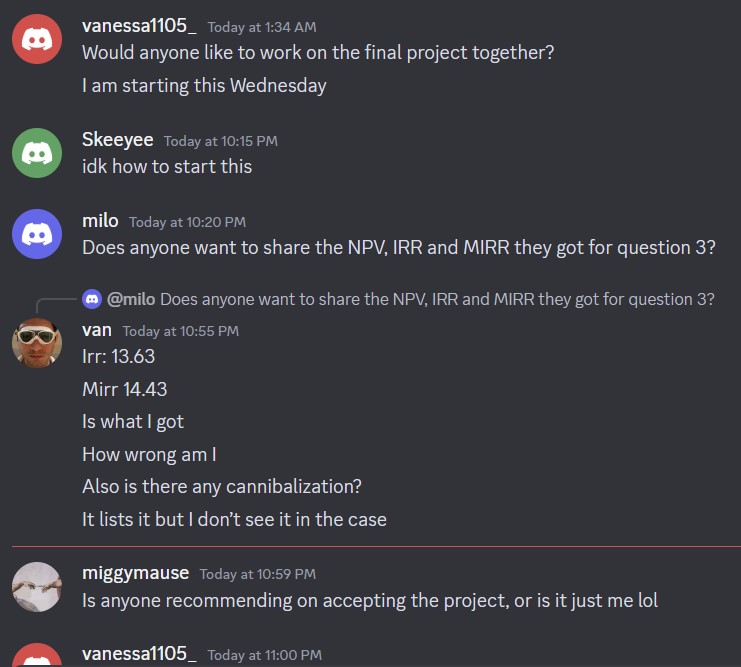

By and large, the plethora of cheating that I witnessed over three-and-a-half years was so shockingly rudimentary and uncreative that I was consistently sure they would get caught, and yet, they never did. And you know why? Because the professors just didn’t give a rat’s ass. They couldn’t care less. Here’s how I know:

Normally, cheating by my fellow classmates didn’t affect me, and so I didn’t care. If they wanted to cheat their way to a degree, what difference did that make to me? I was there to learn, and part of my thrill came from excelling and being the best that I was capable of. Cheating would have stolen that thrill from me, and so even when it was available and easy, I truly had no interest. I don’t pretend to be more moral than anyone else, cheating would have just robbed me of the pure joy I got from excelling at something difficult, and so it was of no interest for me. However, others cheating did affect me when the professor would curve an exam. Now, I have a lot to say about curving exams, but I’ll keep it short here. I don’t like it. It’s just another form of laziness. Write an exam that covers the material you taught, don’t make it ridiculously difficult as if to show off how smart you are, and then grade it appropriately. Why are you curving? If you need to curve an exam, its either because you didn’t do a good job teaching the material, or you put material on the exam that was too advanced for where the students are. Curving is lazy and apathetic, and really just insulting to the students.

In my Intermediate Managerial Finance class, the professor not only curved the exams, she used these very same publisher-provided exams which are all over the internet, and then asked students to take them on their honor. In my entire time back in school, I don’t believe I ever took a legitimate exam where I scored below the class mean score. And, I rarely, if ever, took an exam where I was below the third quartile of scores. So, when I ended up below the mean on the first test in this class, it was quite obvious what had happened. And, the mean score was so high that the professor didn’t curve the exam, so now, this was affecting me. Prior to this exam, I had been invited to take the test with a group of students in the library, where there are blocks of computers where numerous people can sit in groups and look up answers. I refused, of course, but after this first test, I asked for a meeting with the professor. I told her that there was rampant cheating happening on her tests, I showed her that the answers were available online, and I told her that I’d been invited to cheat. Her answer? “There’s not much I can do about it.”

Um, how about you write your own test instead of using a publisher-provided test that has been around for two years? How about you change the wording just slightly so that a different answer is right? How about you do anything at all instead of just telling me that you don’t care? This was infuriating to me, and I considered taking it further up, but I didn’t like the way this “snitching” was making me feel. And this wasn’t the only class where I had this problem. Far from it, actually. My last semester, my Econ 470 professor told me that he couldn’t release the correct or incorrect answers to the exam because it would “compromise the test for future classes.” I sent him a long email telling him that his exams were already compromised, then did a google search for the question I wanted the answer to, and sent him a screenshot of his very test question with the correct answer available online. I don’t understand how these professors can possibly be so naïve as to think that the tests they use over and over again remain uncompromised. It seems impossible that PhDs can be that stupid.

This is probably more than enough about cheating, but let’s just say that it is happening all the time, and it will continue to happen until professors actually decide to care about it. And, from what I’ve seen, very few do.

Anyway, back to the business of registering for my final semester at UNLV.

The UNLV business school has pretty strict requirements for the awarding of Latin honors, the “cum laude” honors that you see all the nerds getting and probably always wondered what they were. The top honor is Summa Cum Laude, and here at the Lee Business School at UNLV, that requires a GPA of 3.991 or higher. I did some math and figured out what this meant, and I believe that if you took a full 120 credits at UNLV, you could get exactly three A-minuses or one B, but not both. If you only took 60 credits here, meaning you started at CSN or some other community college and transferred, you could get one A-minus but not a B, so this is a very difficult honor to receive. I think that of my graduating class of ~550, only three students achieved this honor. Magna Cum Laude is next, and this requires a GPA of 3.9 or higher, and Cum Laude requires a GPA of 3.8 or better. I believe around 25 students from my graduating class got Magna Cum Laude, and somewhere around 50 earned Cum Laude.

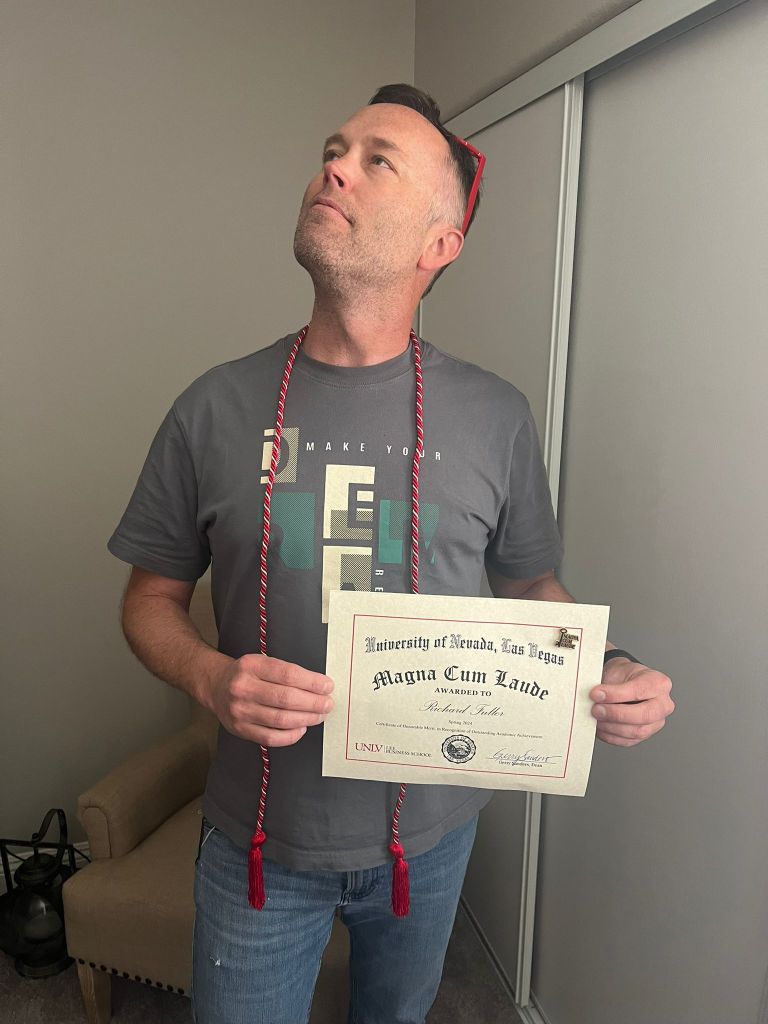
Why do I mention this? Well, when I started publishing this article, I began it with an absurd and utterly snobbish photo of myself holding my Magna Cum Laude plaque while I put on the snootiest airs I could conjure up. You probably remember. It was this photo:
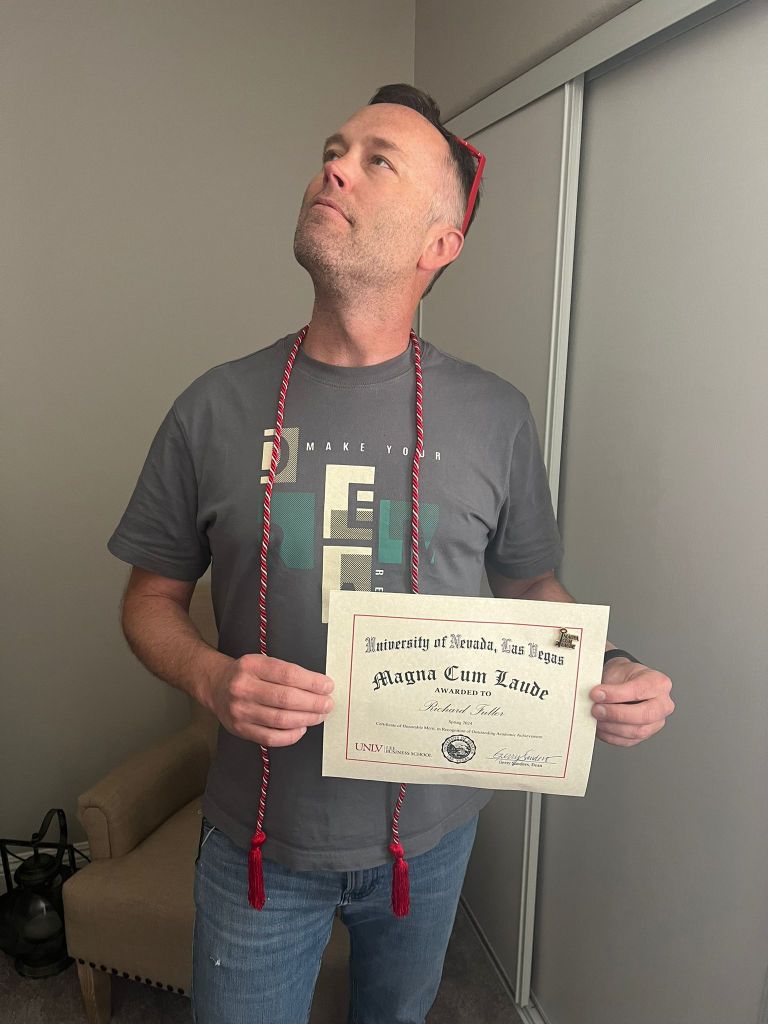
Not only do I look like a complete idiot in this photo, but I announced to the world that I had earned Magna Cum Laude, and yet, I hadn’t received my final grades. With a GPA of 3.958 coming into this semester, I had a little bit of wriggle room above the baseline 3.9 to actually get the Magna Cum Laude honors, but not much. And just because they gave me a nice certificate, did not mean that I had actually earned them. Not until final grades were in and my final GPA was still above a 3.9. So, why in the world would I possibly announce on a public blog that I had earned Magna Cum Laude, all while posing in such a way that I would look like a complete jackass were I to not actually earn those honors? I don’t know. I guess I’m an idiot.

To provide evidence for just how much of an idiot I am, let me tell you what classes I registered myself in for the spring semester. I had four classes remaining, only one of which was a required class. I needed two finance classes and two economics classes, and the only one that was mandated was Advanced Managerial Finance (Fin 405). I had some leeway with the other three, the only requirement being that at least one of my economics courses had to be 400 level, while the other could be either 300 or 400 level. For my second finance class, the Student Investment Fund (Fin 426) was a no-brainer. I explained this class in my previous post, a great class where the students manage an actual investment fund, making all the investment decisions for a fund that had more than $400k in real money. The university allowed students to take this class twice, and I was grateful to once again receive one of the 20 highly coveted slots.

For my two economics electives, I chose Economic Analytics (Econ 306), and Urban and Regional Economics (Econ 470). These all seemed like fine choices as they weren’t easy classes by any means, but they would sort of fill in the gaps where my economics instruction was missing a few things.

And then I did something stupid.

Graduation was fast approaching, and I really had no idea what I wanted to do once it arrived. I’d attended several sessions with guest speakers in finance who told the class all about what they did for a living, and without exception, I came to the conclusion that if I held any of those jobs, it would not take long for me to begin craving the sweet, sweet taste of a hollow-point bullet. I would always ask the presenters what was the most exciting part of their jobs, and, without fail, their most exciting days would have me wanting to stick a fork in my eye. I recognize that my attitude sucks, and I recognize that this sort of outlook probably makes me unemployable, but I just can’t see myself sitting at a desk figuring out ways to make other people rich. Not of any interest to me. Nope.

For economics, I was coming to realize that nobody is hiring an economist with a BS degree. It’s a BS degree, but it might as well just be regular old BS, because there really just aren’t economists out there who don’t hold at least a master’s degree, if not a PhD in economics. There are plenty of jobs in finance for someone with a BS, and in fact, I get solicited constantly through the UNLV job portal for finance degree related jobs. But, like I said, if I’m going to take one of those jobs then I probably should also be enrolling myself in Introduction to Noose Tying (Rope 201), because I’ll definitely need it.

Because I hate all the jobs I’ve seen in finance, and because there are no jobs in economics for someone with my level of education, I came to the realization that I should at least consider a graduate program in economics. I like economics and I seem to be pretty good at it, so if I want to work as an economist then I need to get a little more schooling. Of course, there are plenty of other jobs not in finance and not as an economist that I might find enjoyable. After all, I now hold two business degrees and those are probably worth something out there in corporate America. But I like to keep all my options open, and one of those options was a graduate program in economics.

Keep reading, the really stupid thing is coming.

Looking into some of those graduate programs, I discovered that they require calculus. Since I hadn’t taken calculus, that would have meant I would have to return to an undergrad calculus class at some point if I decided to go that route. I’m actually a little annoyed that the Economics BSBA doesn’t require calculus already. We have to take partial derivatives and full derivatives for marginal revenue functions and wage and capital equations anyway, and because calculus isn’t required, the professors all along the way have had to give us the shortcut to those equations instead of being able to make us derive them ourselves with calculus. I had found this rather annoying over the last couple of years of classes, and I felt that many of my professors also found it annoying.

As I mentioned, I like to keep my options open, so I decided I should take calculus this semester, in addition to my required final four classes. The problem was, I hadn’t even taken the prerequisite for calculus. Sure, I took precalculus one and I took finite mathematics, but neither of those met the prerequisite to register for calculus. It required precalculus II, which is basically trigonometry. I was at first dismayed, but after some digging, I found a work-around. I could test into calculus and bypass the prerequisites. Hooray!

Of course, the problem was that I didn’t know trigonometry. Oh, don’t get me wrong, I took trigonometry once. It was in 1990, and I think I got a C-. And, of course, I haven’t used a single thing from that class since. So, while a few things might seem vaguely familiar 34 years later I definitely wouldn’t know enough to pass the test. So, I decided to teach myself trigonometry during the Christmas break.

I found a great online class through Campus, and another at Khan Academy, and I spent the Christmas break teaching myself about tangent and cotangent and sine and cosine waves, and about the unit circle and the amazing vagaries of pi, and after three condensed and hectic weeks of instruction, I was ready. I took the proctored entrance exam and somehow, I passed. I was now eligible to take calculus!

This might lead you, dear reader, to ask, what kind of a fool takes his final semester, a nice, easy semester with just four classes, and voluntarily adds calculus when he didn’t even have enough classes to qualify to take calculus and just barely passed the test that allowed him to bypass those requirements?

This kind of fool.
So, into calculus I went, joining 55 mostly first-year students in a class that I would come to find out was taught by the most narcissistic, egotistical, holier-than-thou professor I’d yet had. I don’t want to drag this on forever, but this guy suuuuucked as a professor. Absolutely horrible teaching style, but beyond that, he felt the need to lord his intelligence over the students through both his words and his lecture slides, which were absolutely indecipherable and unwatchable. He did have the decency to post his lectures online so that his class, which was unbearable, could be skipped, but instead of posting the lectures to the UNLV system called Canvas, he posted them to YouTube where we had to watch a commercial every five minutes. Things were pretty awful, however, there was a saving grace. This is math. There’s nothing unique about math. An instructor teaching calculus badly, as this one was, is still teaching the same exact calculus as a great instructor somewhere else. And the internet is full of videos of people teaching calculus. All I had to do was figure out what the lesson for that day was, since although calculus is always the same, the order in which it is taught can vary pretty widely, and then find some online instruction that matched. Simple enough, right?

Not quite.

I’ve mentioned Khan Academy a few times, and I can’t say enough good things about them. They are an amazing resource, and I dove deeply into their calculus course, doing my best to match my instructor’s syllabus with the available videos on Khan Academy. I felt that I was keeping up well, and when I would attempt to watch one of this instructor’s god-awful videos, I would give up quickly and return to Khan Academy.

I felt confident going into the first exam, and it went well. I got a 95%, which was a solid grade, particularly when the class mean was an absolutely dismal 63.32% with a median of 69%. I’ll remind you that a passing grade at UNLV is a C, which most professors set at 70%, so more than half the students failed this exam. That is horrible, and an absolute testament to the terrible teaching style of this professor.

But it would get worse.

The grade for this class was based on three exams and attendance at the Friday lab session. This Friday session was really just a review of the material from that week, and while the class itself was not required attendance, the lab attendance was 15% of my grade. I had conflicts that I knew were going to require me to miss 2 of the 12 total labs (test days were also Friday in the lab but didn’t count as attendance credit), and so I would automatically be losing some points there. That meant I really needed to perform well on the exams in order to get an A in the class. I would end up missing 3 of the 12 lab days, which meant I would only get 75% of the 15%.

The first two tests were each worth 25% of the final grade, and the final exam was worth 35%, so with my 95% on the first test, I was sailing along smoothly in spite of the points I would miss for the required lab attendance. Then, along came the second exam.

If anybody reading this has taken calculus, I’m going to post one of the questions that were on this exam. Keep in mind, this is exam two of a first semester calculus class. Does this seem like a fair question to any of you? If you think it is, please let me know, I would love to discover that this sort of question is standard operating procedure instead of a jackass professor being super clever for his own amusement. Here’s the question. Also, keep in mind that each test has 10 questions and we have about 70 minutes to complete it, so a student can only really allocate about 7 minutes to each question.

For anybody who has not taken calculus, here is the answer to this question, as provided by the professor. If you don’t know calculus, then, looking at this answer, does this question seem reasonable to you for a first semester calculus class?
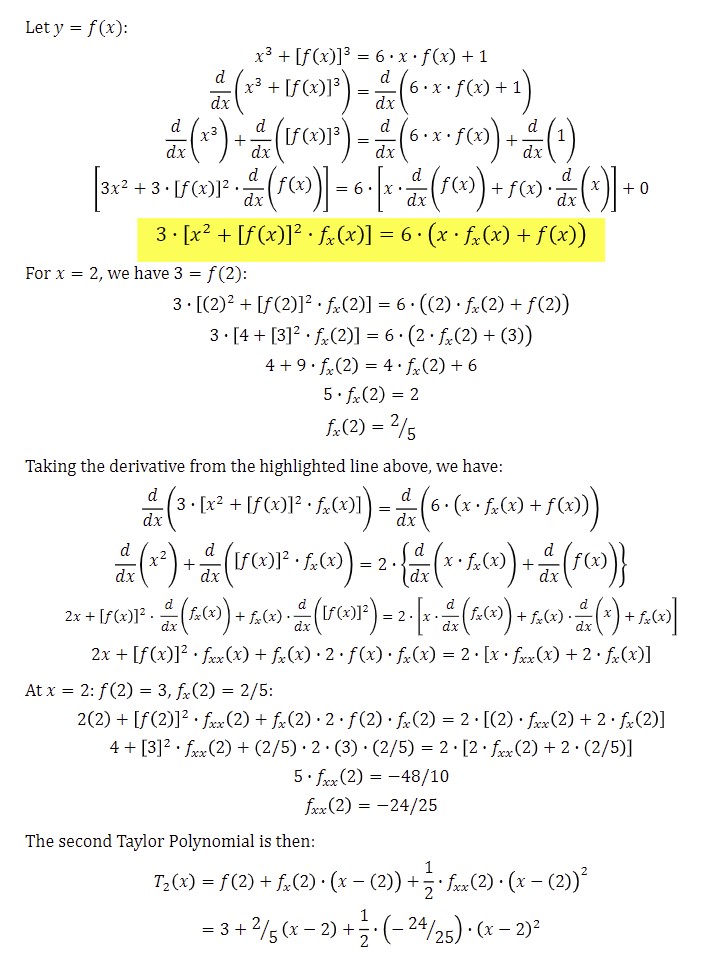
I am, of course, presenting the most difficult question on the test, however, the rest of them were not exactly easy. I did not do well on this exam. In fact, I got one of the worst scores on any exam in my college career. I got a 74% on this test, and suddenly, I was sweating this class. How do I know that I’m not just an idiot and a huge baby, and the test was perfectly fair? Well, of the 56 students in this class who took this test, the high score was 81%. The mean? 36.13%. The median? 30.5%. HALF OF THE STUDENTS WHO TOOK THIS TEST GOT 30.5% OR LESS. The third quartile was 61.5%, which meant that 75% of the students got 61.5% or less. WHEN 75% OF YOUR STUDENTS ARE SCORING 61.5% AND UNDER ON YOUR EXAM, YOU SUCK. This appalling scoring is not the fault of the students. It’s the fault of the professor, and I would challenge anyone who says otherwise.

The next class after these abysmal scores, I decided to actually attend for the first time since the beginning of the semester. I wanted to hear what he had to say about this horrible and appalling result. HE SAID NOTHING. NEVER EVEN ADDRESSED IT. He did send an email with a single sentence that essentially said he would adjust the weighting of the final exam if necessary so that students who currently would still fail the class even with a 100% on the final would not lose all hope.

So, on to the final exam. I studied my ass off for this exam. Although I was certainly in the top 5% of this class with my solid B, I wanted to do better. Not only did I punish myself thoroughly by watching every one of this professor’s unwatchable videos, I spent dozens of hours learning the intricacies of calculus with Khan Academy’s vast library. I was prepared. I aced the Khan Academy mock exams. I knew my calculus.

Until I showed up for the final exam and flipped over the test to begin.

Once again, this jackass decided to humor himself with questions that were so advanced that failure was guaranteed. I just cannot understand how this clown has a job. I will never understand a math department that accepts the failure rate that this professor shoves down their throats.

Although I was sweating this grade, I did some math (not calculus, obviously) and realized that I only needed to get 50% on the final exam to get a C in the class and pass it, and the C would not drop my total overall GPA below the 3.9 threshold for Magna Cum Laude. Whew! I knew I did better than 50% and so I was golden. As long as I got As in every one of my other classes – and after finals week, I felt confident that I was going to get As in all those classes. Of course, a C in calculus is terrible, but at least I was done with it and Magna Cum Laude was a lock. I wrote and posted the first blog, along with the picture I was about to deeply regret.

A day later, I wrote and posted part two. I was feeling cocky and happy, and I was thrilled with the viewership of my first blog. After I posted the second blog I went to bed and then suddenly woke up in a panic a few hours later thinking I missed something. I ran downstairs and redid the math. Oh dear God, I got it wrong the first time. (maybe I deserve to fail calculus after all?) If I got a C in calculus, my GPA would actually drop to 3.889. It was a four-credit class because of the lab, and I had done the calculation based on a three-credit class. A C and I would lose Magna Cum Laude. And I had just posted this picture for the world to see.

What an idiot I am.

I quickly calculated what I needed on the final exam to get a B in the class. I would need a 76%. I thought back to the test. That was going to be VERY, VERY close. I wasn’t sure I had made it. It was an absurd test, on par with the previous test where I got a 74%. I would need to do better on this one, and I didn’t think I had. And, this all assuming I got straight As in the other four classes, and I suddenly was getting cold sweats imagining scenarios where that didn’t happen. The Econ 470 class had the A-cutoff at 94%. 93.9% was an A-minus. (What even is this grade? Who gives minus grades, and certainly who sets the cutoff so high?) What if I got an A- in that class? What if I got an A- in Econ 306? His syllabus just said, “standard 10-point grading scale.” I had assumed that meant no minus/plus grades, but did it? What if “standard” meant minus and plusses? I was sitting at 92.88% in that class, was that actually an A-? If I got two A- grades, would a C+ in calculus pull me under the 3.9? I did the math. It would. What about a B-? Yes, it would. I perused the calculus syllabus. No mention at all of plus or minus grading. No mention of the grading scale at all, in fact. Typical assclown professor move. I was screwed. Why did I miss those lab days, particularly the one where I just simply didn’t feel like going? That was 1.25% for each day, 3.75% in total. I needed those percents now, and I’d so nonchalantly waved them off. What an idiot. YOU CAN’T TAKE IT AWAY, UNLV, YOU ALREADY SENT ME THE CERTIFICATE!!

But of course, they can.

Throughout the week, I watched anxiously as grades were posted. I held off on writing part three of this blog. I worked through all the scenarios and came up with the best way to post a retraction. My Facebook picture (I think you know the one by now) had over 100 likes. I had received dozens of congratulatory messages. How did I retract this and tell everyone that I’m an idiot, and I deservedly lost Magna Cum Laude because I’m retarded?

The grades began posting. Finance 426, (A). No surprise there, anything less would have been an absolute shock. Econ 470 (A). I faded the 94% A-minus cutoff, closing the class with a strong final exam and an overall 96.8%. Fin 405 (A). I got 100% on the final project while the class average was in the low 70’s so I should have been feeling great. Of course, I wasn’t. I only cared about the calculus grade. Would I get the 76% on the final exam which would put my final grade at 80.1%?

Econ 306 came in. I did worse than I thought on the final exam with an 85%, and had 92.88% for the class. I didn’t know if this was an A- or not, but was glad to see when he posted it that it was a pure (A). Thank you, sir. Four As in the books. If I hadn’t taken this optional calculus class, I would have closed my college career with straight As and a GPA that would have been in the 3.97 range, quite respectable under any conditions, and certainly under the double major program I’d put myself through.

Of course, the calculus professor waited until the last minute to post the grades. All the bad professors do this. I think they just decide that if they wait as long as possible there will be less time for the students to complain and try to finagle a grade change. I got the email that the grade on the final exam was in. I logged in and held my hand over it to sweat it like I was squeezing Aces at the poker table. The first number I saw was the class mean. 39.92%. The next was the class median. 40%. Well, he obviously didn’t do anybody any favors with a curve of any type. And yeah, the test was just as hard as I’d anticipated. My heart was in my throat. I needed 76%. I kid you not, I squeezed the number by blocking the screen with my hand. I’m not dragging this out just for you, I did it to myself as well. I moved my hand just enough to see the first number.

7.

Oh dear God. I was hoping to see an 8. I was dreading seeing a 6. I scored in the 70s. Six numbers (70-75) got me a C and an incredibly embarrassing public retraction. Four numbers (76-79) got me a B and the Latin honors I’d already announced to the world. I was a 3-2 favorite to have to start writing that retraction and making some phone calls to my family. I squeezed the last number.

6.

I got a 76. The absolute minimum number I needed. Did I miscalculate this?? I pulled up a calculator and crunched the numbers again. Yup. 76% meant 80.1% for the class. B or B-minus, it didn’t matter. I would be above a 3.9 GPA and all would be good. It turned out, of course, that he gave me a B-minus. Despite the fact that his syllabus makes no mention of minus grades. Because he’s a jackass and possibly the worst professor at UNLV.

The high score on the final exam was 88%, and the upper quartile was 59.75%. Once again, somewhere in the range of 80-85% of the students failed the final exam, and almost certainly somewhere north of 75% of the students failed the class entirely. How can you possibly take any pride as a professor with that kind of failure rate? How can a school justify employing a professor with that kind of failure rate? Does he simply tell them that all his students are idiots? Does it even get brought up at any point? I’ll just never understand. And lest you think I’m exaggerating or making this up completely, here are the exam scores.  

It was officially over. I finished my college career, or at least the undergraduate portion, with a GPA of 3.916. After one year and 29 credits at CSN, I raced through UNLV with 109 credits in just two-and-a-half years, a blistering pace, and now I was finally finished. So, now what? Grad school? A job? Something else entirely?

I don’t know.

As I mentioned when this all started, I want to do something that betters the world. I want to build something. I want to be a net contributor to society rather than a net drain. I want to feel good about what I do, and most importantly, I need to be challenged. I need a job that challenges me every day, because I get bored VERY easily. It’s miserable being me sometimes. Even exciting stuff bores me. I don’t know why, but I know that I want to work, and I know that I need something titillating. I’m smart, I’m driven, I’m energetic, I want to work, I’m willing to work hard, and now I have some schooling. Is it enough schooling though? What should I do?

Anybody out there looking to hire a recent 51-year-old college graduate?

Thanks for reading!

Final semester classes:

ClassCodeCreditsGradeCumulative GPA
Student Investment FundFIN 4263A3.96
Advanced Managerial FinanceFIN 4053A3.962
Economic AnalyticsECON 3063A3.963
Urban and Regional EconomicsECON 4703A3.965
CalculusMATH 1814B-3.916

Overall college courses, CSN and UNLV combined:

Stupid Gen Ed required classes:

ClassCodeCreditsGrade/GPA
Nevada HistoryHIST 2173A
Precalculus IMATH 1263A
EthicsPHIL 1023A
Chemistry (+lab)CHEM 1054A
Arabic IARA 1114A
AstronomyAST 1043A
Composition IIENG 1023A
U.S. Since 1877HIST 1023A
Critical Thinking and ReasoningPHIL 1033A
World Literature IENG 2313A
History of Rock MusicMUS 1253A
U.S. GovernmentURST 2413A
Calculus IMATH 1814B-
Totals 423.876

Business school required classes:

ClassCodeCreditsGrade/GPA
Financial AccountingACC 2013A
Intro to Information SystemsIS 1013A
Finite MathematicsMATH 1323A
Managerial AccountingACC 2023A
Business CommunicationsBUS 3213A
Business AnalyticsIS 3353A
Leadership & Management SkillsMGT 3713A
Principles of ManagementMGT 3013A-
Marketing ManagementMKT 3013B
Operations ManagementSCM 3523A
Business LawBLW 3023A
Tech and InnovationIS 3303A
Global Business StrategyBUS 4983A
Totals 393.900

Finance degree-specific classes:

ClassCodeCreditsGrade/GPA
Principles of Managerial FinanceFIN 3013A
Money and Capital MarketsFIN 3123A
Intermediate Managerial FinanceFIN 3033A
InvestmentsFIN 3073A
Student Investment Fund IFIN 4253A
Student Investment Fund IIFIN 4263A
Advanced Managerial FinanceFIN 4053A
International Financial MgmtFIN 3083A
Totals 244.000

Economics degree-specific classes:

ClassCodeCreditsGrade/GPA
Beginning MicroeconomicsECON 1023A
Beginning MacroeconomicsECON 1033A
StatisticsECON 2613A
Statistics IIECON 2623A
Intermediate MicroeconomicsECON 3013A
Intermediate MacroeconomicsECON 3033A
Intro to EconometricsECON 4413A
Economic AnalyticsECON 3063A
Industrial OrganizationECON 4553A
Urban and Regional EconomicsECON 4703A
Seminar in Economic ResearchECON 4953A
Totals 334.000

Pursuing a college degree as an adult: part three

On December 6th, 2023, at approximately 11:30am, a man in a trench coat entered Beam Hall, the home of the Lee Business School at UNLV. As is the case with the vast majority of universities in this country, UNLV is an open campus, and this man was unchallenged as he came onto the grounds. He walked past room 104, where students in Finance 308, International Financial Management, were just taking their seats. It was the week prior to finals week at UNLV, and this class would be a review session for the final exam which would take place seven days later. The man got on the elevator, went to the 4th floor where business school professors had their offices, and opened fire with a 9mm handgun. He would end up murdering three professors and wounding a fourth before exiting the building amongst panicking and confused students. On the front steps just outside Beam Hall, he would be confronted by a University Police detective responding to the shots fired call, and he would be killed in a shootout.

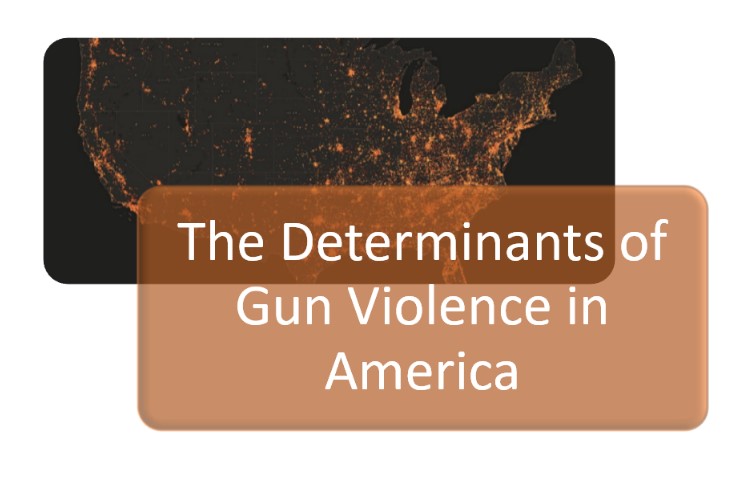
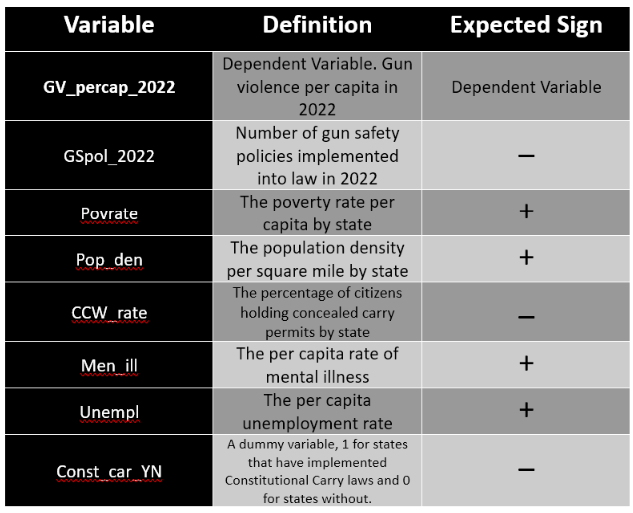
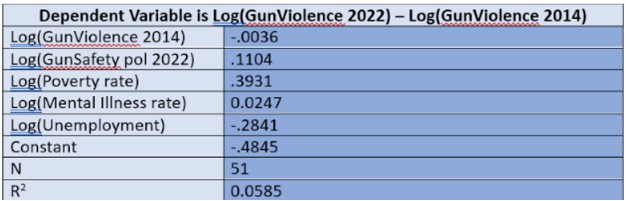
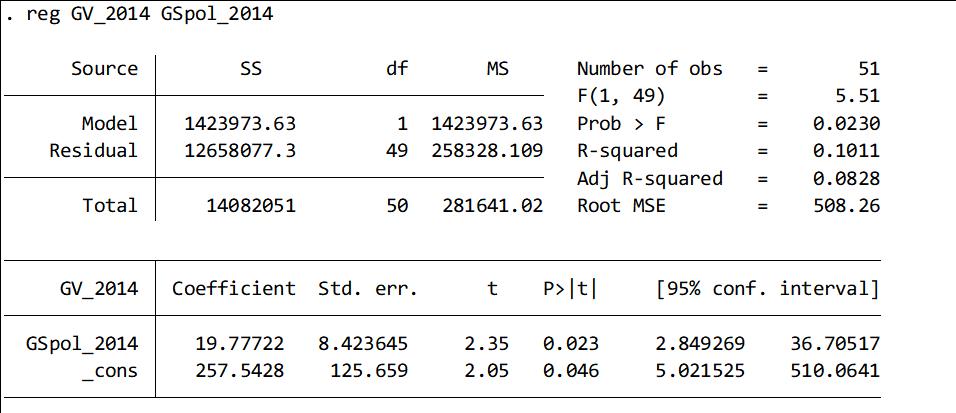
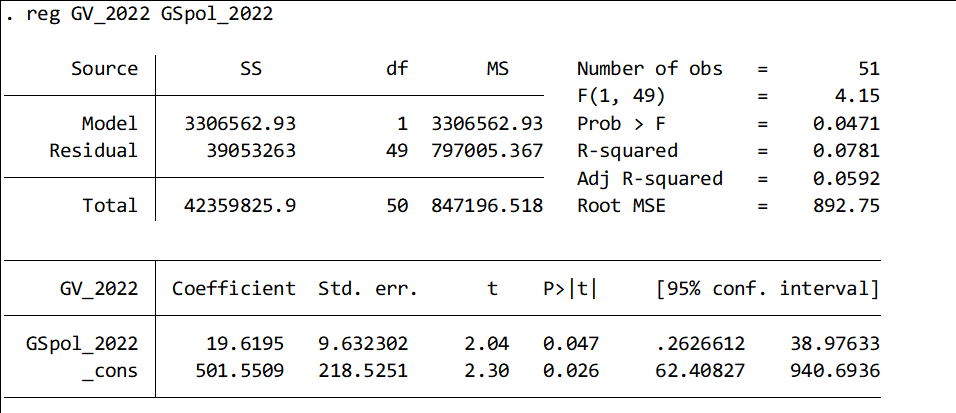
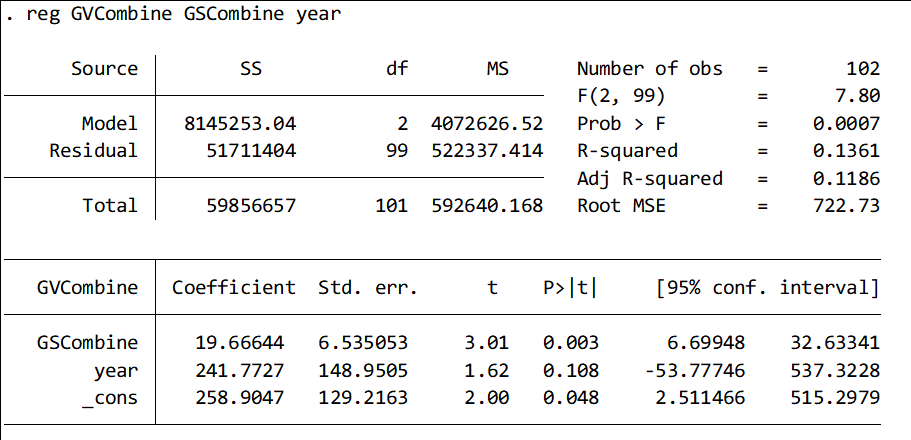
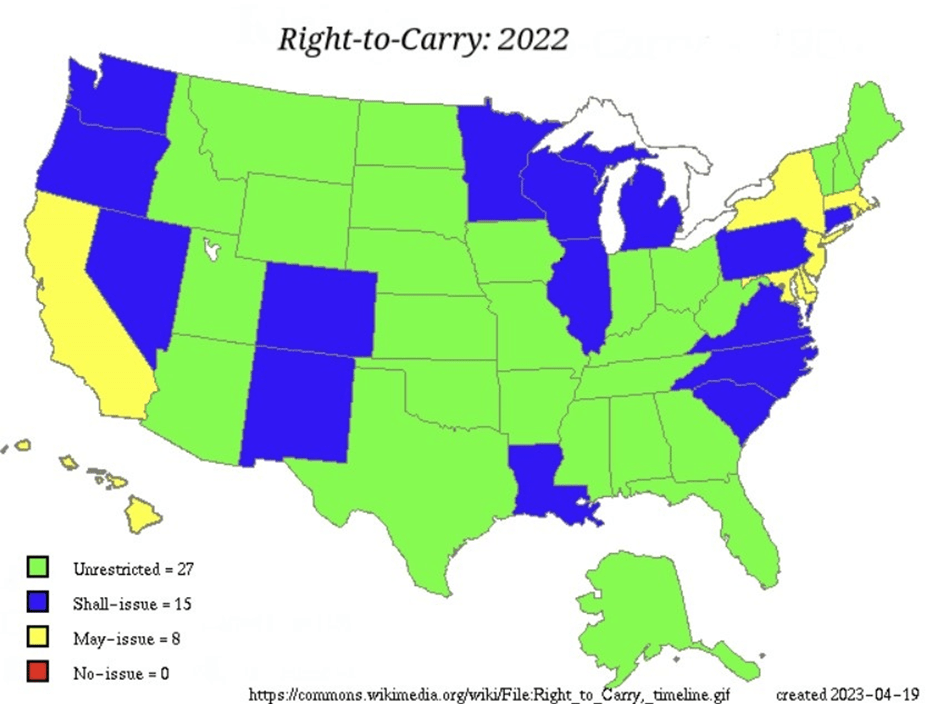
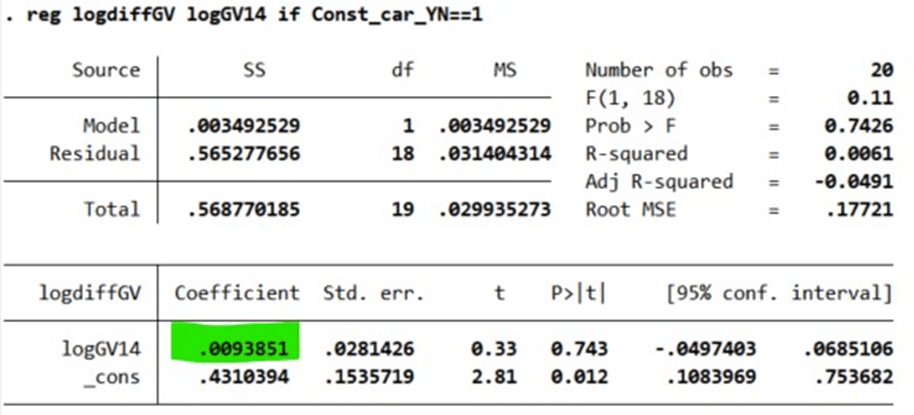
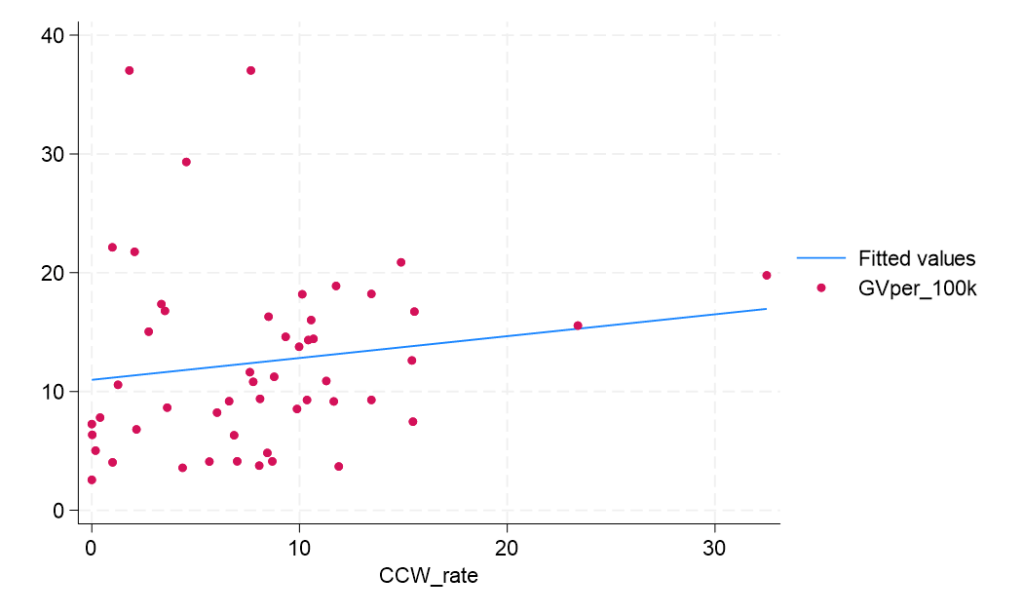
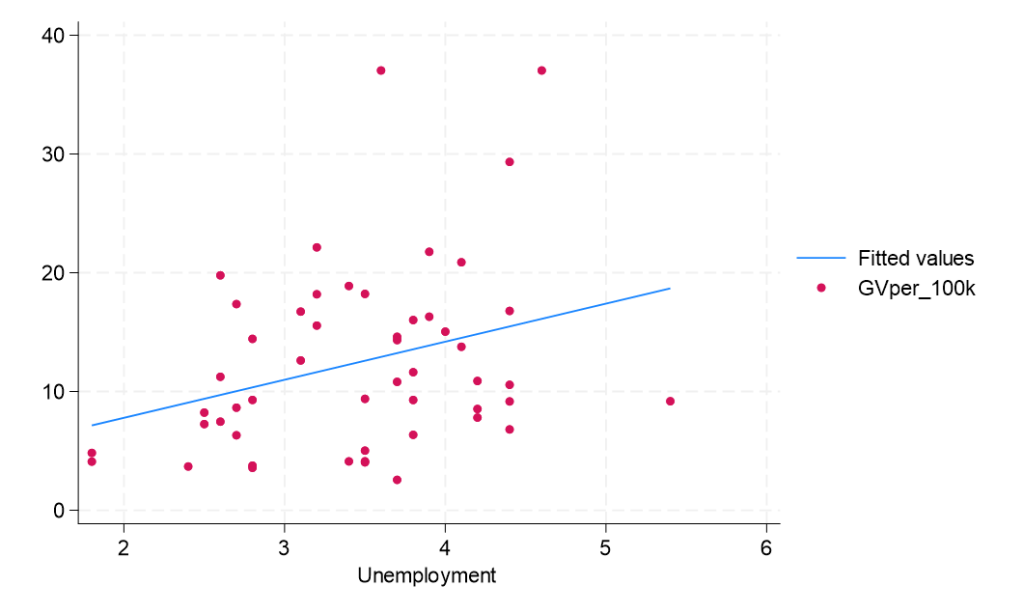
This would upend the entire university, and create massive changes to the remaining schedule of classes for the students, not just in the Lee Business School, but across the entire campus. Three people were murdered, and I am always appalled when people take a tragedy and try to make it about themselves when they were only peripherally involved, if at all. However, this did have a major effect on the penultimate semester of my university experience, particularly as I was scheduled to present my culminating research project in Economics to a panel of judges at the Undergraduate Research Symposium just three days later. The topic of my research paper was, “The Determinants of Gun Violence in America.”

I get ahead of myself though. The 2023 school year started 11 months earlier in January, and I was once again enrolled in the maximum allowable six classes. As a double major, I had so many required classes that I didn’t have any true electives to take during my entire time at UNLV. 120 total college credits are required to graduate, and I had well over 100 credits of required classes to go along with the 29 credits transferred from CSN, so any easy classes I might have had were still required classes, and those were all in my past. While some of my classmates were taking classes like Beers of the World, Bowling, and Intro to Kayaking, the very types of classes that had formed my negative opinion of a college education in the first place, I was force-feeding myself with the maximum allowable class load of study-intensive Finance and Economics classes just to meet the stringent requirements that accompanied the double-major.

My spring 2023 schedule consisted of four live classes and two online classes. The live classes were, Business Law (BLW 302), Intermediate Macroeconomics (ECON 303), Intro to Econometrics (ECON 441), and Money and Capital Markets (FIN 312), while my online classes were Intermediate Managerial Finance (FIN 303), and Investments (FIN 307), the latter of which, although an online class, had a mandatory scheduled lecture time where attendance was part of the grade, and would turn out to be taught by the worst professor I ever had.

Business Law was an interesting class, taught by a lawyer, and covering a very wide array of business legal topics including, labor law, contract law, and business case law. The instructor was stern and no-nonsense, his eagle-eyes identifying students using their cell phones during his lectures in the 100-seat auditorium like, well, like an eagle spotting a mouse in a large field of hay. He would stop the lecture and refuse to start again until the student put down the cell phone, an absolutely ridiculous show of unjustified irritability that would be very uncomfortable to witness, particularly for those of us on laptops playing Angry Birds.

This instructor was diligent about cheating, one of the very few I ever encountered. I’m going to talk more about this in a bit, but to prevent cheating, he would make two versions of each test, and then religiously ensure that no two students with the same version sat next to one another. He had two assistants in the room who would help him watch over us test-takers, and then he would check each person’s identification when we handed in the tests. I never had another class where a professor checked identification, and I had actually always thought that was strange, particularly in high-level classes where attendance isn’t required. You teach students for five or six weeks and start to get to know their names, and then on test day, a totally unknown person shows up and takes the test and you just accept that test without confirming who they are? It always seemed to me to be a situation rife for cheating, particularly with classes such as accounting which, unless you’re specifically an accounting major, wouldn’t be a class where information would build and you would suffer later by having an expert take your exam for you.

Anyway, there was another version of this Business Law class that was online with this same professor, and he actually caught more than half the class cheating on one of the exams. I never found out exactly how they did it…some version of taking the exam together from the same room, probably the library, where they all got exactly the same wrong answers. Being a lawyer which is a profession where integrity is burned into their psyche throughout their careers, this was a big deal to this instructor, and he called each of them in individually for interviews/interrogations. Many of them were failed out of the class or had to retake the exams with penalties. Again, this sort of diligence to combat cheating was incredibly unusual, and quite refreshing. Much more on this in part four.

The class titled Investments was one that should have been incredibly useful and very applicable to any sort of career in finance. It covered such topics as portfolio management, bond-equivalent yields, variance and standard deviation of portfolios, yield curves, the Sharpe ratio, duration and modified duration, the dividend discount model, and so many more important concepts. Unfortunately, the professor was horrible. Bottom three that I ever had easy, possibly the actual worst. He taught by reading from his notes in a thick accent and circling slides over and over until his scribbles crossed out the information you needed to learn. You were required to download the lecture slides the day of class…if you missed them, he deleted them, which served no purpose other than of a punitive nature toward anyone missing the lecture. He discouraged questions and made fun of students who did brave his wrath by interrupting him with a question. This material was dense and difficult, and he taught it as if this was a master’s level class, expecting students to absorb his words and understand his rambling, despite his lack of any teaching ability. He’s the only professor I ever saw have under a 1.5 rating on ratemyprofessors. He’s also the only professor I ever went to the chair of the Finance department to complain about. He curved exams, like most of the bad professors, for the simple reason that he was incapable of teaching the material. One of the exams we took required a 19-point curve to get the class mean up to a C-average. When your class average is in the 50s, that is not on the students, that is on you as a teacher. Sadly, I would experience much worse than this in my final semester here, but up to this point, this professor was the worst I’d ever seen.

Thanks to the curve, I got an A in this class, but I mourned the loss of information I thought was vital to a finance career, and it definitely required me to go out on my own and learn much of the material this class was supposed to teach me, lest I fall behind in later classes that built on this information. It’s sad that professors like this are able to achieve tenure at universities. I understand that good professors are hard to attract, and that administrators cannot always rely on student evaluations to rate professors as that would become manipulatable and hurt the sanctity of objective educational standards, but when professors such as this one get through the cracks, it is bad for all involved.

Both of my economics classes were incredible, and I found that I enjoyed the sub-field of macroeconomics more than its sister, microeconomics. Econometrics is the field of regression analysis, and this class continued my first immersion in this field from Statistics II. This class was taught by a phenomenal professor who also happened to be the vice provost. He is an absolute savant in the program R, an analytical regression program similar to STATA, which is the one I would become the most adept in as I moved forward. I would come to love conducting regression analysis on data, and this class was my first experience in that amazing sub-field of economics.

I finished the spring semester with perfect As, and my streak continued. I decided once again to take four classes during the summer sessions as I still had several business school requirements to get through, and, as I might have mentioned, I’m not exactly a spring chicken. I wanted to pound out classes as fast as I could, and these remaining business school classes were a thorn in my side. I didn’t want to take them, I had no interest in them, and yet they were required classes, so I had no choice. The only thing I could do was limit the pain by taking the super-condensed versions of them offered in the summer session, five-week long classes instead of the normal 4+ months. I enrolled in Tech and Innovation (IS 330) and Principles of Management and Behavior (MGT 301) for the first 5-week term, followed by Marketing Management (MKT 301) and Operations Management (SCM 352) for the second 5-week term.

I had no memory of taking IS 330 while writing this, and had to go back to my folder to see what it was. It was filled with nonsense like creating “empathy maps” and designing a new cell phone application. The kind of nonsense class that someone getting a marketing degree—the third worst, and mostly worthless degree offered by a university—would love. I hated it and was thrilled to only have to suffer the agony for five weeks instead of four plus months.

Management 301 was more nonsense involving abhorrent business concepts such as the six forces of the general business environment, the four approaches to ethics and values, Kohlberg’s theory of ethics, the corporate social responsibility pyramid, polycentric and geocentric management approaches, Hofstede’s model of cultural dimensions…it was five weeks of memorizing nonsense and attempting to regurgitate it for the test and then blocking it out of my brain forever. Perhaps my terrible attitude toward this type of instruction is why I got an A- in this class? Gasp. Yup. The 4.0 dream died by mutilation this summer with my first ever sub-A grade. By the way, what the fuck even is an A-? Why does this grade exist? Not all professors have this grade. Many don’t give minus and plus grades. I earned a 92.5% in this class. Why isn’t this an A? This nonsense pisses me off.

It wouldn’t matter in the long-run though, because I was going to do even worse in the next summer session. MKT 301 and SCM 352 were taught by the same professor back-to-back, so I had to spend three hours a day with him, five days a week for five weeks. He was a good instructor, but the problem was that he was a lecturer, not a professor. This meant that he had no leeway to adjust the curriculum—he had to teach what they made him teach. That meant that we went over a chapter each day, Monday through Thursday and then tested on Fridays. That meant memorizing a great deal of information and then taking a publisher-provided test, which tend to be rather more difficult. Because it was a live class and, as a lecturer, he didn’t even have the option to curve the grades, it was an incredibly difficult test each week, made even more difficult by the fact that both classes had almost the same schedule. So, I would be trying to memorize eight chapters of information in four days between the two classes. This was incredibly difficult, and my grades suffered. I managed in A in SCM 352, but got my first ever B in MKT 301. Have I mentioned how much I hate marketing? Did I mention it’s the worst degree offered in business school?

Entering the fall semester, I was forced to have amnesia toward my first non-As of my college career, putting them behind me and moving forward with my best foot. The good news was that the majority of the nonsense business school classes were behind me, with only the capstone class remaining. The other good news was that after consultation with an advisor, I learned I had only nine required classes remaining, which meant that I could split those up five and four. My semesters of maximum classes had come to an end.

I enrolled in five classes to start the fall semester 2023. Might as well leave my final semester as the easiest with only four classes, the normal class load that most students take. I enrolled in the business school capstone class, Global Business Strategy (BUS 498), Industrial Organization (ECON 455), Seminar in Economic Research (ECON 495), International Financial Management (FIN 308), and Student Investment Fund (FIN 425). Even though I still had a couple of economics courses to take, I had taken enough to take the capstone class which was Econ 495, so I would be taking two capstone classes this semester. The finance program at UNLV doesn’t have a capstone class, so this would be the last of those for me.

Global Business Strategy was probably the most interesting and enjoyable business school class I took, mainly because the professor was fantastic. For starters, his class was not mandatory and he posted the lecture notes online, so you really didn’t need to attend. Which meant that I never did. The material dealt with international business issues, and it was interesting. The projects were interesting, the final project was a group project, which I normally abhor, but I somehow found myself in with an amazing group of intelligent go-getters, and I really enjoyed our final project which was a business plan to bring Grey Goose vodka to the Saudi Arabian free trade city of Neom. One of my fellow students was Saudi, and he wore the full regalia for our presentation to the class. It all sounds like the type of nonsense I would typically despise, but for some reason, I really enjoyed it.

The Student Investment Fund class was phenomenal. Taught by one of the best instructors in the finance department, this class required an interview with the professor in order to enroll. He only took 24 of the best finance students for this class, and not having had him for any previous classes, I had to make sure that I impressed during the interview. I was lucky enough to get in, and it was an incredible experience. Somebody, many years ago, donated $100k to the school to start this program, and it’s been going ever since. The students manage the money as they would in any wealth management career, investing in equities and mutual funds as they see fit. The money is real, and when I entered the class, the total funds were just over $400k. We would pitch buy, sell, or hold presentations to the class, the class would vote, and if 70% or more approved the initiative, the professor would make the trade. We were assigned to sectors that matched the S&P 500 sectors, and we were solely responsible for managing the funds allocated to that sector. It was real-world wealth management, and the class became a socially cohesive bunch, including the old man of the class. (That’s me.) Pitches would come with often rousing and animated discussions, all moderated expertly by the professor, who would chime in with advanced finance instruction if we missed something, or were operating under false information. He otherwise stayed out of all discussions and deliberations. He let us succeed and he let us fail, and it was an amazing experience, not to be missed if you happen to be a finance program student at UNLV, or anywhere else that has a similar opportunity.

International Financial Management was really all about currency trading, and I found it very interesting, though quite a difficult class with a lot of dense information to learn. This is the class that was in session when the December 6th shooter opened fire. More on this in a minute.

Econ 455 was taught by a new professor to the school, and he was excellent. Another difficult class with a lot of dense material, but one I thoroughly enjoyed. Econ 495, the economics capstone class involved a final project using regression analysis. Students had to choose their topics, compile their own data, and run their own unique regressions. The build-up to this culminating project involved regression analyses using data provided by the professor. Incidentally, he was the same professor I had for Statistics II, which was my true introduction to regression analysis, and I wasn’t a huge fan of his. I respected him, and I thought he was quite knowledgeable and a nice guy, but as an instructor, I did not like his style. He was a tech philistine and taught by using a notepad and markers which he would project onto the screen, almost never looking up at the class. There was little-to-no interaction with the students, no attempts to be personable in any way…just start the lecture right on time, draw on the notepad the entire time, and end right on time. Anyway, he had a lock on this capstone class, and so there were no other options.

All my classes were going well right up until some bastard murderer who was mad that he didn’t get a job (by the way, kudos to whomever made the decision to not hire this guy. That was prescient of you.) decided to kill a few professors on December 6th. I wasn’t in class that day. I felt comfortable with the material for International Financial Management, and didn’t think I needed to be there for the review day, so I skipped. It wouldn’t have mattered had I been there—he wasn’t targeting students, he was targeting professors, the tiniest glimmer of a bright spot on a horrible day. While I look more like a teacher or a staff member than a student, the murderer had a plan, and I would not have been in danger even had I been there. Nonetheless, I felt fortuitous to have decided to skip that day.

This was pandemonium, of course, and the students all overreacted, if that’s possible in such a situation. Someone started a petition to make UNLV a closed campus. (This would be nearly impossible, BTW.) Another started a petition for administrators to denounce gun violence. (Huh? WTF is this going to do? And who doesn’t already denounce gun violence?) And, just about every single student in my Discord groups began immediately pretending that their lives were in danger, that they saw the gunman in the parking lot before he entered the school, that they were minutes away from death, that they’ll never feel safe on campus ever again, etc, etc.

I know that people cope with tragedy in different ways, and I understand that people desire to pretend that they were involved in some capacity more than they were in any sort of newsworthy event. It’s human nature, but I find it appalling and annoying nonetheless. People died, and I felt that students were more concerned with trying to finagle their way out of final exams than caring about the deaths. For the school, the timing was horrible. Finals were the next week, and they had to make some difficult decisions. While I don’t agree with the decisions they made, I do recognize that it was a very difficult spot to find a fair and compassionate resolution.

What they ended up deciding is that finals would be canceled. Professors could offer completely optional final exams that would be taken online (campus would be closed for the remainder of the calendar year, Beam Hall, the home of the Lee Business School where the shooting took place would be closed to students for the following semester as well.) and these finals could only help grades, they couldn’t hurt anyone who chose to take them. All assignments that had a due date after December 6th were canceled, and whatever the students’ grade was as of December 6th was his final grade if there was no optional final exam. Professors also had the ability to bump students up a grade if they felt the need or desire. Students who were failing at the time, or getting a worse grade than they desired, would be given the option of taking a pass/fail for the class so that no grade would negatively impact their GPAs.  

For me, and I suspect for most students, this had a huge impact on the semester. I mentioned earlier that my capstone project for the Econ 495 course was a regression analysis into the determinants of gun violence in America. Great subject, eh? Very topical choice, as it would turn out. Remember, this was a capstone course in economics. The culmination of the economics program. The opportunity for students to show that they learned something over several semesters of economics instruction. The professor had also generously back-loaded several assignments, moving the due dates to the last day of class to give us ample time to work on them. This meant that as of December 6th, we had turned in exactly one project, the remainder had been pushed back. And now, the edict had come down that any assignment due after December 6th was no longer due. The professor sent an email telling us that as these projects had been originally due prior to this fateful day, he still expected us to turn them in. Somebody must have complained though, because the next day he was forced to send a retraction, and the tone of the email left little doubt as to his feelings about the matter. Our economics capstone course would be graded on a single introductory project turned in months earlier. Kind of a travesty, really.

Some of my fellow students hadn’t even begun working on their final projects yet, and they were, of course, elated. I myself was dismayed. I had already put dozens of hours into my final project, and I had derived some very interesting results. I had volunteered to present my findings at the undergraduate research symposium, and I had been really looking forward to it. Even had they allowed this to proceed, would I have wanted to present “The Determinants of Gun Violence in America” to a group of professors who had just lost colleagues to gun violence? Doubtful.

I was currently getting an A in every class, and so I had no need of the optional final exam offered by my Econ 455 professor. However, I’m a complete suck up, I guess, because I took it anyway. I just really like to know if I’ve learned the material or not…

My business 498 professor pretty much just gave everyone in the class an A which left no need for him to provide any optional final. The Finance 308 professor bumped everyone up a letter grade and didn’t offer a final exam. I already had an A, so this did nothing for me. Finance 426 was finished anyway, there is no final exam in that class. The only thing remaining was this econ 495 final project, and I REALLY wanted to finish it. I was very interested in the conclusions, and I wanted feedback on the process. The problem was that I still had quite a few hours of work to do on it, and I didn’t want to do that work for no reason at all. I emailed the professor and asked him if I still turned it in, would he give me feedback on it? He had no reason to say yes, this would only be extra work for him, but he generously agreed, and told me that if the work was good, he would help me get it published. Elated, I spent the next week finishing the regressions and compiling the data, and then submitted it to him. I was bummed to not be able to present it to the symposium, but excited to actually complete a full regression analysis using data I’d compiled myself. *BTW, this paper is available here on my blogsite if anyone is interested in reviewing it.

After the shooting, UNLV canceled all finals except those in the Boyd Law School and the medical school. Those were finals that couldn’t be canceled, and so they made exceptions for them. I thought they also should have made exceptions for capstone courses. How do you grant a degree to someone in a field where they essentially didn’t complete the capstone course? This was especially true in my economics class where so many students never completed a thing other than the very first project. They are going out into the world with economics degrees, and many of them have never done a real regression project. There are other classes that required this type of work, but nothing of the nature and depth of the project for the capstone class. I thought that UNLV should have also made the decision to still require capstone work to proceed, but, as I mentioned, I certainly understood the difficult spot in which they found themselves.

ClassCodeCreditsGradeCumulative GPA
Business LawBLW 3023A4.0
Intermediate MacroeconomicsECON 3033A4.0
Intro to EconometricsECON 4413A4.0
Money and Capital MarketsFIN 3123A4.0
Intermediate Managerial FinanceFIN 3033A4.0
InvestmentsFIN 3073A4.0
Tech and InnovationIS 3303A4.0
Principles of ManagementMGT 3013A-3.990
Marketing ManagementMKT 3013B3.945
Operations ManagementSCM 3523A3.950
Global Business StrategyBUS 4983A3.951
Industrial OrganizationECON 4553A3.952
Seminar in Economic ResearchECON 4953A3.954
International Financial MgmtFIN 3083A3.956
Student Investment FundFIN 4253A3.958

In the final installment of this series, I’ll talk about my final semester at UNLV, the rampant cheating that takes place on today’s college campus, and admit to you how I came very close to looking like a complete jackass by beginning to publish this series of articles prior to the release of my final grades.

Pursuing a college degree as an adult: part two

When I made the decision to go back to school in 2021, I didn’t initially tell anyone. I had no idea if I would follow through; after all, I had made this same decision more than once in my life already. When I graduated high school in 1991, I was a terrible student. I think my GPA was something like 2.95, less than a B average. It wasn’t that I wasn’t capable of excelling, I just had no desire to try. I managed to score in the 1300s on the SAT test, and somehow that was enough, despite my abysmal GPA, to get me into the University of Washington in the fall of 1991.

At that time, I was 18 years old, had a full-time job working the night shift at a grocery store in Snohomish, Washington, and I was living in a small house with two close friends. I’m not sure I would describe it as a party house exactly, however, we did have a room just to store our beer, and our furniture was mostly milk crates and discarded chairs left on the side of the road, so you can be the judge. The University of Washington was an hour drive away, so I would get off work at 7:30am, rush home to change clothes, drive a half hour to my cousins’ house in Bothell, and then commute with them to the university where we would arrive just in time for 9:00am classes, and just in time for me to promptly fall asleep in the back of the massive lecture halls that held hundreds of students. This would describe a good day. A bad day had me bringing a pillow onto campus and skipping class for the library where they had these amazingly soft couches and I could sleep undisturbed, while my education slipped into the ether like the ephemeral dreams I was enjoying. Being pre-cell phone days, my cousins would have to come search for me so we could commute back north after they got out of classes. A really bad day had all three of us skipping class entirely so we could play poker in a smoke-filled back room at the bowling alley, Kenmore Lanes.

Needless to say, this sort of schedule was not conducive to academic success, and I quickly found my way onto the Dean’s list—not the good one, the bad one—and in danger of academic expulsion. I would never let an educational institution beat me in that manner though, so I quit instead.

Now, almost exactly 30 years later and unsure if I had what it took to be a good college student and focus for the nearly four years it was going to take me to get a degree, I approached with determination, but some trepidation. Unlike when I was a kid and I just wanted to get through the classes I took, I found that as an adult, I wanted to actually learn the material. As I moved from CSN to UNLV, I was fascinated with the courses in which I was enrolled, and with learning from professors who mostly had doctorates and knew what they were talking about. I won’t say that all of my instructors met these criteria. There were a few lecturers with master’s degrees and even grad students teaching some of the lower-level classes, but for the most part, the upper-level classes were taught by competent professionals in their respective fields. As a research university, UNLV requires professors to publish, and much of that work-in-progress would be presented to us during instruction, particularly in the economics department. I found this titillating, and I discovered that adult Rick was a faaaarrrrr different student than was young, idiotic Rick. Adult Rick loved learning and loved school, and I rediscovered my competitive edge, seeking to excel in every class that I took. I didn’t just want to get through the class, and I was incredibly annoyed by easy classes that didn’t challenge me intellectually. While most of my fellow students were thrilled just to pass class, or to get out of class early, or to have a professor cancel a class, I was annoyed, as I wanted the knowledge more than the grade.

There’s a saying in academia that the only customer who doesn’t mind being cheated is the student, and this would be proven true numerous times over the next few years. The favorite professors of most of the students would be the ones with lax grading and sharp curves, the ones that didn’t require students to put in effort. I got this, in a peripheral sense. However, from the viewpoint of someone spending a lot of money for every credit, I wanted value for that money. I didn’t want to be cheated, but I was far in the minority.

In my opinion, the key concept to know and embrace as an adult returning to school is probably just how much technology has changed education. When I was in school in the 80s and 90s and didn’t understand something, I was screwed. I would go home and study my textbook (assuming I didn’t forget it in my locker) and if I still didn’t understand, that was it. There was no viable mechanism or alternative to help me understand. Today, that seems ridiculous. YouTube is littered with instructional videos in every subject, and many of them are excellent. Khan Academy is a free online academy with instruction in all kinds of STEM fields, and other superb instructors lecture on both the mundane and the advanced on many platforms, all over the world wide web, for absolutely free. If you don’t understand a concept, there are dozens of alternative videos online where a knowledgeable person explains it in a different way that you might better understand. Want to know how good your professor is when you’re registering for classes? Ratemyprofessors.com, lets you look up any professor and see what other students think of them before you decide to go with that choice. You have to spend some time weeding through the comments because, as I mentioned, some students complain about a professor who assigns homework or doesn’t curve a test, but I find those professors to typically be above average. Others assign 5-stars to a professor who is lazy or grades very easy, and I find those to be a waste of my tuition. However, overall, the site is fantastic for weeding out and avoiding the truly bad professors…and there are a number of those, even at a research institution like UNLV.

In addition, for most classes one of the students sends out a Discord invite to the rest of the class. Discord is basically an online chat room. The value in that is reminders of assignments due, discussions of the material, and study groups that form for tests. Although I often had Discord muted, and was quite often annoyed by the whining and complaining from a select few classmates, overall, I found it a very valuable resource all along the way. Note-taking has mostly moved from pencil and paper to laptops and electronic tablets that can be drawn upon and uploaded straight into organizable folders. Professors email class lectures, and students can download them and make notes directly on them during the lectures. Office hours often come with online options, so students can increase access to their professors and maximize limited time. ChatGPT, which really became available to the public right about the time I was entering UNLV, has made searching for information and writing papers magnitudes easier and more convenient. Overall, technology has made education much simpler and eased so many of the burdens of the past. There is just little-to-no reason to be failing classes these days with all these available options, and I was in constant stunned amazement at how much easier school was today than thirty years earlier.

With some amount of trepidation, I entered the Lee Business School at UNLV as an Economics major and a Finance minor. Walking into these classrooms for the first time felt a bit awkward. The students look at you as if you might be the professor, but then you take a seat next to them and they carry on normally. It’s unlikely that they’re looking at you as a walking example of a screwup they hope they never become, but it can feel that way sometimes. College classes often require group projects, something they’ve implemented at every level recently in response to employer complaints about graduates who have no idea how to work with others, and so forced integration into group projects becomes the norm in many business school classes. Awkward at first, it didn’t take too long before I became quite comfortable working with kids less than half my age, and I found that when I treated them as equals, they reciprocated, and often looked to me for leadership and guidance, probably mostly because I cared so much about excelling and was willing to shoulder the lion’s share of the workload. Still though, it felt good to run nearly every group project in which I was involved, managing group dynamics and time constraints to get the best grade in the class. I found that as the semesters passed, I stopped considering or worrying about the age difference between myself and my fellow students, and as I advanced into the upper-level classes, it stopped mattering entirely as we all had the same objective and the worst students had mostly been weeded out.

Spring semester 2022 was all about completing the general education classes required of all students. Knowing that at my age, there’s no time to screw around with light loads, and still not fully mentally committed to following through with this, I went for it and registered for the maximum allowable six classes, three of them live classes and three online classes. English Composition (Eng 102), U.S since 1877 (Hist 102), and Information Systems (IS 101) were the live classes, while Critical Thinking and Reasoning (Phil 102), Financial Accounting (Acc 201), and Finite Mathematics (Math 132) were online. This would change a bit on the first day of live classes when the professor for the Information Systems class proffered to the class the option to move it online where all tests would be open-book, open-note, and he would drop the lowest score of the tests, or we could stay as an in-person class and all tests would be taken without notes and none of them dropped. This, in my view, was atrocious behavior as I wanted this class to be live, had intentionally chosen a live class instead of the online version, and the professor decided to arbitrarily make it an online class by offering a non-choice, holding students over the barrel with the disparate options, and holding a vote that was obviously going to be heavily in favor of the easiest option.

My U.S. history class also got off to a rough start when the instructor, a grad student rather than a tenured professor, handed out 3×5 notecards and asked us to all list our preferred pronouns. This is beyond stupid for a number of reasons, the least of which is that she had no idea who was whom in the class when we all piled the notecards on the desk in front of her. Beyond the fact that “personal preferred pronouns” are abject nonsense, how was she to ever know to whom each notecard belonged, and at what point was she going to actually refer to someone by their preferred pronouns in any classroom situation whatsoever? Because this exercise was silly nonsense, I chose my pronouns as “They/Them” and added underneath, “Because these make us feel omnipotent.” Isn’t it good to know that even in one’s late forties, churlish behavior can still overpower common sense?

Despite the performative wokeness of this initial assignment, I very much enjoyed this class which involved a lot of essays and writing assignments, something I enjoy much more than projects or tests. I also, perhaps rather surprisingly, found the teacher to be an excellent instructor. She was a doctoral history student at the time, and is likely now a history PhD, and I think she’ll probably make a great professor somewhere, particularly since when I came up to her at the end of the first class, after the notecard incident, and stated, “You and I are going to fight this semester,” her response was that although we might have some disagreements, she doubted we would actually fight and she looked forward to the debates. That was a perfect response, and I appreciated it.

One last note on this class was that I discovered about halfway through, that it didn’t qualify to meet my U.S. history requirement for the strange reason that classes that fail to cover the U.S. Constitution are not sufficient. Since this class only covered post 1877, it didn’t touch on the Constitution. This was annoying because it meant that I’d taken this class for absolutely no reason whatsoever, wasting time and money that I didn’t have. This was my own fault, and a good lesson in making sure to take advantage of the guidance counseling services that are completely free. A guidance counselor could have told me this information and saved me from having to be referred to as “They/Them” all semester.

The Critical Thinking philosophy class I barely remember, to be perfectly honest. I recall something about linked vs convergent arguments, and something about modus ponens and transpositions, but that is literally it. I couldn’t tell you what these things are today, and so the class really had no lasting impact upon me. Financial Accounting was an online asynchronous class, which meant that you could complete the coursework at your own pace, and I flew through it, finishing the entire semester in just a few weeks and knocking that one off my plate, a great feeling with a full load of classes like this. English Composition was another class taught by an MFA grad student who did a good job teaching a bunch of kids with zero writing skills, and I obviously skimmed right through this class with very little effort as it was entirely writing assignments where I feel quite confident. Finite mathematics was designed as a class to bridge the gap between precalculus and calculus, and I took it thinking that it would satisfy my math requirements, which was technically true, but overlooked something important that I’ll go over later. It covered matrices, networks, optimization problems, and probability, and I actually really enjoyed it.

As the spring semester wound down, I realized that I really needed to take summer classes if I wanted to be able to register for upper division classes in the fall, for the sole reason that I was missing one key class, Accounting 202, and there were no exceptions allowed. I would have to take that class to officially be accepted into the major and allowed to enroll in the 300-level courses, so unless I wanted to be a semester behind, I needed to take it during the summer. Since I would have to be there anyway, I decided to take a full load of summer courses, and I registered in the necessary Managerial Accounting (Acc 202), as well as World Literature I (Eng 231), History of Rock Music (Mus 125), and Government in the United States (URST 241), the class that corrected my earlier blunder and fulfilled my history requirement with its coverage of the Constitution. World Literature was very enjoyable as I got to read a couple of the classics that I’d never before read but had been interested in, such as Oedipus the King, The Odyssey, and The Epic of Gilgamesh. The History of Rock Music was a joke of a class but fulfilled some cultural requirement nonsense, and I was actually quite happy to pound through that one in a short 5-week summer session rather than have it drag out over an entire semester which would have been excruciating.

Qualified now to enroll in actual business school classes, and having completely fulfilled all of the nonsense courses required of all students, I entered the fall semester of 2022 excited to officially start business school. I once again enrolled in the maximum of six classes, this time five of them live and only one online. My live classes were Business Communication (BUS 321), Leadership and Management (MGT 371), Intermediate Microeconomics (Econ 302), Statistics II (Econ 262), and Principles of Managerial Finance (Fin 301). The lone online class was Business Analytics (IS 335).

The two econ classes were thoroughly enjoyable and reinforced the correctness of the decision of economics as my major as I found them intriguing and they made me want to learn more about economics. The statistics class introduced the world of regression analysis, which was entirely new to me, and I loved to work with STATA and different data sets to begin to learn this fascinating component of economic study. I remember precisely zero about Business Analytics. Looking at my work folder from that class, it seems we spent some time with advanced Excel learning and a program called RapidMiner which tabulates databases, but although this information is very valuable, this class was a joke and completely useless. The business communication class was nothing but busy-work as it involved very mundane group projects and presentations which I found to be rather painful. These types of business school classes are designed to teach kids how to grow up and become professionals rather than to teach actual material, and although I understand their necessity, as an adult, they are excruciating, probably one of the worst parts of going back to school at this age. For every one of these generic business school classes, I just lowered my head and did my best to charge forward and complete the work with a smile, looking forward to putting them behind me and moving forward toward the actual interesting classes in my degrees.   

The one standout to this semester was Finance 301, an Introduction to Managerial Finance. This class was taught by a CPA, another lecturer rather than a professor, but he was probably the best instructor I ever had. Smart and witty, he was tough but fair, and he conveyed information in a such a way that you could see he thoroughly enjoyed teaching and finding that ‘aha’ moment for each of his students. He didn’t give anyone an easy pass on this difficult material—in fact, I believe the final class grade average was in the upper 70s, probably lower than should be for a 300-level class, but even with lower-than-average grades and certainly some failures amongst the crowd, he achieved the remarkable with a pure 5-star rating on Ratemyprofessors.com, a testament to how good he was as an instructor. He did, in fact, make finance so enjoyable, that I made the decision right then to upgrade what was until that moment a finance minor into a second major, making this instructor the very reason for me achieving the double BSBA major. Of course, not all is ever truly rosy in the real world, and this great instructor would, early the following year, find himself embroiled in an investigation for sexual misconduct allegations, which would be founded and result in his termination. So, I guess not everyone found him to be a great professor after all… I don’t have any information into the allegations themselves, and I make no judgement as to their validity, and if they were true, then he had a darker side that I didn’t see, but the loss of one of the best instructors I would ever have in the Finance Department was a big one, and truly unfortunate for UNLV.

The end of this semester wrapped up my first full year at UNLV, and I managed to make it through with nothing but As in every class, though a couple came close. This is probably a good spot to talk about how different professors define the grading scale, because its pretty important to pay attention to that when you’re looking at the syllabus for each class, as there is rather wide disparity even in similar classes. For starters, UNLV, or at least the Lee Business School, requires a C for a passing grade. This means that a D, and even a C- if the professor gives that grade, are failing grades. So, if you’re sitting there with a 73%, its pretty important for you to know if that’s a C or a C-, and some professors use altered grading scales, so it can be even more complicated than that. There are professors who consider a C to be 75% and above, and others who say that 67% is a C. There are some who don’t give A- grades, considering 90%+ to be an A even if they give minus grades on the other letters. There are some who do give A- grades and the cutoff can vary between 92% all the way up to 93.9% for that minus grade cutoff. Needing to achieve 94%+ to get an A is quite difficult, and figuring out how to do that can require some work.

For me, what usually came into play with these various grading cutoffs, was what I needed to achieve on the final exam in order to get an A in the class. With six full classes each semester, study time for final exams was finite, and I had to allocate those hours carefully. If I was sitting at a 98% in a class and there was no A- grade such that an A was 90%, I would probably allocate very little if any time studying for that final exam. So, each semester, I would calculate the grade I needed on the final exam in order to get an A in the class based on all these different cutoffs. There were times when I needed to get only 50% or 60% on a final exam to get an A in the class simply because the final exam wasn’t weighted heavily enough to drag me into the B arena with even that low of a grade. There were times when I found I could completely skip the final exam and still pass the class, though that usually meant getting a C, which would have been unacceptable to me, but it was still nice to have no pressure for at least that one exam.

Then there were times when I was sitting at something like 87% or 88% in the class and I needed to absolutely nail the final exam or final project to get me up to an A. This is how I would allocate my study time in the last couple of weeks of class in order to get all these As and excel, and there were definitely semesters where I was sweating my final grade because I knew it was going to be close. I found that the more time I allocated to the class during the semester, typically the less time I would need to allocate to the final exam, but all the classes had different difficulty levels and required different allocations of time, so it was always a delicate balancing act. I assume that other students performed at least some version of this balancing act as well, often probably just trying to pass the class, not to get an A, but I don’t know. Maybe if you’re struggling just to pass you don’t have the wherewithal to think along these lines.  

Of all the classes this year, the only one that I think I really came the closest to not getting an A in was MGT 371. This was a very strange class, and the professor required a massive journal project with all kinds of stipulations on what needed to be in it, including very annoying requirements such as writing down things you’re grateful for and ways that you tried to be a better person each and every week. I, of course, am rarely grateful for anything, and I’m already about as good a person as you’d ever want to be, so this was a struggle for me, (this is a joke, calm down) and in fact, I didn’t really record anything at all the entire semester. When the end of the semester was nearing, I was sitting at a solid B- in the class and knew that I would need to absolutely nail this journal assignment to have any chance of an A, and even then, I would need the professor to probably weight it heavier than the 30% the syllabus suggested would be its weight. So, along those lines, I allocated the entire Thanksgiving break to conjure a journal out of thin air, and let me tell you, I hammed up that mf’er. I probably spent 40 hours on it, and I ended up turning in a 73-page journal filled with gratitude and good deeds, and then wrote four pages about how this assignment had made me a better person and turned my life around, making sure to point those pages out to him when I turned it in to ensure that he saw them and read them.

I got an A in the class.

The professor later told me that when he read that section of my journal, he told himself that he was giving me an A no matter what the rest of my grades looked like, so sometimes getting an A is really all about working the system and solving the puzzle of what the professor is looking for, rather than taking a rigid approach to the work itself. This is, of course, an outlier type of class, and this type of manipulation would get you precisely nowhere in many of the courses, especially in economics and finance where answers are finite rather than manipulatable, but solid performance, both in business and in school, is often about finding ways to succeed by analyzing the situation and thinking outside the box.

Here’s the full breakdown of my first year:

ClassCodeCreditsGradeCumulative GPA
Financial AccountingACC 2013A4.0
Composition IIENG 1023A4.0
U.S. since 1877HIST 1023A4.0
Intro Information SystemsIS 1013A4.0
Finite MathematicsMATH 1323A4.0
Critical Thinking & ReasoningPHIL 1023A4.0
Managerial AccountingACC 2023A4.0
World Literature IENG 2313A4.0
History of Rock MusicMUS 1253A4.0
U.S. GovernmentURST 2413A4.0
Business CommunicationsBUS 3213A4.0
Statistics IIECON 2613A4.0
Inter. MicroeconomicsECON 3013A4.0
Prin. of Managerial FinanceFIN 3013A4.0
Business AnalyticsIS 3353A4.0
Leadership & Mgmt SkillsMGT 3713A4.0

In part three, I’ll go over what the remainder of my time looked like at UNLV, and I’ll discuss the surprising amount of rampant cheating that occurs regularly in these classes. I’ll also talk about what happens when a gunman walks onto the campus and goes on a shooting spree, killing three professors right before finals week.

Pursuing a college degree as an adult, and why you should(n’t) do it!

Last week, I turned 51 years old. Tomorrow, I will graduate magna cum laude from UNLV as a double major with a BSBA in Finance and a BSBA in Economics. Why am I telling you this? It dawned on me that while someone my age deciding to go back to college is not all that novel, and my particular story not all that compelling or inspiring, few people my age who decide to get a degree actually write about their experience with the goal of helping others who might have similar ambitions. And let me tell you, there is a BIG difference between attending college as a teenager and attending college when you have kids older than most of your fellow students.  

First, let me explain exactly why I made the decision to go back to school. For the past 20 years, I have been a professional gambler. I mostly played poker for a living from 2004 to about 2015, at which point, I began focusing more on sports betting than poker. It was around this time that I became tired of the vagaries and swings of gambling for a living, and I began searching for something new. I find professional poker to be a somewhat toxic environment, and making a living off exploiting weaknesses in others began to gnaw at me. Poker truisms like “Don’t tap on the fishtank,” a saying that discourages the idea of telling other players what they’re doing wrong in order to ensure they keep losing money began eating at my conscience. Watching other professional players befriend rich people so they would keep playing with them and losing money, earning a living off the exploitation of the weaker gambling skill of others who build things that better our country or our world while I merely wait for them to drop crumbs in my lap…it all began to bother me. Poker is a very exploitative game at the professional level, and, upon close, objective introspection, it begins to feel parasitic when you do it for long enough. I wanted to do something that betters society, not be the leech feeding off the weaknesses of those who do exactly that. I wanted to be a builder, a contributor to the world rather than the degenerate, cannibalistic, backroom denizen I’d become. I wanted to stop “game selection,” which means searching for “fish” that are worse players than you so that you can take their hard-earned money. I wanted to stop being a contributor to problematic gambling and an industry that is a net negative to society as a whole. I wanted to stop identifying as one of a group of people who are, collectively, worse people than any random grouping of the general public. I’m not boorish enough to think that if I stop exploiting others they’ll stop losing money they can’t afford to lose, but I no longer desired to be one of the cogs in the great machine that I feel continually encourages those types of detrimental actions.

Starting in 2015, I began writing books. I have always felt that I was a pretty strong writer; I’d written quite a few articles for numerous poker magazines over the years, and I thought I would enjoy writing books. I have also always admired artists and writers for the enjoyment they bring the world through their works, and I felt that was a good way to contribute to society. I wrote and published six fiction novels over the next few years, and it was enjoyable. In fact, I loved writing books. The problem was that it is nearly impossible to break into the world of traditional publishing, and without the backing of the advertising arm of a major publishing company, the chance of financial success, especially for an indie author like myself, is near zero. I would consider a few of my books to be pretty good, and a couple of them to be pretty weak overall, but I know objectively that none of them are great. They aren’t strong enough in plot or style to be best sellers. I think with some work that I might have a chance to get there, but years of writing for a monthly income that is dwarfed by the average contents of the tip jar at Starbucks just sort of killed that dream. At some point, I need to actually make some money, and it didn’t seem that being a professional author was going to get it done.

I was interested in leveraging the skills I learned over decades as a professional gambler, skills like risk assessment, bankroll management, and a mind tuned toward probability assessments in nearly everything I encounter, with the skills I have as a writer, so I began searching for a job that would cater toward those skills and allow me to contribute meaningfully to society. I always felt that if I could get an interview I could manage to talk my way around my lack of an education, and I’ve always felt that a formal education was a complete waste of time and money. I’m a curious person, and I’ve spent a huge chunk of the last two decades seeking knowledge and education in many areas of interest, on my own and for free. I’ve written long, scholarly articles on numerous well-researched subjects ranging from rare earth elements to nuclear weapons to headboards, and I’m enthralled with learning. None of that matters in the real world though. All that matters is that you have a piece of paper from an institution that says you have learned the things they find valuable. And I was lacking that piece of paper. I was unable to get even an interview in any of the jobs I found to be of interest or that I felt would make me a net contributor to society. I was energetic, intelligent, motivated, driven to succeed, and unemployable.

I finally came to the realization that my only option was to go back to school and get a degree.

I’d attended college a couple of different times, many, many, many years ago, and I’d amassed quite a few credits during that time, and so I looked into transferring those to the community college here in Las Vegas, CSN, the College of Southern Nevada. Unfortunately, most of the credits I had amassed came from Everett Community College in Washington State, and that college works on a quarter-based schedule while this system in Nevada uses a semester-based schedule. That meant that my credits needed to be converted to the semester style and pro-rated, which meant that quite a few of them that were 4 or 5-credit classes at ECC would be credited as 2.6 or 2.7-ish credits here, and those were useless in a program of 3-credit classes. Some of those long-ago classes were not recognized today, and many of my electives in criminal justice were useless as credits in a business program. I did get utilizable credit for exactly two required classes, a communications class and a psychology class, so there was some minor value in the hard work I’d done many years earlier in life, but I was nonetheless disappointed that I would be forced to start from very close to square one. Bucking up my shoulders, I sent in my application to CSN and prepared to start classes.

I decided to ease my way back into the murky waters of higher education with four classes that first semester at CSN, starting in January 2021, with Covid still looming with all of its restrictions and concerns. All four classes were online classes, and let me tell you, they were a struggle. The online program had been force-fed into the system with the lockdown of Covid, and the teachers struggled to prepare material and work with unfamiliar equipment and software to convert the live classes they’d become comfortable with, to online classes that required them to actually do something new for the first time in many years. This online-only mandate was still in effect even though it was nearly a year after Covid had flared up, and most other restrictions had already been eased. My classes were Nevada State History (Hist 217), Philosophy (Phil 102), Pre-calculus I (Math 126), and Chemistry (Chem 105) along with a one-credit chemistry lab (Chem 106). At this point I had no idea what I wanted to major in, or if I was even fully committed to this return to education, so I took only these classes that were required courses toward any generic degree. The precalculus class (Math 126) was one that I tested into through the required math entrance test. While I actually enjoy mathematics, I hadn’t taken a math class since high school thirty years ago, and the highest math class I had ever taken in high school was precisely precalculus, a class that I barely passed. My grade on the assessment put me into this class at the absolute bottom score for acceptance into it, so I knew that it was going to be a bit of a struggle for me to catch up with the advanced algebra that I’d surely forgotten over the previous three decades.

Although I hated the online course concept, and the chemistry lab in particular was an absolute joke with the professor having the camera presence, teaching skills, and demeanor of a lab rat being waterboarded, I enjoyed learning the material, particularly in the actual chemistry class that associated itself with the imbecilic lab. Perhaps I would major in chemistry and become a scientist? The ethics class involved a lot of writing papers, and I discovered that my skills as a professional writer were going to be very useful in college and would set me apart in classrooms full of recent high school graduates who wrote like they talked, complete with slang words and phrases like “cause” and “imma go there.” Not joking. I saw these specific examples and many, many other abhorrences in college papers over the last few years. The semester ended in May with me getting As in all four classes plus the lab, and I felt hooked and ready to enroll in more classes.

After taking off the summer, I registered for the fall semester with two goals: find a major to start working toward, and move to live classes instead of online. The Nevada System of Higher Education (NSHE) had finally reopened campuses, and live classes were just restarting. I’d also decided that even though I love science, if I wanted to put my degree to work at some point, at my age I would be best served with some type of business degree. For my declared major, I finally landed on the one field in the school of business I knew the least about, and that was economics. I was very interested in economics but knew nothing about how even basic things worked, things like inflation and the CPI, and how businesses make decisions based on marginal revenue or demand functions. I never understood how the FED made decisions or what was meant when they “set” interest rates. My thirst for knowledge meant that I couldn’t try to major in a field where I already had some knowledge, thus my choice of the area where I currently knew the least but also would eventually find valuable in business. The other close choice for me was finance, but I shelved that idea for the time being, though I would reconsider that very soon.

Fall 2021 found me enrolled in a full load of five classes: Microeconomics (Econ 102), Macroeconomics (Econ 103), Statistics (Econ 261), Astronomy (Ast 104) and Arabic (Ara 111). Micro and macro economics were obvious choices for my now decided major, and I was thrilled to find out that statistics was an economics class, as I actually love statistics and wanted to explore that field of study a lot more. Astronomy fulfilled my final science requirement, and I would find myself enthralled by this class, learning about how stars are born, live, and eventually die in magnificent splendor. I would once again be lured toward a science degree and further exploration of the incredible fields of astronomy and physics, but would have to suppress that desire in the interests of the more employable degrees. A foreign language class was required, and even though I have a pretty strong background in Spanish and could have floated my way through that class, I wanted to learn, and I found Arabic to be a fascinating choice. I very much enjoyed beginning to learn Arabic, reading and writing in previously unfamiliar script that flows beautifully and reads from right to left, and I will someday study this language much more, however, for the time being, this would end up being my only foreign language class of my college career.

It was during this semester at CSN that I became absolutely annoyed and fatigued by the constant bombardment of “celebrations” that this school loves to propagate. Every single month, and nearly every single week, it seemed that we were barraged and inundated with emails and banners celebrating some sort of made-up holiday. CSN, naturally, has an Office of Diversity, Equity, and Inclusion, and I’ll say this for that group of people, they work their tails off to make sure they justify their budget. Every possible race, belief, heritage, or ideology seemed to have a calendar week or even month dedicated to its promotion, and CSN made sure to zealously promote them all with not just one email, but multiple emails that flooded my inbox seemingly every day of the year with reminders and announcements, the marvelously woke administration of this school never missing a single opportunity, including some celebrations that I have never seen promoted anywhere else in the world. Beyond these annoyances, they felt the need to constantly prop up the students with congratulatory emails celebrating even the most mundane of achievements. The email I got congratulating me and celebrating my amazing achievement of 100 DAYS AS A STUDENT!!! was the final straw. Is this what the youth of today need in order to succeed? They absolutely require acknowledgement of every strand of DNA in their body and a continuation of the blue ribbons they got from their 44th place finish in the third-grade fund run? I thought college was supposed to prepare our youth and transition them into the real world, and this pandering, sycophantic behavior of trying to make every person seem special was disgusting to me. Not because I think accomplishments shouldn’t be celebrated, but because I think that mediocrity shouldn’t be celebrated. This is not how the real world operates. No employer is going to throw you a party for working there for 100 days. No employer is going to give you a banner and an animated e-card because its National Deaf Eastern Asian-Pacific Gay Islander week and you have 6% of that in your ancestral history.

I appreciate some of the celebratory months this country acknowledges. For example, Black History Month is, in my opinion, something that has helped bring our nation toward enlightenment and racial harmony. But, Women’s Empowerment Month? LatinX Heritage Month? An email telling me that Halloween is “problematic for Native Americans due to the cultural appropriation caused by revelers donning mock regalia” and therefore costumes should not be worn on campus? Alliances and special Student Unions for every separate race and ideology imaginable. International student celebration week. Dreamer celebration week. Moving Native American Heritage Month to March instead of November and insisting on a series of emails announcing it because Thanksgiving is too much of a reminder of the terrible government-sponsored genocide against Native Americans. Reminding students that it isn’t appropriate to celebrate Columbus Day because he was nothing but “a lost slave trader who brought disease and….trivializes the government-sanctioned genocide against Native Americans and contributes to their overall erasure.” The list goes on, and on, and on. These messages and many, many similar emails regularly flooded my inbox or were left on pamphlets on my car, or were streamed from banners across the campus and it all became absolutely nauseating. The thought that a chunk of the money I was spending on tuition was being diverted toward this absolute nonsense was something I just couldn’t stand or justify any more. I needed to move on. I made the decision to forego whatever remaining classes I could have taken there, and transfer to UNLV where I hoped they would treat students more like adults and less like coddle-dependent children in dire need of an office of DEI so they could be indoctrinated and grow up to become good little liberal soldiers. (Unarmed, of course.)

Funnily enough, I was able to share these very thoughts with the administration at CSN when they solicited the students’ opinion as to why we thought enrollment had fallen so drastically that semester. According to my professors, enrollment for the following semester was off by more than 50%, and the administration could not figure out what was the cause of the plummeting numbers. I was thrilled to write a scathing indictment of their mollycoddling, repulsive, indulgent, DEI force-fed pampering of young adults as if they were timid preschoolers, and declare that although this might not be the reason they were failing at their enrollment requirements, it was exactly the reason that I would not be re-enrolling, despite the extra money it would cost me to take 200-level classes at UNLV instead of at CSN. I’m sure my caustic words were hurtful and that President Zaragoza had to find a safe space to deal with and express his horror at my belligerence, but nobody from the administration ever acknowledged my opinion, which I found to be incredibly alienating and not very inclusive of them.

CSN TOTALS

ClassCodeCreditsGradeCumulative GPA
Nevada HistoryHIST 2173A4.0
Precalculus IMATH 1263A4.0
EthicsPHIL 1023A4.0
Chemistry (+lab)CHEM 1054A4.0
Arabic IARA 1114A4.0
AstronomyAST 1043A4.0
Micro EconomicsECON 1023A4.0
Macro EconomicsECON 1033A4.0
StatisticsECON 2613A4.0
Totals 29 4.0

In part two, I’ll delve deeply into my experiences, both good and bad, at UNLV, and my decision to become a double major instead of going for just one degree, along with my quest for perfection as I chased a 4.0 grade-point average.

The Determinants of Gun Violence in America: an empirical paper

Abstract:

Rising rates of gun violence has become a severe public health crisis across America. While the media focuses on mass shootings, the plague of firearm-related homicides and assaults stretches far beyond the heinous incidents that catch the attention of the American public. The purpose of this paper is to conduct a comprehensive regression analysis aimed at identifying the key determinants of gun violence in the United States. In 2022 alone, there were more than 40,000 incidents of criminal gun violence resulting in almost 20,000 fatalities across the nation. With politically divided and motivated statements of causation dominating the news cycle and social media platforms, often without any grounding in scientific or data-driven facts, it is imperative to gain a deeper understanding of the true factors that contribute to this pressing issue. My goal is to enhance public awareness by presenting the statistical findings in a comprehensible, easily understood manner, ensuring that my research can be utilized by professionals, researchers, and policy-makers to objectively examine the plague of gun violence and use data-driven decision-making to create policies that effectively deal with this public health crisis.

Key Findings:

Although gun safety laws, also known as gun control measures, have been on the rise over the last decade with the overall United States experiencing a greater than 55% increase in the number of laws, a few states have chosen to eliminate nearly all of their gun laws, with Mississippi and Georgia leading the charge by reducing their gun safety laws by ~50%. At the same time, many states have legislated a sharp increase in gun regulations, led by Colorado which tripled its gun safety laws, adding 21 to the books over the 8-year period. Also during this time period, 22 states have eliminated the requirement to obtain a permit in order to carry concealed pistols, bringing the number of these states who have “Constitutional Carry” from a mere 5 up to 27, more than half the states in this country. My objective with this study was to see if states that increased their gun safety regulations experienced less gun violence than those that maintained or decreased their laws, and to see if there was an adverse effect to removing the licensing requirement for concealed carry. My research found that there was no statistically significant effect on the rates of gun violence by either implementing gun safety laws, or by removing the licensing requirement for concealed carry. In fact, states that implemented more gun safety regulations tended to have increased incidents of gun violence, though the data failed to rise to any level of statistical significance.

Conclusions:

I gathered data on six independent variables for this study: number of gun safety polices, poverty rate, concealed carry permit rate, the adult prevalence of mental illness, the unemployment rate, and the population density of the state or district and regressed these against the dependent variables of both total incidents of gun violence by state, and gun violence by state per capita. Of these variables, the only one that remained statistically significant throughout all of the regressions was the poverty rate. To analyze these variables, I designed and ran four regression models. The first model is a partial model testing for both unconditional and conditional convergence between states with different initial steady-state gun violence rates. This model was meant to test if states with lower incidents of gun violence in 2014 tended to converge with states with higher incidents of gun violence. The unconditional model tested only those variables while the conditional model controlled for gun safety regulation, the poverty rate, the mental illness rate, and unemployment. My expectation was that there would be convergence between these states as the tendency for states with lessor incidents of gun violence in 2014 was to reduce gun safety legislation and implement Constitutional Carry, while the tendency for states with higher initial gun violence rates was to increase gun safety laws. I found that instead of the expected convergence, the unconditional model found divergence between these states, though the magnitude of the divergence was very small at .01796. The conditional model which controlled for the several variables listed above found a very small convergence effect with a magnitude of -.0036.

The second regression model is a partial model testing for the effect of changes (increases or decreases) in gun safety laws. In this model, I stacked gun safety regulations and gun violence incidents from both 2014 and 2022, and added a dummy variable with 0 and 1 representing 2014 and 2022 respectively. The regression resulted in the “year” dummy variable showing a coefficient of 241.77. The positive coefficient indicates that gun violence levels in 2022 (dummy=1) are higher by 241.77 cases compared to 2014 levels (dummy=0 baseline) after controlling for differences in gun safety laws. This model also found that a one unit increase in the strictness of gun safety laws is associated with a predicted INCREASE of 19.666 gun violence fatalities (p=0.003), a statistically significant effect controlling for other factors.

The third model is another partial model testing for the effect of the increase in states with Constitutional Carry laws. Prior to 2014, five states had implemented concealed carry without a permit (AK, AZ, AR, VT, WY). Between 2014 and 2022, 20 additional states implemented this law. There are two states (FL, NE) that have implemented Constitutional Carry in 2023. To test only the 20 states that implemented this regulation in the intervening years of interest, I set the listed seven states to the dummy variable of zero to maintain consistency with the tracking data. For this model, I took the natural log of the difference in gun violence between 2014 and 2022, and, using that as the dependent variable, I ran a regression with the natural log of the base year (2014) as the explanatory variable in order to turn the coefficient into a growth rate. Using Constitutional Carry as a dummy variable with only the 20 states of interest set to 1 and the remaining states set to 0, the model showed a coefficient of .00938 on the variable log(GV2014), indicating a growth rate of effectively zero, with a 95% confidence interval of -.04974 to .06851 and an R-squared of 0.0061. This model showed that implementing Constitutional Carry had almost no effect on gun violence rates in those states.

The fourth model is a complete model regressing all six explanatory variables plus a dummy variable for Constitutional Carry against the dependent variable “Gun violence per capita in 2022.” The model has an F-value of 4.72 and a Prob > F of 0.0005 making the model statistically significant at an alpha of .01 (three stars). The R-squared for the full model is 0.4346 indicating that it explains more than 43% of the determinants of gun violence. Of all the regressors, the only one that is statistically significant at any recognized alpha level is the poverty rate with a P > t value of 0.000 (three stars). The coefficient on the poverty rate is 1.824, implying that every 1.824 increase in the per capita poverty rate is associated with a 1-point increase in the per capita gun violence rate, a result that comes with little surprise. The coefficients on gun safety policies, population density, and the concealed carry permit rate were all positive implying that an increase in each of those is associated with an increase in gun violence, though none were statistically significant at any recognized level of alpha (0.215, 0.398, and 0.161 respectively).

The conclusion derived by the models is that increasing gun safety policies does not have a statistically significant negative effect on gun violence rates, and that states that have implemented Constitutional Carry laws have seen no statistically significant increase in gun violence rates greater than those that have not. According to this model, if America wishes to decrease gun violence rates, the most significant efforts should be directed toward reducing the rate of poverty.

Introduction:

Gun violence in America has risen dramatically over the past decade. Between 2014 and 2022, total incidents of gun violence increased by 74.5%, from approximately 25,500 shootings in 2014 to 44,200 shootings in 2022. During that same time period, states increased laws designed to protect against gun violence by an unprecedented 55.2%, from 627 total laws in 2014 to 949 in 2022. These gun law changes were not equally distributed among the states, however. States like Colorado, California, Illinois, Oregon, and Washington implemented significant increases in the number of gun safety laws on their registers, while other states, led by Arkansas, Georgia, Mississippi, and Oklahoma actually decreased the number of gun laws governing firearm ownership and usage in their states.

Much of the attention on incidents of gun violence by both the media and policy-makers is focused on mass shootings, typically defined as four or more dead including the shooter. However, this heinous act, while drawing the attention and wrath of the public, accounts for only about 1% of all gun violence incidents. The overall plague of gun violence is not well represented in the number of mass shootings. The focus of efforts to decrease gun violence in general should have an adverse impact on mass shootings as well, yet most of the policy measures implemented by state legislatures are instead focused on controlling this one-percent event.

There exists in this country a polar divide between liberal and conservative lawmakers on how to handle the gun violence problem. Policymakers on the left are convinced that gun safety legislation and gun control acts will decrease gun violence, while policymakers on the right are convinced that gun violence is a criminal problem brought on by weak prosecution and lax application of law and punishment by liberal prosecutors and a weak criminal justice system. Very little usage is made of the data available on gun violence, and much of that data is misleading or compiled in biased fashion. Most data on gun violence includes instances of suicide by firearm, accidental deaths, and police legal intervention, and these inclusions skew the actual problem of criminal firearm violence that is plaguing the community. Suicide by firearm alone makes up the majority of gun violence in this country, with suicides accounting for 56% of all firearm deaths. While suicide is a serious problem, it is a separate problem from the plague of gun violence, and as such, should be removed from any data sets analyzing firearm violence.

Gun violence continues to inflict devastating costs in lives lost across many parts of the United States. Over recent decades, debates have intensified over potential policy and legislative strategies to curb firearms deaths. Some advocate for stricter state limits on gun purchases, possession regulations, and investing in prevention programs. Others argue additional restrictions fail to impact violent offenders while impeding the rights of law-abiding gun owners. 

Disentangling the complex linkages surrounding gun policies remains imperative but challenging. This study seeks to provide state-level empirical evidence using data regression models evaluating the direction and degree of association between, among other things, stricter gun safety legislation and gun violence rates from 2014 to 2022. Controlling for underlying socioeconomic drivers such as poverty, unemployment, and mental illness rates, this study will test for the factors that influence the rising rates of gun violence. Understanding the trajectories of firearm-related deaths amidst a patchwork of diverging state laws stands essential to move towards solutions balancing individual rights with violence prevention. This analysis investigates the role legal restrictions may play in shaping overall gun violence outcomes across locales providing longitudinal evidence integral to an issue central to public safety and public discourse alike.

Organization:

In this paper, I’ll first discuss the related literature and studies done in the past. The study of the determinants of gun violence has been attempted by numerous scientists in a wide variety of fields. As gun violence grows, trying to solve why it occurs becomes ever more crucial. This paper will examine some of the related studies and the polar conclusions that have come from these varied efforts to understand this phenomenon. I’ll then explore the explanatory variables that I’ve determined are most likely to be important in determining causation for gun violence. After discussing the meaning and significance of the explanatory variables, I’ll go over the models I’ve run.

For this study, I’ve chosen four models that I felt were the best explanatory models for the regression variables. While these four models only begin to scratch the surface of this serious problem in America, they do bring some surprising conclusions that I’ll discuss in depth. Following the outline of the models, I’ll go over the data that I compiled to prepare this paper. This data, grabbed from numerous sources and checked carefully for reliability and accuracy, is extensive but not necessarily thorough, a problem I’ll address in the conclusion. The data and descriptive statistics section will have tables showing the variables and their ranges, followed by a matrix and some scatterplots showing the level and magnitude of correlation between the variables, and then looking at the statistical significance of both the regressors and the models themselves.

Finally, the paper will conclude with a discussion of the purpose of the study, the key findings, the policy implications, and some suggestions of where we need to go from here.

Related Literature:

There have been numerous previous studies regarding gun violence. The Rand Corporation (Rand, 2018) has compiled a list of many of these studies into the determinants of gun violence. One such study by John Lott and David Mustard, (Lott and Mustard, 1997) found that states that had “shall-issue concealed carry” laws observed a decrease in violent crime, murders, rapes, and assaults. Lott would partner with John Whitley and Florenz Plassman a few years later, (Lott and Whitley, 2003) to confirm these findings, specifically that an annual reduction in murder rates between 1.5 and 2.3 percent occurs for each additional year that a right-to-carry law is in effect. Ian Aryes and John Donohue, publishing in the Yale Law School Repository, found that shall-issue states saw an increase in more crime categories than saw a decrease (Aryes and Donohue, 2003), a finding that Lott and Whitley found great fault with, and Donohue alone later found that effects were mixed and sensitive to model specifications and data (Donohue, 2003). According to Rand, nearly all of the early studies into the analysis of shall-issue states failed to control for serial correlation in the panel data set and that led to gross exaggerations of the statistical significance of the study results while elevating the risk of finding effects that were in the opposite direction of the true effect (Rand, 2018).

Mark Gius published a study in the Royal Statistical Society in 2014 that showed that assault weapons bans have no statistically significant effect on gun-related murders, and that permissive concealed carry laws may actually reduce gun-related murders. Gius found that states with more restrictive concealed carry laws had gun-related murder rates that were 10% higher than those states that had less restrictive laws (Gius, 2014). In 2013, Michael Siegel, Craig Ross, and Charles King published a study for the American Public Health Association that found that there was a robust correlation between higher levels of gun ownership and higher firearm homicide rates, although they were not able to determine causation in their study. (Siegel, et al, 2013)

There seems to be little doubt that although there have been dozens of these studies all with similar goals and supposedly similar data sets, much of the research into this phenomenon has been flawed or biased in one way or the other. Inclusion of suicide statistics, accidental deaths, and legal intervention, along with misinterpretations of causation have created flaws in many of the research to date. While it likely exists, I was not able to find any regression analysis using the same or similar explanatory variables to the ones I’ve used for this study.

Descriptive Statistics:

Table 1

Table 1 shows the descriptions and sign estimates for the variables in my analysis. When looking at gun violence per capita, I’ve collected numbers for all fifty states plus the District of Columbia. The first variable is gun violence per capita in 2022. This is the dependent variable, and the variable for which I’m attempting to find the determinants. The first explanatory variable is the number of gun safety policies by state in 2022. States have the Constitutional right to decide the relative strength or weakness of their own gun laws provided such laws do not violate the Second Amendment to the U.S. Constitution. As such, there is wide disparity in the number of gun safety policies legislated into the laws of each state. For this study, I identified 54 possible gun safety or gun control laws that are present in the laws of the various states. The implementation of those potential laws is widely disparate, with a minimum of just three in Mississippi, to a maximum of 45 in California. These various laws and policies include things such as a ban on “assault weapons,” a ban on high-capacity magazines, background checks, waiting periods for firearm purchases, minimum ages to purchase a handgun, whether or not firearms are allowed on school grounds, in bars, or in state buildings, seizure laws for domestic abusers and felons, castle doctrine, duty to retreat, gun-show loophole closures, and many more. The expected sign of the coefficient for this variable is negative as I expect that states that have taken the greatest efforts to control firearms will see the lowest number of incidents of gun violence per capita.

The second regressor is the poverty rate per capita. This ranges from a low of 7.42 in New Hampshire to a high of 19.58 in Mississippi. As I anticipate that higher poverty is correlated with higher rates of crime, the expected sign of the coefficient for poverty rate is positive. The third regressor in the chart is the population density. Population density ranges from a low of 1.3 persons per square mile in Alaska to a high of 11,295 persons per square mile in Washington D.C. The second highest population density in the United States is in New Jersey, with a density of 1263 people per square mile, making the Washington D.C. figure an outlier in the data. In addition to this outlier, Washington D.C. also showed an outlier in gun violence per capita with a number of 105.388, with the second highest rate being Louisiana at 37.035. To avoid skewing the data with these outliers which are genuine values and not data errors and should be included in the regressions, I chose to treat them by trimming them both under the Winsorisation approach. As I anticipate that more dense populations provide for more opportunities for crime, the expected sign of the coefficient is positive.

The third regressor in the list is the rate of concealed carry licenses issued in the state. States that license their citizens to carry concealed weapons vary widely between “shall issue” and “must issue” states, and courts have repeatedly held that denial of a permit to carry a concealed pistol must be accompanied by specific and justifiable reason. Some states make it very easy to obtain this license, and some make the process as arduous as possible while attempting to avoid being sued. This permit issuance rate varies quite widely from 0% in Vermont and Hawaii up to 32.5% in Alabama. Hawaii issues very few licenses and essentially requires that permit applicants provide a valid reason and qualifiable necessity that has yet to be challenged, while Vermont is at 0% simply because the state has never required a permit to carry a concealed firearm, and thus has never issued such permits. The sign of the coefficient on this variable is rather tricky to estimate as there are two very reasonable schools of thought. The first is that more people carrying concealed firearms makes it less likely that criminals will engage in firearm violence knowing that citizens around them are more likely to be armed and willing to engage them. In this case, I would expect the sign of the coefficient to be negative. However, the other reasonable school of thought is that more people carrying concealed firearms equates to more guns in public and therefore more opportunity for gun violence to occur, a scenario where a positive sign on the coefficient would be expected. For this paper I have estimated that the first scenario is more likely than the second as criminals intent on firearm violence are not dissuaded by laws requiring them to obtain a license, but that beneficent individuals who might stop such gun violence will tend to follow the law and therefore may not be armed without a permit, depending on how arduous the permitting process is. Therefore, the expected sign of the coefficient here is negative.

The next variable is the rate of mental illness. Although I expected mental illness rates to have very little deviation among states, there is significant disparity. The per-capita rate of diagnosed mental illness ranges from a low of 16.37 in New Jersey to a high of 26.86 in Utah. I have anticipated that much gun violence is a result of mental illness, and thus have assigned the expected sign of the coefficient to be positive.

The unemployment rate of the state is the next regressor, and I’ve estimated the sign of the coefficient to once again be positive. The more unemployed people a state has, the greater the chance of gun violence through either necessity or ennui. I also anticipate that unemployment leads more often to increased gang affiliation, particularly among the youth, and since gun violence and gangs are likely to be correlated, I anticipate higher unemployment rates leading to higher incidents of gun violence.

The final coefficient on this list is a dummy variable representing whether or not the state has implemented Constitutional Carry laws—the right to carry a concealed firearm without a state-issued license. For the same reasons outlined in the variable for the rate of concealed carry licenses issued by states, I anticipate the expected sign of the coefficient here to be negative.

Models:

Model 1

Due to the complicated nature of this study, I’ve identified four regression models to use in the analysis. The first is a two-part, partial model that tests for both unconditional and conditional convergence between states from 2014 and 2022. I want to see if states with lower initial levels of gun violence tend to converge with states with higher levels of gun violence both with and without controlling for other factors such as gun safety laws and socioeconomic concerns. For model 1A, I used a log-log model where I took the natural log of the difference in gun violence by state between 2014 and 2022 and regressed that against the natural log of the steady-state gun violence rate in 2014. The model equation is as follows:

where Y is the natural log of gun violence in 2022 minus the natural log of gun violence in 2014, and X1 is the natural log of gun violence in 2014. The regression results are:

In this regression model, convergence between states with lower initial levels of gun violence and those states with higher levels is indicated by a negative coefficient on the natural log of the initial level in 2014. Here we see that the coefficient is actually positive, indicating that we have divergence between these states. The coefficient itself however is close to zero with a value of .01796, meaning that the divergence is marginal if it exists at all. This model tests for unconditional convergence without controlling for any conditional differences in state demographics or efforts toward gun violence prevention. The next model looks at convergence in a conditional sense, controlling for these variables.  The equation of the conditional convergence model is:

where ln Y is again the natural log of gun violence in 2022 minus the natural log of gun violence in 2014, and X1-X5 are the natural logs of the regressors. The regression results are:

In this model, we see evidence of conditional convergence indicated by the negative coefficient on the variable the initial rate of gun violence in 2014. However, similar to the previous model, the magnitude of the coefficient is very close to zero, even closer to no effect in this model with a measurement of -.0036. This magnitude is small enough that there is little confidence in the statement that states with lower initial levels of gun violence tend to converge with states seeing higher initial levels.

Model 2

Model 2 is a partial model examining the effect of gun safety laws, otherwise known as gun control laws, on the rates of gun violence. For this model I’ve used data from 2014 and from 2022 on both gun safety laws and gun violence. During this eight-year period, gun violence has increased by 74.5% while gun safety policies across the nation have increased by 55.2%. In 2014, American states had a total of 627 gun control laws, a number that grew to 949 in 2022 mostly due to an increase in high profile mass-shooting events like the Aurora theater shooting in Aurora, Colorado in 2012 that killed 12 people, the Orlando nightclub shooting in 2016 that killed 49 people, and the Route 91 Harvest Festival shooting in Las Vegas in 2017 that killed 60 people.

For this database, I relied on gun safety laws identified by Giffords Law Center to Prevent Gun Violence, a non-profit organization that has a charter to prevent gun violence. Giffords scorecard methodology is detailed and transparent, and although their grading of states may be biased, their sourcing of historical data on state law changes is sound. Giffords has identified state gun laws in several policy areas such as background checks, weapons bans, sale and transfer regulations, gun owner accountability, consumer safety, guns in public, and investigative tools for gun violence. In total, Giffords has identified 54 potential gun control laws currently on the books in at least some states. (Giffords, 2022)

Gun control measures have not been uniformly implemented by states, and some states have in fact reduced the number of gun safety laws during this time period. Eleven states in total either reduced or maintained the number of gun control laws between 2014 and 2022, led by Mississippi which had six gun safety laws in 2014 and only three in 2022, a 50% reduction. The remaining 39 states plus Washington D.C. all increased the number of gun safety laws during this time period, led in total number of new laws by Colorado which added 21 laws, and in percentage of new laws by Vermont which legislated an increase from four laws in 2014 to 18 laws in 2022, a 350% increase.

For this model, I first regressed the dependent variable “gun violence rate in 2014” with the explanatory variable “gun safety policies in 2014,” followed by the same regression for 2022 numbers. Both of these models were statistically significant at an alpha of .05 with the 2014 model showing an R-squared of .1011 and the 2022 model an R-squared of .0781. The coefficient on gun safety policies was nearly identical for both years at a value of 19.777 for 2014 and 19.62 for 2022, indicating an increase of a little less than 20 incidents of gun violence for every gun safety measure enacted for both years, the similar coefficients indicating a steady state of gun violence despite the growth of gun safety policies.

Regressing Gun Violence rates in 2014 with Gun Safety Laws in 2014.

Regressing Gun Violence rates in 2022 with Gun Safety Laws in 2022.

To further test this, I stacked both gun violence incidents and gun safety laws for both years and regressed those stacks with a dummy variable called “year” with a zero representing 2014 and a one for 2022. This model returned an almost identical value on the gun safety coefficient with a value of 19.666. The coefficient on the dummy variable was 241.77. The positive coefficient indicates that gun violence levels in 2022 (dummy=1) are higher by 241.77 cases compared to 2014 levels (dummy=0 baseline) after controlling for differences in gun safety laws, suggesting that gun violence has increased from 2014 to 2022 by around 242 shootings, holding gun laws constant in the model. The size of 242 cases is a meaningful effect size indicating rising gun violence post-2014.

The combined model had an overall P-value of 0.0007, and the P-value of the combined gun safety explanatory variable was 0.003. The model and the explanatory variable are both statistically significant, and the R-squared for the stacked model is 0.136, indicating that gun safety laws explain 13.61% of the variation in gun violence. The positive value of the coefficient on gun safety indicates that for every gun control law implemented between 2014 and 2022 approximately 20 additional gun violence incidents were observed. My initial estimate of this coefficient was that it would be a negative value, so these results were surprising. Although it is unlikely that implementing gun safety regulations causes an increase in gun violence rates, and more likely that states with higher gun violence tend to implement more gun control laws, the model is clear that the null hypothesis must be rejected and there is no evidence to support the notion that gun control laws decrease gun violence.

This conclusion was so surprising that I had to regress a few more things by setting up dummy variables first to test if only states that INCREASED gun control laws saw a decrease in gun violence rates, and second to see if states that increased those laws by 25% or more saw a decrease. In these regressions, both of these coefficients on gun safety policies remain positive with almost identical values of ~15, however the P-values at 0.226 and 0.264 respectively show that they are not statistically significant. Either way, we fail to reject the null hypothesis and have to state that there is no evidence to support the notion that gun control legislation adversely impacts gun violence rates as was anticipated.

Model 3

In model three I wanted to see if states that have implemented Constitutional Carry laws have seen an increase in gun violence incidents over states that have not done so. Constitutional Carry is defined as the rights of the citizens of a state to carry a concealed firearm without a permit. Prior to 2014 only five states granted their citizens this right (AK, AZ, AR, VT, WY). The remaining 45 states had varying laws between “shall issue,” the requirement that providing a citizen isn’t statutorily prohibited from having or carrying a firearm, the state must provide a concealed carry license, which may require testing and training, and “may issue,” which leaves the decision to issue the license up to the discretion of the issuing authority in the state, typically the county sheriff. In “may issue” states, the applicant is typically required to provide supporting evidence to show that they have an actual need to be armed, along with character references and possibly additional documentation that shows good character, while in “shall issue” states the applicant must only pass the background check and occasionally the requirement to attend classroom training and qualification testing on a gun range.

Between 2014 and 2022, twenty additional states changed their laws from either shall issue or may issue to Constitutional Carry, removing the licensing requirements entirely. Two additional states have added this law here in 2023, but since this dataset is for 2022, those states were removed from this model. It should also be noted that the only remaining “may issue” states today are Connecticut and Delaware, and both of them are likely to be forced to remove this discretionary aspect due to the Supreme Court case NYSRPA v. Bruen in 2022 in which the New York State Rifle and Pistol Association challenged the state of New York’s “may issue” law. The Supreme Court held that New York’s 1911 Sullivan Act requiring concealed carry applicants to show “proper cause” to apply for a license was a violation of the rights granted under the Second Amendment (Root, 2022). Prior to this case in 2022, eight states were “may issue” states, and in 2022 there were a total of 27 states with Constitutional Carry laws.

The addition of 20 states to list of Constitutional Carry states between 2014 and 2022 made for an interesting database to determine the effect of this important change of law on the rates of gun violence. Advocates of Constitutional Carry insist that criminals have always carried concealed firearms without regard for the law, and hurdles that make it more difficult for law-abiding citizens to acquire a concealed carry license serves no lawful purpose. Many also insist that law-abiding citizens having concealed firearms will cause criminals to reconsider violent crimes and lessen the potential victim pool. Detractors of these laws claim that adding more firearms to the streets will only increase gun violence incidents. My estimate was that the former was most likely to be true, thus the negative anticipated sign of the coefficient.

For this model, I was interested in the growth rate of gun violence between 2014 and 2022 in those states with Constitutional Carry and those without. I created the dependent variable (logdiffGV) which is the natural logarithm of the difference between gun violence in 2014 and gun violence in 2022, and the independent variable (logGV14) which is the natural logarithm of gun violence in 2014. I then created a dummy regressor variable for the 20 states that added Constitutional Carry during the same time period, using one for those CC states and zero for the 30 states (plus Wa. D.C.) that either already had Constitutional Carry, implemented it in 2023, or do not recognize this still today. The regression results show a coefficient of .009385 on the independent variable (logGV14) indicating that controlling for states with Constitutional Carry, gun violence has increased by less than 0.1%, meaning that while there has been an increase in gun violence in these states over states without Constitutional Carry, the magnitude of the increase is miniscule. The 95% confidence interval for this coefficient is -.0497 to .0685, and the P-value is 0.743, indicating that the regressor is not statistically significant at any level of alpha, nullifying any definitive conclusion.

The dismally low R-squared of 0.0061 with an adjusted R-squared of -0.0491 shows that not only is the variable not statistically significant, Constitutional Carry laws have little to no explanatory power for the explosive growth of gun violence between 2014 and 2022. In conclusion, there is no evidence to support the notion that Constitutional Carry laws have any impact (positive or negative) on gun violence rates.

Model 4

The final regression model for this analysis is the full model with all explanatory variables and the rate of gun violence per capita in 2022 as the dependent variable. This model uses the three key variables I identified (gun safety policies in 2022, the poverty rate per capita, and the rate of concealed carry permits or Constitutional Carry) as well as the three lessor explanatory variables (population density, the per capita rate of mental illness, and the unemployment rate). The model has an overall significance level of three stars with a P-value of 0.0005, making the model statistically significant at all levels of alpha. The R-squared for the overall model is 0.4346 indicating that this model explains about 43.5% of the variation in gun violence per capita.

Gun safety policies in 2022, the poverty rate, population density, and the rate of concealed carry permits all have positive coefficients, while the unemployment rate and the dummy variable for Constitutional Carry have negative coefficients. The only variable that is statistically significant at any level of alpha is the poverty rate with a P-value of 0.000. The poverty rate also has the largest positive value at 1.824, indicating that for every unit increase in the poverty rate there is a 1.824 unit increase in the rate of gun violence. Since this variable is the only one that is statistically significant, the poverty rate is the most reliable indicator of gun violence per capita in all states for the explanatory variables in this model.

Data and Descriptive Statistics

Table 2

Table 2 shows the descriptive statistics of the variables used in the preceding regressions. The observations for all variables numbers 51—the 50 U.S. states plus the District of Columbia. An important note about the statistics for the District of Columbia. Washington D.C. is the most population dense variable and also has the highest rate of gun violence per capita, by far. These numbers were so much larger than the next closest number that they were actually outliers in the data. In order to avoid having these outliers adversely impact the standard errors, it was necessary to treat these outliers. There are several scientifically legitimate ways to deal with outliers, and the method I chose was Winsorization—reducing the outliers to their next largest values. The true values for gun violence per capita for Washington D.C. is 105.388. This was reduced to the next largest value, that of Louisiana at 37.05. The true value for the population density of Washington D.C. is 11295 persons per square mile, and this value was reduced to the value for the next largest, New Jersey at 1263 persons.

Table 3

Table 3 is a matrix of correlation coefficients with the primary explanatory regressors used for this analysis. There are several correlation coefficients that are of interest in this matrix. The first is the correlation between gun violence in 2022 (GV_2022), and gun violence per capita in 2022 (Gvpercap). If gun violence was equally spread amongst the states, we would expect perfect correlation between these two regressors, however, the correlation is only 0.4877, indicating that gun violence is somewhat concentrated in some states regardless of population. Another measurement of interest is the correlation between gun violence in 2022 (GV_2022), and the number of gun safety policies embedded into law in 2022 (GS2022). As gun safety laws increase, we hope to see gun violence rates falling, a correlation that would result in a negative number, but here we see a positive correlation, indicating that increased gun safety policies are associated with increased gun violence.

The largest correlation present is with the poverty rate per capita (POVrate) and gun violence per capita in 2022 (Gvpercap). This correlation of 0.5244 would seem to indicate that poverty and gun violence go hand-in-hand, a result that is perhaps not too surprising, but interesting nonetheless. A final item of interest in this correlation matrix is the negative coefficient on the correlation between the number of mentally ill persons per capita (Men_ill) and gun violence in 2022 (GV_2022). This negative number would seem to indicate that increased mental illness is associated with a decrease in gun violence, the opposite of what we might expect. It’s possible that gun laws prohibiting access to firearms by those diagnosed with a mental illness may be effective in curbing a measurable amount of gun violence.

Scatterplots

Scatterplot 1: gun violence per capita and gun safety policies

Scatterplots provide a visual depiction of the correlation coefficients matrix. In scatterplot 1, the fitted regression line shows the very slight positive correlation with states that have implemented more gun safety policies seeing higher incidents of gun violence per capita.

Scatterplot 2: gun violence per capita and the poverty rate

Scatterplot 2 shows a strong, positive correlation between the poverty rate and gun violence per capita. This fitted regression line depicts this highly correlated pair, with a small standard error evident in the closely spaced data points.

Scatterplot 3: gun violence per capita and population density

In scatterplot 3, we see the slight positive correlation between the population density and gun violence per capita. There’s a lot of room in America, and as such, the 51 observations are congregated toward the left of the chart. However, there is a clear upward trend in the datapoints that shows that although it’s a small correlation, higher population densities are associated with higher incidents of gun violence.

Scatterplot 4: gun violence per capita and the concealed carry permit rate

This scatterplot shows the results of the correlation between the rate of concealed firearm carry permits issued and the rates of gun violence per capita. This data may be somewhat misleading or unreliable due to the number of states that don’t require a permit to carry a concealed firearm. Since 2014, 22 states have dropped the requirement of its citizens to endure the process of applying for a permit, allowing concealed carry without any permit.

Scatterplot 5: gun violence per capita and the rate of mental illness

Scatterplot 5 shows the surprising results of the correlation between mental illness and gun violence per capita. My initial anticipation for this regressor was that mental illness would have a positive correlation with gun violence, but this scatterplot clearly shows the reverse is true. Higher incidents of confirmed mental illness are consistent with declining rates of gun violence, a result that may be consistent with the vast majority of states prohibiting gun ownership to anyone diagnosed with serious mental health issues.

Scatterplot 6: gun violence per capita and the unemployment rate

With a positive correlation between the poverty rate and gun violence, it should come as no surprise that we see a similar positive correlation between unemployment and gun violence. Scatterplot 6 depicts that correlation, a medium correlation but undeniably positive.

Empirical Results

Table 4

In table 4 I’ve taken the regression results from the full model (model 4) and placed the explanatory variables into a table to more easily view and understand their values and the meanings and implications of those values.

From this table, it’s easy to see that my initial expectations were vastly different from a few of the results. I fully expected higher numbers of gun safety policies to result in lower incidents of gun violence, but from the coefficient, it’s clear that this is not the case. The rate of concealed carry also shows a different than expected sign, however, I was initially ambivalent about those results as I could see merit in the argument of both gun control advocates and Second Amendment defenders as to how allowing more guns into the public could affect gun violence. For the rate of mental illness and the unemployment rate, I anticipated those to both have a positive correlation toward gun violence with incidents rising as those rates increased, but it’s easy to see that this data shows the opposite, albeit with P-values well outside the bounds of any acceptable statistical significance.

There were 51 observations for this model, all 50 U.S. states plus Washington D.C. The model has an R-squared of 0.4346 indicating that it explains a little more than 43% of the variation in gun violence rates amongst the states. The calculated F-value is 4.72, and the probability of observing a value greater than F is 0.0005 making this model statistically significant at an alpha of 0.01 (three stars).

Conclusion

The purpose of this paper was to examine the alarming increase in gun violence over the past decade and attempt to identify some of the causes of that increase. America is diametrically divided over guns and the root causes of gun violence, particularly the mass shootings that make up such a small percentage of gun violence but capture so much of the attention of the American psyche. Political narratives and talking pundits have only served to further entrench the often mistaken or uneducated viewpoints of the majority of Americans, and social media has become a cesspool of screaming, faux intellectual idealogues who are convinced that their viewpoint is the correct one, despite the nuance of this incredibly complex problem.

Are guns the root cause of gun violence? Well, sure, the same way that cars are the root cause of fatal automobile accidents. The solution to the problem of auto-related fatalities is not to get rid of cars because our society relies too heavily on rapid and reliable transportation to possibly justify eliminating them. And the solution to the problem of firearm violence is not to get rid of guns. Not because we need them, but because we absolutely can not get rid of them. The United States of America is founded on the principles of a Constitution and a Bill of Rights that grants certain rights to its people. The Second Amendment guarantees U.S. citizens the right to “keep and bear arms,” and the political divisions in this country ensure that this amendment will not be repealed in the foreseeable future. In addition, firearms outnumber people in this country. This is what makes laws that attempt to reduce firearm access or ownership so futile. None of these things are going to change, regardless of efforts or attempts to do so. It’s only when we understand and accept that fact that we can attempt to make meaningful progress toward reducing gun violence.

With this research paper, I wanted to take an unbiased approach to the causes of gun violence. Although I have personal biases regarding this subject, as do most people, I did my utmost to set them aside and compile unbiased data and come up with hypotheses that were completely objective. I was fully prepared to discover that gun control laws decrease gun violence, or that Constitutional Carry laws are associated with increased firearm fatalities. The data was derived from unimpeachable sources that are highly respected by both political divides, and I did my best to fact-check or cross-verify every source that I used.

The key finding of this paper is a difficult one for many to accept—gun safety laws do not have a meaningful negative impact on gun violence rates, despite what politicians may claim. Other findings may be surprising as well. Constitutional Carry states, and states with higher numbers of concealed carry permit holders do not see a statistically significant increase or decrease in rates of gun violence. Mental illness rates are not a reliable indicator of gun violence, and in fact, increased mental illness is associated with decreased levels of gun violence. Finally, the most important finding, and the only one that was statistically significant in every regression ran, higher poverty rates per capita are associated with sharp increases in gun violence rates.

One surprising state that has done a great job in controlling the rate of gun violence is California. In 2022, California had a gun violence per capita (100k people) of 7.812. This puts them at 14th in the country, and since 2014, California has seen an increase in gun violence of 47.7%, far below the national average of 74.5%. California also has the most gun control laws of any state in the union at 45. Politicians like Governor Newsom love to soapbox these stats and claim a correlation along with causation, but the results of this study make it clear that increased gun laws are not associated with decreased gun violence. However, it is clear that California is doing something right when it comes to gun violence. The poverty rate in California is 12.58%, putting them right at the national average of 12.595%, so lower poverty is not the cause of California’s gun violence success. It would be a wonderful surprise if the politicians of that state would decide to actually look at the facts and the data and determine what it is they are actually doing right instead of grandstanding with performative speeches associating their highest-in-the-nation gun control laws with lower rates of gun violence.

Washington D.C. has so much gun violence that the number was an outlier that had to be Winsorized to avoid contaminating the regressions. Gun violence per capita in D.C. in 2022 was 105.39, well above the next highest on the list, Louisiana at 37.035. This is in spite of D.C. passing 43 gun control bills, just two fewer than California, and 30 more than gun violence runner-up, Louisiana.

Not all gun violence is equally distributed. Chicago is notorious for its rampant deadly shootings. Illinois has a very high gun violence rate of 29.335 with the third highest number of gun safety laws in the country at 42. But most of Illinois is very safe, with a large percentage of its violence concentrated in Chicago. The gun violence per capita rate in Chicago is higher even than in Washington D.C., at 106.37. This is, however, down from 2021 when the gun violence per capita rate was an eye-popping 128.74. Even in Chicago itself, gun violence is not equally distributed with most incidents congregated in the southside and in the west. This should indicate to us that blanket gun safety laws that are not targeted toward the actual problem can not be expected to solve the problem.

Gun violence in Chicago from 2014-2022. Yellow dots indicate a shooting injury while red dots indicate a shooting death.

I have no doubt that some gun safety laws are useful and, if data could be compiled and regressed successfully on the impact of individual gun control laws, then we could identify the ones that are actually useful in combating gun violence. As of now, with the shotgun approach toward gun legislation, gun safety laws are performative only. They look good to politicians pandering to their liberal bases while accomplishing nothing useful and serving only to distract from any meaningful solution to this deadly problem. My hope is that this paper will serve to disseminate true factual data that will be used to actually combat gun violence and make a meaningful dent in the rising problem. In addition, we need to gather more and better data. Data on gang affiliation is spotty at best or doesn’t exist at worse. I suspect that much gun violence is gang related, but without that data, we can not make meaningful decisions or implement regulations that have a meaningful impact. Domestic violence is another area where I suspect much gun violence results. Although police departments are supposed to identify domestic violence incidents, this often doesn’t happen. While researching the data for this paper, I found many incidents where the association with domestic violence was listed as “unknown.” Clicking on the incident and reading the details, I found numerous incidents that were clearly DV related despite the “unknown” tag, and this is an important statistic. If any gun violence law is going to have a meaningful impact on gun violence rates, it would seem that keeping them out of the hands of convicted domestic abusers would be crucial, but we can’t know this for certain without solid and reliable data. Police departments need to ensure that this type of data is accurate at a much higher rate than it currently is. This type of data would assist in future analysis into the determinants of gun violence, and would allow policymakers to make meaningful changes to impact this persistent and deadly problem.

References:

Number of gun safety policies adopted per state:

https://sightmark.com/blogs/news/states-ranked-by-how-strict-their-gun-laws-are

Number of gun safety polices historical numbers:

Adult prevalence of mental illness:

Population rates for 2022:

https://en.wikipedia.org/wiki/List_of_U.S._states_and_territories_by_population

Historic population rates:

Number of shootings and deaths:

https://www.gunviolencearchive.org

https://www.thetrace.org/2023/02/gun-violence-map-america-shootings

Poverty Rates:

https://en.wikipedia.org/wiki/List_of_U.S._states_and_territories_by_poverty_rate

Population density:

https://en.wikipedia.org/wiki/List_of_states_and_territories_of_the_United_States_by_population_density

Concealed and permitless carry data:

Gang stats:

https://www.fbi.gov/file-repository/stats-services-publications-national-gang-report-2015.pdf/view

Unemployment data:

https://www.bls.gov/information-guide/home.htm

Data on firearm violence from 1993 to 2011:

Suicide rates:

https://everystat.org

Suicide rates by state:

https://www.cdc.gov/nchs/pressroom/sosmap/suicide-mortality/suicide.htm

US population growth by year

https://www.macrotrends.net/countries/USA/united-states/population#:~:text=The%20current%20population%20of%20U.S.,a%200.49%25%20increase%20from%202019

Gun policy research review:

https://www.rand.org/research/gun-policy/analysis.html

Gun death information

Other gun violence studies referenced:

Effects of Concealed-Carry Laws on Violent Crime – Rand Corp, Jan 2023

https://www.rand.org/research/gun-policy/analysis/concealed-carry/violent-crime.html

Paper on firearm ownership and correlation to homicide rates, Siegel, Ross, King:

https://ajph.aphapublications.org/doi/full/10.2105/AJPH.2013.301409

Gius 2014 study on shall issue states

https://rss.onlinelibrary.wiley.com/doi/full/10.1111/j.1740-9713.2014.00732.x

Lott and Mustard 1997

https://www.journals.uchicago.edu/doi/abs/10.1086/467988

Ian Ayres, John Donohue 2003

Wikipedia article on NYSRPA v. Bruen 2022

https://en.wikipedia.org/wiki/New_York_State_Rifle_%26_Pistol_Association,_Inc._v._Bruen#:~:text=In%20a%206%E2%80%933%20decision,guaranteed%20by%20the%20Second%20Amendment

Root, Damon. June, 2022. Reason.com. “SCOTUS Affirms Right To Carry a Handgun for Self-Defense Outside the Home.” https://reason.com/2022/06/23/in-landmark-2nd-amendment-ruling-scotus-affirms-right-to-carry-a-handgun-for-self-defense-outside-the-home/

Trekking the largest cave in the world: Hang Son Doong, Vietnam, part four.

Day 4 (This is part four of a multi-part series. To start at part one, click here: https://authorrickfuller.com/2024/03/24/trekking-the-largest-cave-in-the-world-hang-son-doong-vietnam/)

Waking up on the final day of a long trek brings a bittersweet feeling. The tour has been lengthy enough that you’re ready for it to conclude, yet you know you’ll miss it once it’s over. You’ll look back on this moment, wishing you could return, spending more time soaking in the sights, smells, and the magnificence of this transient experience. The outside world awaits with its ebbs and flows, the hectic, frenetic pace of normal life that we’ve nearly forgotten while immersed in this incredible cave with no external contact. We understand that we must rejoin that world, ready or not, and so this ultimate wakeup carries a sense of anticipation tinged with a slight foreboding, blending into that undefinable bittersweet sensation.

I’m awake this morning at 4am, the darkness and peaceful quiet of the still camp telling me the approximate hour before my watch confirms it. I know that this is going to be a taxing day full of grueling ascents and descents, and sleep is going to be paramount toward getting the most enjoyment out of the effort, and yet the anticipation of the day forces sleep to elude me. I lay restlessly until 7am and then finally exit the tent to a dot of blue sky in the doline far above. The normal routine of coffee and organization of our gear follows before the call to breakfast is given. Our fare this morning is French toast, called “egg toast” by our team, which allows me to pretend that I’m not eating French toast after all and thus, do not need any maple syrup. Accompaniments include fried rice with and without meat, and lots of fried and steamed vegetables, and there is, as usual, too much for us to even come close to finishing.

After breakfast, we don the five-point safety harnesses which the safety assistants secure under the watchful eye of Hieu who double-checks their work when they finish. Today we’ll be exiting the cave via a strenuous and long climb, and harnessing us here in the light from the doline is much easier and safer than trying to do it in the darkness later, despite the large distance we still have to traverse before they’re actually needed.

The final group photo before leaving camp three.

We leave camp at 9:15, trekking away from the light and into the darkness once more, headlamps atop caving helmets illuminating the gloom, carabiners clanking rhythmically to our steps. Even our group’s safety assistants are quiet this morning, a pensive and almost maudlin countenance on every face that flashes though my light. I have no doubt that for them, this is always rather difficult. They’ve gotten close to many of us, chatting and sharing life stories, and they know that they’ll likely never see us again after today. And then, after a few days of resting at home, they’ll meet a new group of ten and start over, in a repeating cycle of almost getting to know someone before they leave your life forever. While we’ll remember their faces for a long time, both in the memory of an incredible experience and in photo, the memory of our faces will quickly ablate to them, fading away to be forgotten in the blur of client group after client group.  

Our path today is flat and easy, well-marked with ribbons that keep us from marring the ancient formations we pass. And these formations are absolutely magnificent. Massive stalagmites once again greet us as we wind around them, trekking over voluminous calcite flows that often seem to have sprung from the walls. We stop at a stalactite formation with a very unique shape called “The Dog’s Bollocks” that comes to a point maybe four feet off the ground, a perfect spot for posed photos, and all but one of the group participates with joy, the lone holdout a curmudgeonly old naysayer dashingly youthful adventurer who looks on with impatience and annoyance contentment and delight.

*Confession: It was me. I was the lone holdout.  

While the photo shoot ensues, I take the time to study the incredible formations caused by millennia of dripping water. My writing skills are not up to the task of describing these ridiculous etchings which seem to somehow have both uniformity and chaos, a random walk in a roomful of mirrors perhaps. I’ll let the picture speak where my skills lack.

Just one of the dozens of massive columns that adorn this ancient cave.
The intricate carvings and colorations from millions of years of water leeching are strangely captivating.

After an easy walk in the magnificent forest of cave formations, we traverse massive underground sand dunes, safety assistants spreading out once more with powerful lights to display the full grandeur of the massive cave that houses these unique dunes. We then pass an area that is packed with cave pearls trapped in intricately weaving gour dams formed by shifting waters and swirling minerals. These alone would be fascinating artifacts were it not for the massive sensory overload of four days of this cave. There are only so many ways to say, “magnificent, huge, amazing, spectacular, incredible, and mind-blowing,” and my brain is spilling over with the sights I’ve seen. I can’t take any more magnificence, and this more than anything else tells me that it is indeed time to get back to the real world.

Ride along with me for five minutes of cave trekking.

We move on, crossing a region of sand dunes and then through a massive cavern which the crew lights up for us again. After an appropriate amount of marveling, we trek across the cavern and drop down by means of a rope handhold and soon arrive at the lake zone. This is a wide spot in a massive cavern, and in some seasons, this is a tremendous (magnificent, huge, amazing, spectacular, incredible, mind-blowing) lake that is held at bay by the natural dam known as the Great Wall of Vietnam. More on that in a minute.

Sand dunes in yet another massive cavern.

This lake is often deep enough so as to require passage by boat. Today, it is a huge field of mud, and these boats are tied up in front of us, resting on the mud as if waiting for the tide. Because there is no lake at the moment, our destiny is a muddy trek away instead, and we wind down into a very narrow channel approximately six to twelve inches wide, with steep, muddy slopes spanning up and away ten to fifteen feet high on both sides. The channel contains three to four inches of mud with about a foot of water on top, and we splash through that channel in single file, using our hands against the muddy walls of the bank to steady our approach. The mud sucks at our feet with every step, and the serpentine path winds its way forward, unseen deeper spots forcing a slow passage lest we trip or stumble and end up covered in the viscous goo that now surrounds us.

Forlorn trio of boats waiting for the flood.

One of the safety assistants leads the way, and Jeremy and I follow, quickly outpacing the rest of the group, the only sign of their passage the occasional reflection of light from their headlamps. After thirty minutes of walking the thin line like a drunk performing a sobriety test, with, much like that drunk, many stumbles and lots of arm waving for balance, we finally arrive at the Great Wall of Vietnam.

This wall was first encountered by the British caving team during their exploratory surveying. A massive vertical wall that disappears into the darkness above, they originally had no way to scale it. By turning off their lights, they could see a faint glimmer of daylight far above, and they had no way of knowing if they were seeing the exit from the cave or yet another doline. Returning with climbing equipment, they now had to figure out how to drive anchor bolts into calcite, a task that does not inspire confidence when one is ascending a great height. The story of these cave experts solving the puzzle of conquering the Great Wall is a good one, but beyond the scope of this blog, however, one line tells the tale better than any other:

“8 meters up seems a long, long way when you’re 5 kilometers into a cave, 10,000 kilometers away from home, hanging from a bolt installed in something with the consistency of wet putty.” – Sweeny, member of the BCRA, who first conquered the Great Wall of Vietnam.

Because the ascension of the wall remained difficult and dangerous for many years, until 2017 tours ended here, clients forced to retrace their steps all the way back through the cave, exiting the same way they came in, a longer and more exhausting tour undoubtedly. Today, the wall has been solved via a massive (amazing, spectacular, incredible, huge…) ladder.

This ladder, made of steel and reinforced with supports that have been drilled through the wall and massive struts, rises 120 feet in height, its top disappearing into the darkness, beyond the reach of our headlamps. Jeremy and I stand on a narrow ledge below the ladder, the river roaring away just barely visible below us, a potential fall disastrous as any slip would lead us to undoubtedly be swept away, into the river and underground, and the waiting here seems rather pointlessly dangerous as we shuffle on tired feet trying not to bump each other off the ledge and into oblivion.

There is a pipe that is tapped into the river, and water pours from it into a bucket with scrub brushes. The safety assistant who led us here scrubs himself clean of mud before calling us over one-by-one to scrub the mud from our boots and legs. Any trekking of mud onto the ladder or onto the wall that awaits somewhere above the ladder would make it slippery and dangerous for those following, and the crew takes their time removing all vestiges of mud with scrub brushes dipped into the bucket.

Waiting our turn at the foot washing station prior to ascending the Great Wall of Vietnam.

When we’re clean, we stand on a curved and sloping rock just inches away from that potential tumble into the rushing river, and I hope that I haven’t done anything to offend Jeremy over the last three days as we await the arrival of the rest of the group. Luckily the surface on which we stand has the consistency of sandpaper, and traction is great, though the looming chance of death behind us serves to keep our apprehension elevated.

Tha arrives along with the other safety assistants, and they clean themselves off before the assistants scoot up the ladder to secure their positions on the wall where they’ll be helping guide us from section to section of this long climb back to the surface. The waiting game drags on as orders are shouted in Vietnamese up and down the height of the wall, and the anticipation of this exercise keeps all of us buried in our own thoughts. Finally, Tha signals that we’re ready to begin.

We pair off in groups of two, and Tracy and I are elected to be the first to climb. Tracy motions me forward and I step first onto a horizontal ladder that spans ten feet over the raging river. Iron bars rammed into the muddy bank provide handholds and I quickly cross the span and then stand at the bottom of the massive ladder. I can’t help but marvel at the herculean effort required to move a gargantuan contraption like this first into the cave, and then into position at the base of the Great Wall. 120 feet in height and bracketed into the wall with thick steel supports, the story of how it was placed is one I want to hear. However, there is no time.

Tha checks my boots once more and finds them not clean enough, so he takes another scrub brush to them to eliminate the remaining mud. He then clips my center ring into a rope and shouts up into the darkness far above. Slack is pulled up and my harness straps are pulled taut. Tha and I nod at each other and he gives me the green light to begin the climb.

Stairway to heaven

I move quickly, admiring the views as I ascend into the darkness, the vertical wall getting closer as I near the top. I’m breathing hard when I reach the top, and beads of sweat have begun to coat my body in the thick humidity. There’s a narrow ledge here where the pitch of the Great Wall turns from 90 degrees to about 60 degrees, and I step off the ladder and onto that ledge. The safety assistant waiting there clips my two free carabiners onto a safety rope that is anchored to the wall, and then clips a new support rope to my center ring. He asks me if I want to rest, but I am amped up and I reply, “No, let’s go.” He calls up the slope far above and the slack in the new rope is pulled up, and I begin to climb again, leaning back with the rope between my legs and my boots grabbing purchase on the sandpaper-like slope of the wall. I again move quickly, climbing as fast and hard as I can in some bizarre race to outclimb the safety rope. I have no idea why I feel that I need to outclimb the safety rope or why I can’t just enjoy the climb, but the purely fabricated competition drives me to the top. By the time I reach the next ledge, perhaps forty meters above the top of the ladder, I’m drenched in sweat, panting for breath, my arms weakened through the effort. Here, I do take a quick break, until I hear the shouts from below and realize that Tracy has begun her ascent of the ladder. Panic over potentially being a cog in the operation rears up, and my race against my own brain begins anew. Still panting like Seattle Slough on the 10th furlong, I nevertheless grab the new line and step onto a 45-degree slope, racing my way up this last section until I triumphantly arrive at the very top of the wall.

I’ve won the race. Against myself. Yippee.

I’m drenched in sweat but I couldn’t be happier.

The Great Wall of Vietnam is a truly amazing feature of Hang Son Doong, and by my estimation, more people have ascended to the top of Mount Everest than have climbed this wall, which means very little except in my head, but which is still a pretty cool stat nonetheless. After Tracy reaches the top, we are escorted off to the side of the cave where a large shelf juts out, providing a nice viewing area of the top section of the climb. From there, we cheer on the rest of the group, taking pictures and videos and shouting encouragement. After the last climber, the rest of the safety team climbs up, moving far quicker than any of us, including myself, while carrying their big, heavy packs. They are truly impressive.

The last few steps of the great climb.
Tracy, Rick, and Damien: sweaty, tired, and very happy.
Just a few more ups and downs before we exit the cave for good.
The final treacherous descent. At least the final one INSIDE the cave.

When all have safely navigated the climb, we have lunch, the light from the cave exit visible in the distance. The cave trek is ending, and we are all flying high from the much-anticipated climb of the Great Wall. Lunch finished, we move quickly the remaining distance and then climb a steep, rock-strewn slope toward the light of day. After three days of immersion inside the largest cave on the planet, we step out of the cave and back into the jungle.

Only a few steps from the exit, the dark maw of the cave is swallowed by the jungle, all traces disappearing, and once again, this really reinforces the previously inconceivable idea that the cave had remained hidden for so long. Here, in the middle of a dense jungle, very high on the top of one of thousands of limestone monoliths, far from any civilization, this narrow opening, covered by the thick vegetation, could very conceivably have never been found.

Mere feet away from an entrance to the largest cave on Earth, and the jungle already begins to conceal it.

Although this feels like the end of the trip, it is anything but. In fact, the hard part is yet to come, a nice little secret not talked about by most. Unlike most, I spread truth, and I’m therefore going to be the first to tell you, that the descent from the cave exit is one of the toughest downclimbs I’ve ever done. We first pass a ranger who guards the cave from unauthorized visitors. I marvel at his camp which is perched very high on the mountain. Tha tells us that he will stay here for three to four days straight until he is relieved, and that this cave entrance is guarded 24/7. This job, sleeping in a tent in the deep jungle, far from civilization, out of cell phone range, all alone for three to four days, is one that I think would drive me completely crazy after more than a shift or two.

This guard stays here alone on top of a mountain, deep in the jungle, guarding the entrance to Hang Son Doong.

After passing the one flat spot on the jungle-covered mountain, we begin the descent. We’re told that our caving helmets are required for this descent, and though it annoys me to wear this thing in the heat of the day in the steamy jungle, I completely understand the necessity. The slope is rock-covered mud, with many spots that require holding onto a rope while navigating a slope of 70+ degrees. When we’re not trekking barely manageable slopes, we’re moving from knife edge to knife edge, wobblily stepping across chasms just waiting to break a leg. Tha tells me that he was seriously injured once on this descent when he gashed open his leg on one of the knife-edge rocks, and Hieu was so badly hurt in a fall here that he had to be carried out by the porter team. This descent is absolutely no joke, and we are all panting, aching, and covered in sweat by the time we finally reach the dry river bed that marks the bottom of the valley. Although it took only an hour to get here from the cave exit, it was by far the toughest hour of the entire trek, and we are exhausted.

The hardest part of the tour is the descent from the cave exit to the river valley far below.

We rest here for a bit, drinking water to rehydrate. I move up the river valley to relieve myself and find an entrance to yet another massive cave. Returning, I tell Tha about my discovery and ask if we can name it Hang Rick, but to my utter disappointment, he claims to already be aware of it, and in fact tells me that Oxalis provides a tour through it.

As I pick up my pack, I realize that Tha has filled the outside pockets with heavy river rocks, a rather funny joke that would have been better if he’d put them into the zippered pouches so I didn’t see them. I empty the pockets and we now climb out of the valley. It takes us 20 minutes of tough climbing on the well-trodden path before we pop out of the jungle and back onto the Ho Chi Minh trail. Jeremy, the old man of the group is the first to arrive, and when I pop out, he has already cracked open a beer which the crew has thoughtfully provided in an ice-packed cooler that is awaiting our arrival.

The porter team has beat us here (of course) and they lounge around in the shade, smiling and cheering for each of us as we pop up out of the jungle and onto the road. It’s 3:30pm and we are exhausted as we chug the beer and high-five all around. We truly feel that we’ve accomplished something incredible, and we’re excited and proud to have successfully and safely completed this incredible trek.

Celebrating an incredible, memorable trip with a well-deserved beer.

Epilogue:

The tour doesn’t officially end at the roadside, though it may feel that way. The price includes a stay that night in a beautiful bungalow at a place called Chay Lap Farmstay, where the ten of us gather for a last supper with our guide Tha Tran, and our safety specialist Hieu Ho. The dinner is wonderful, and afterwards we take another group picture and then Tha and Hieu hand out wooden medals to commemorate our trek.

On the nightstand in our bungalow room was an envelope where we could provide an optional tip to the 26 members of the Oxalis staff who catered to our every need for four days straight and ensured that we successfully turned this dream into reality. When we first booked this adventure a year previously (the tours fill up early, and a one-year advance booking is usually the minimum) we weren’t sure that it would end up being worth the $3,000 per person that they charge. It seemed like a lot of money at the time, especially in a country like Vietnam where a dollar goes a long way. After taking the trek, we were actually stunned that it was so cheap. Two full-time chefs who make every meal into a delectable feast. 17 porters who each carry monstrous packs through an arduous trek where us clients sometimes struggled with just day packs. 6 safety assistants who watched our every step to ensure we were safe and injury-free. A safety supervisor specially trained by the British Cave Research Association with top-notch modern cave trekking knowledge and skills. And lastly, an incredible guide who had the most magnetic, energy-filled personality you could ever want. And this doesn’t even begin to touch on the staff at Oxalis who put all this together from the time of booking to the time of our departure. The fee includes round-trip transportation from Dong Hoi, the two nights in the different bungalows that bracketed the actual trek, the roughly $750 per person fee that the Phong Nha-Ke Bang National Park charges for entry, and many more things. After tallying up what it should have cost, we were actually amazed that it was so cheap.

Upon embarking on this trip, we made sure to bring enough Vietnamese money to tip the staff at the end. We planned on a local-appropriate tip of somewhere in the 5-10% range, depending on the level of service and our satisfaction with the tour. After we finished, we realized that this was nowhere near enough. The level of service was absolutely exemplary, and the professionalism of every member of the staff was far and above any reasonable expectation. We were so appreciative that we felt compelled to show our gratitude in the only way a client truly can, and that was through a much more generous tip than we’d originally planned, and it still felt like it wasn’t enough. It’s incredibly rare to experience 6-days and 5 nights on a tour and not think there was at least some mishap or room for improvement, but Oxalis has managed to create an exemplary tour that addresses every conceivable issue with first-class service that I am dying to repeat sometime soon. My recommendation could not be more glowing.

The day after we exited the cave we had time to relax in the very nice bungalow and resort area. Every bit of our laundry, which had to be as disgusting as possible after most of our clothes sat wet for three or four days in a plastic bag, was professionally done at a total cost of somewhere around $10, and was waiting outside our room when we woke up. I took a complementary bicycle and explored the town with a 5-mile ride on an idyllic country road that winds through lush farmland with the cloud-enveloped and jungle-covered limestone mountains as the backdrop. At noon, the provided car service picked us up and we were driven to the train station in Dong Hoi where we weren’t taking a train, but were instead picked up by another car service I’d booked to take us back to Hue. The rest of our Vietnam trip, both before and after the cave tour was absolutely wonderful as well, though those details will have to wait for another time.

A trek through the incredible Hang Son Doong is an unforgettable, life-changing experience, and if you get the chance to take this journey, have no qualms or second guesses, just jump on it. You will not regret it!

Trekking the largest cave in the world: Hang Son Doong, Vietnam, part three.

Day 3 (This is part three of a multi-part series. To start at part one, please click here: https://authorrickfuller.com/2024/03/24/trekking-the-largest-cave-in-the-world-hang-son-doong-vietnam/)

There’s really nothing like a cold-water plunge at the end of a long and strenuous day to facilitate great sleep, and the underlying knowledge that I was hundreds of meters underground inside the largest cave on Earth fortunately did nothing to encourage insomnia. In fact, the only thing truly interfering with a legendary sleep on this night was the poking of elbows and fingers from Tracy every time that I started to snore, something I don’t do often but is irrefutable evidence of the depth and quality of my sleep, all of which carried, apparently, no weight in her decision-making process when she decided to throw said elbows and fingers. I woke at 5am to the muted light of doline one filtering through the tent, and the soft stirring of the porter crew already awakening to begin their laborious day. Dozing on and off for another hour, I finally crawled out of the tent at 6am to join our guides at the charcoal fire, after grabbing a delicious mug of the pour-over coffee.

Relaxing around the fire with Tha and Hieu in the early mornings is a wonderful way to start the day, the absence of cell phone service and internet and the typical morning routine of rushing to access both not remotely missed. It felt like this was the way that a vacation should truly be. White-sand beaches and umbrella-adorned fruity cocktails may be wonderful for some, but I’ll take ancient mineralization and calcite formations with mugs of steamy coffee and a true disconnect from the outside world any day of the week.

A full tour of camp two just below doline one.

Breakfast was served at 7:30 sharp, a Vietnamese take on pancakes with honey, bananas, and chocolate sauce, missing only maple syrup. While undeniably delicious as served, for a traditionalist like myself, the absence of Canada’s national libation was an unforgivable oversight. Luckily, the pancakes themselves were delicious and the wide selection of fruits and noodle soups with beef and chicken compensated almost sufficiently.

Today was to be our only “dry feet” day of the trek, and because of the lack of water crossings, I’d done my best to dry my boots the night before, tipping over a chair and hanging them upside down on the legs next to the smoldering fire. I’d also brought along fresh insoles, and, with the donning of new socks, although the boots were still damp, my feet felt relatively dry when I slipped them on. A welcome change, even though it felt like as long as one could avoid jungle rot, wet feet every day wasn’t as bad as I’d anticipated.

The crew leaving camp two to make our way to doline one.

We lined up and departed camp at 9:15am, leaving the porter crew behind to pack up the camp and follow us to doline two, our next camping spot. We marched straight toward the doline, which, in both pictures and in person did not seem too far away. This deception would quickly become apparent though, as our trek to reach the top of the collapsed cave became an arduous scramble through massive boulders with sharp edges and mossy, slippery sides where water dripped and sunlight occasionally found contact. The trail is marked with faint red splashes, which Tha insisted was blood from previous tour groups. This trail, absent in any sort of further marking or foot path, winds under, around, and sometimes through the boulder field, oftentimes seeming to trudge straight into a house-sized boulder only for a crack to open up requiring us to contort our bodies and slip under the leaning rock. In two spots, ladders were placed helping us descend to the narrow passageways.

One of the many tight squeezes through the massive rockpile from the collapsed cave roof.
The arduous climb to doline one begins with a steep descent through the massive rockfield.

After thirty minutes of sweating and scrambling through the limb-scraping passages, we finally reached the base of the doline, just under the rim, a mountain of stone still remaining to climb, but the massive rockfall field successfully traversed. We rested here for a few minutes while the remainder of the group caught up, and then we moved up another fifty yards to where a nearly perfect tunnel had been water-bored straight through the rock wall. A very cool natural feature of course requires a photo shoot, and two safety assistants climbed into the tunnel and to the far side in order to backlight it so we could take turns doing our best poses ala James Bond. I was reticent to join in on the fun until Damien and Jeremy shamed me, whereupon I chose the Vitruvian Man pose which turned out to be pretty stupid cool, just as expected.

To protect the PG-13 rating of this blog, I portrayed Vitruvian Man fully clothed.

An hour of this photoshoot allowed the porter team to slide past us, which is probably the true purpose, as they needed to get ahead of us to set up our next camp so that it would be magically ready upon our arrival. The first-class operation run by Oxalis requires that guests not have to look behind the curtain to see the wizardry, and they truly put on an amazing performance that would make a magician proud.

The collapse of this doline is in two distinct parts, and we resumed the trek by marching under a bridge of the originally existing cave arch. Here, we stopped again for the attachment of belt harnesses for an upcoming tricky part. The belts strapped around our waist and attached to them are two carabiners which allows us to click into the rock-wall mounted rope. Not as safe or secure as a true five-point harness, this belt harness is meant merely to prevent disaster in the form of an unlikely fall. In fact, as we traversed the knife edge that ran along the top of a forty-meter slope that probably approached 80 degrees of pitch, I couldn’t help but think that we had several times already traversed more dangerous spots without any aids of any kind. In the blackness below, the river could be heard, a distance-muted roaring of rushing water, however, there were ledges that would likely catch any falling hiker before they achieved splash-down far away in the stygian blackness.

I traversed the knife edge easily, and, as Hieu removed my safety belt on the other side, I asked him why they felt the need to attach us to this section that didn’t seem all that dangerous, comparatively speaking. His answer was a rather wry response that, with its candidness, betrayed the underlying truth. A fall in this spot would likely result in serious injury or death, much like many other spots, however, the difference here was that retrieval of the body, should it tumble to the rushing river below, would be nearly impossible, and probably result in significant danger to the body-retrieval team. The river here is unexplored, and the likelihood that the body would hang up somewhere in the unknown depths to never again be found was high. I made the decision to keep this knowledge to myself, but was nonetheless glad to get an answer to the mystery of why to harness trekkers through this fun patch.

That black hole to the left drops more than 40 meters to the raging river where bodies are never seen again. (In theory)

Safely across, we resumed our climb, moving upward toward the light, the sun now streaming through the mist of the verdant jungle that lines the rim of the doline. Finally atop the massive rockfall and in the heart of doline one, we marveled at the formations and plant growth. This doline is named, “Watch Out For Dinosaurs,” an homage to the first exploration by the British caving team when one of the members was inspired by the previously never-before-seen by human eyes landscape to call out that warning to another member who had moved off by himself to explore the landscape. It wasn’t difficult to imagine oneself thrust through time to another world where dinosaurs very well might have survived their extinction through a micro-ecosystem exactly like this. The fact that dinosaurs only predated this cave by a few hundred million years isn’t relevant enough to stop the dreaming and runaway imagination inspired by the magnificent setting in which we’re immersed.

Perched on a rock along the trail are a couple of very heavy, rusted metal fragments, which Tha tells us are bomb-fragments found near the walls of the doline. In awe, we pick up the pieces and examine them, trying to imagine how they possibly could have found their way into the bottom of an untouched cave skylight in the deep depths of a jungle that would never have had target value. There are no identifying marks on the bomb pieces to aid in the hypothesizing, but the prevailing theory is that the fragments are from a bomb that strayed from its target (as many, many did over the years), exploding somewhere far above on the rim, the lush jungle quickly growing back over the evidence while these couple of chunks of shrapnel swished into the basket of the cave skylight.

Bomb fragments that mysteriously found their way into doline one, killing any possible dinosaurs. Thanks a lot, USA.
Full-time supermodel (and part-time cave safety specialist) Hieu Ho on overwatch in doline one.

Further into the doline is a natural formation named the “wedding cake” where we engaged in yet another photo shoot with Tha photographing from above as we took turns posing. After our photos, we were guided back to a lookout spot from where we could see our camp from the previous night, the tiny dots of our sleeping platforms just barely visible, finally giving us the sense of depth and distance that is just so constantly deceptive in this monstrosity of a cave.

Candid shot on top of Wedding Cake. I love posing for pictures!
Jeremy pointing toward our camp from the previous night, barely visible as a dot in the gloom over his right shoulder.

Descending out of the doline, we reentered the cave proper and made our way to a nice flat spot where one of our chefs had laid out tarps and was preparing a light lunch of fried rice, veggies, hard-boiled eggs, and fruits. A toilet was set up here, the only spot to go for the day, a reminder to find a good balance in the amount of water we consumed. We spent an hour here, enjoying the flat and open area while we ate, explored, and took enough pictures and videos to cause construction to start on a new server farm somewhere near Saigon.

Looking back to doline one, the last of the group still posing on Wedding Cake.
One of the chefs laying out our lunch among the calcite flows and clear pools below doline one.
The crew after conquering the traverse of Watch Out For Dinosaurs.

We finally resumed our trek with Tha leading as usual as we walked through an easy section that allowed us to focus on the terrain and the magnificent cave features instead of on our feet. As the light from doline one began to fade behind us, the light from doline two appeared in front of us, and as we approached it, our group split up with six of us choosing to climb to the top of a very high mineral flow while the remaining four stayed on the lower path that circled the base of the flow. From the top of the calcite formation, we sat and watched as our other group members reached the base of doline two and began climbing the winding path up toward the skylight. At a predetermined spot, Tha radioed down to the accompanying safety assistants and the group stopped and all turned their headlamps in our direction, creating a very cool photo opportunity with the massive doline a backdrop to the shining lights of the hikers traversing its side.

Part of our crew navigating the serpentine climb up to Garden of Edam.

The six of us then carefully climbed down from our perches on a very steep and strangely dangerous feeling slope with very narrow ledges for walking with rather long falls awaiting a slip. Luckily, this was an easy spot from which to retrieve a body, so safety harnesses were unnecessary. On the way down, Hieu mentioned that the six of us who chose to climb to the top of this mountain were the same six who chose to trek to the swimming hole the night before, an interesting observation that he indicated was consistent with most treks.

Reconnecting with the trail, we retrieved our packs that we’d dropped and then made our way to the doline slopes and began the long, steep climb. This doline is named “Garden of Edam,” an intentional gaff this time in keeping with the unintentional “Hand of Dog” from earlier in the cave. This doline actually has a jungle growing in it, and as we made our way up the steep slopes, we marveled at the natural terracing that had formed looking so uniform and perfect as to almost seem manmade. Ferns grow on the terraces, each of them turned upward toward the doline opening as if in silent and perpetual worship of the sun god that gives them life, an almost eerie stasis that felt like marching through a roomful of mannequins all staring reverently at a fixed point.

Sun-loving ferns on the terraced path up to doline two.

The trail itself here is narrow and marked with ribbons, encouraging us to minimize our footprint on this virgin jungle that has only recently seen a human. Tha informed us to keep an eye open for monkeys which sometimes make their way down the vertical cliffs via the occasional hanging vine to reach the banana trees which pepper the hidden jungle, and he says he once spotted a flying fox down there, but we see nothing of note during our traverse.

A comparatively easy climb into the jungle of Garden of Edam.

In 2013 there was a massive windstorm in this jungle, and when crews entered the cave for the first time after the windstorm, they found that strong winds had swirled their way into the doline, knocking down almost forty of the trees that were nearly always protected from such devastation. In the decade hence, most of the sign of this devastation has been washed away, with only a few blowdowns remaining today.

As we crested the hill and entered the middle of the Garden of Edam, towering limestone cliffs reached high into a sky which had turned to overcast, blotting out the strong rays from the sun and offering a welcome respite from the heat which otherwise would have enveloped us. To our right, another cave entrance veered off on a branch, and Hieu tells us that it goes only a short distance before dead-ending. I’m up for a side excursion, but it isn’t part of the tour, and we instead marched on toward the main passage. As we left the thin jungle trees behind and stepped onto a ledge, our camp for the night appeared below us, nestled on a sandy shelf hundreds of meters back down to the main floor of the cave, the yawning black maw of tomorrow’s hike awaiting our arrival.

Camp three awaits our arrival below doline two.

The descent from the top of doline two to our campsite was easily the most harrowing of the trip thus far, not so much because of any dangerous drops, but because it was slippery beyond belief, with dripping water from the overhanging doline walls creating havoc on the mossy rocks and dirt path we had to traverse. Every one of us slipped at some point on the descent, with me taking my first actual fall of the hike, slipping and banging my shin painfully on a rock. Limping onward, we completed the descent just before 4pm and strolled into camp, gratefully offloading our backpacks and slumping into camp chairs to marvel at the massive hole we’d left far behind and above us.

This photograph garnered Tracy the nickname “Karen” for the remainder of the trip.

With no water at this camp for swimming, we were forced to take a French bath with wet wipes and change into the last of our dry clothes. Dinner was served promptly at 6pm and was yet another kingly spread, possibly the best dinner of our trip. A surprise was delivered to the table just as we dug in, when one of the chefs brought a basket of cold Coca-Colas over. How they possibly got not just Cokes, but cold Cokes to our third camp of the trip was yet another touch of magnificent magic by the wondrous Oxalis crew, and although I’d not had a Coke in more than a decade, I gleefully swigged down the can.

After dinner entertainment was more sitting around the campfire for most, chatting and getting to know each other better, while a few of the Vietnamese speaking of our group joined the guides for an Uno match. By 9pm I was in bed, not really tired tonight, but just ready to rest and relax, and possibly actually read my Kindle app for a bit for the first time. Despite my wakefulness when I retired, my phone slipped out of my hand after just ten minutes and I drifted off to sleep.

Trekking the largest cave in the world: Hang Son Doong, Vietnam, part two.

(This is part two of a multi-part article. View part one here: https://shorturl.at/iqQT1)

The echoing din of thousands of nesting swiftlets reverberates through the vast cavern, their frenzied chirping mingling with the soft, diffused light of dawn trickling in through the cave’s arching aperture to act as a reveille, calling us from our tents at 6am. Our jetlag lingers despite having already been in-country for five days, and we are bleary-eyed and in dire need of coffee. Despite our extreme fatigue the night before, sound sleep lasted for only five or six hours before a restless dozing took over the remainder of the night. Regardless, the swiftlets and the yawning maw of the colossal cave provide a surge of adrenaline as we’re reminded where we are and just what’s in store for us today. After more than a year of planning and yearning, today we will finally arrive at the legendary Hang Son Doong and bear witness to its grandeur.

With the dawn’s first light slipping through the cavern’s towering entrance, the crew is already a flurry of activity. Porters deftly pack away tents while the two camp chefs, Tu and Luan, have their kitchen humming, aromas of breakfast wafting through the cool air. Two safety assistants tend a pot of boiling water, carefully preparing pour-over coffee and steaming mugs of tea. We meander over and grab a mug of our preferred brews before settling around the crackling charcoal fire.

Sipping our beverages, we watch in awe as thousands of swiftlets dart frenetically in and out of the murky darkness high overhead. The cave is humming with their activity and I use my hand to cover my mug for fear of some unwanted creamer dropping into my coffee. From this very spot, in 2015, Good Morning America made a live evening broadcast to millions of waking American viewers, showing drone footage of Son Doong while the host recounted her trek, and the incredible effort to bring the mountain of equipment required to execute a live broadcast has since paid off well for both Oxalis and the Vietnamese locals who now rely heavily on tourism for their livelihood.

Hang En and the incessant chirping of the thousands of swiftlets that call it home.

Tha and Hieu join us, energetic and friendly, brimming with barely withheld energy despite the early hour. Tha recounts tales of his early life as well as of the more than fifty treks he’s led through the legendary Son Doong cave. 

Coincidentally, Tha was born in 1990 – the very year Ho Khanh first discovered Son Doong’s hidden entrance. As a child growing up in a poor village, he often spent his days searching for ordinance from the war, both unexploded and the exploded shrapnel, which he would play with for hours before turning over to adults to sell for scrap metal. Fortunate to attend university, he studied English and geology before intense guide training that led to a government guide certification. After working as an Oxalis assistant guide for five years, immersing himself in every aspect of the operation and learning the skills needed to flawlessly execute a trip as complex as this, Tha underwent specialized caving instruction from British experts. A probationary year followed, each tour meticulously critiqued by seasoned guides, until he finally earned certification to lead the extraordinary adventures upon which we are now embarked.

All 26 members of the guide team answer to Tha, though he only rarely has to intervene or give direction. Each of them is completely competent and knows their job very well, and Tha is free to spend most of his time with us, the clients, eating meals with us and hanging around the fire to tell stories and answer our questions. Telling tales of floods that have halted tours, Tha focuses his bright flashlight up to a point far above the cave floor on the wall. There, nestled well over 200 feet up in a crack in the limestone is a red bucket, and he tells us that flood waters reached that high a few years back, jamming the bucket into a crack where it remains unretrieved. Imagining the mild-mannered creek that flows lackadaisically below us as the raging monstrosity it would have required to toss that bucket to that height is almost impossible, but the mere presence of the bucket in that crack lends truth to the far-fetched tale.

At 0730 exactly, breakfast is served. Another cornucopia of choices awaits, and we stuff our faces with eggs, bacon, soups, breads, rice dishes, and various fruits weighted toward mango and dragon fruit. At 0900 we don our helmets and cave lights, slip back into our boots which, overnight, have miraculously managed to not lose even a gram of yesterday’s accumulated water, and climb the rockfall behind us to a point high above camp where we gather to take in the magnificent views and pose for pictures.

A morning climb up the rockfall behind camp for a magnificent view of the large main cavern of Hang En.

Dropping back down to camp, we slip into our packs and head out just ahead of the team of porters who fall in behind us. After marching across a sandy swale and crossing the knee-deep creek, we climb out of sight of the entrance light and into the reach of beams of sunlight from the exit. The trail branches and we continue to climb while the porter team with their gargantuan packs take the lower trail. We cross through a boulder field of car-sized rocks and past some towering, flowing calcite formations, beautiful in their unique intricacies. At the top of a rockfall, a splendid view of the exit of Hang En opens in front of us. The arching maw of the cave exit reaches hundreds of feet above the burbling creek, and as we sit to languish in the views, the porter team pops out below us, a well-rehearsed and flawlessly executed maneuver that allows us to fully appreciate the scale of what we’re seeing. Without the humans marching out of this magnificent cave while we perch on the rockfall high above them, the magnitude of the arch would be vastly underappreciated, and Oxalis has timed everything to perfection.

Trekking toward the exit to Hang En, day two of the Son Doong tour.
Approaching the massive exit to Hang En, as seen in the movie, Peter Pan.
The exit of Hang En, porters marching away for scale.

After marveling at the breathtaking views from our lofty perch, we reluctantly climb down to rejoin the creek below, wading once more through its cool shallows. Exiting the cave’s sheltering embrace, we find ourselves once again immersed in the verdant, steamy jungle that so enthralled us the previous day. We’ve crossed under the mountain that stands between the remote village and the entrance to Son Doong, and the river that carved this magnificent passage is but a shade of that which it is capable during the monsoon seasons.

Wading through the river upon exiting the massive Hang En.

Our path now follows this meandering and lazy river, at times trekking along its banks, at others wading directly through the waters that range from knee to waist deep. Towering limestone cliffs surround us on all sides, their craggy tops disappearing into swirling mists high above while the merciless Vietnamese sun is kept temporarily at bay by the shrouds of precipitation. Tha regales us with tales of leading tours during the sweltering summer months when temperatures often soar past 100 degrees Fahrenheit. The thought sends a shudder through me as I tip my hat into the creek, letting the refreshing waters cool my head, providing temporary respite from the already balmy low 80s heat. The lush jungle closes in around us as we press forward, while the ever-present humidity amplifies the sweat that trickles down our brows. There is a wild, primordial beauty to this rugged landscape that rejuvenates us, and we can feel the call of Hang Son Doong, its dark and mysterious entry passages awaiting our arrival.

A rare toll road in Phong Nha-Ke Bang National Park.

After an hour of trekking along the river, it bends around a corner and disappears from site, a muted roar that seems to reverberate through the surrounding rock letting us know that it has not formed a placid lake, but is instead taking a tumultuous tumble underground. Logs and rocks present an impenetrable barrier, and beyond them, a towering limestone cliff bars our passage. Tha now warns us that we are about to ascend the steep slopes to our right, and that this is the spot where we’ll most likely encounter leeches. As we pause to drink water and prepare for the arduous ascent up the side of the mountain, a scream rings out. The safety assistants all turn and rush to the source which is coming from Ly who is grasping at her side in a blind panic. Fears that she has encountered a deadly snake are dashed as she manages to choke out, “leech!” as she makes repeated plucking motions at her side. Despite the advice that an encounter with an attached leech should be dealt with by simply spraying it with bug spray, an act that kills it almost immediately, Ly is panicked, and successful in plucking it off her skin which now bleeds freely. Tha sprays a disinfectant on her, wipes away the blood, and applies a bandage while one of the safety assistants finds the offending creature and crushes it.

The leeches here are generally very tiny, and we are told that they carry no disease risk, so their presence is much more of an annoyance than anything of which to be fearful. This encounter in the river bottom would be only the first of many in the next hour of hiking.

We ascend a narrow and rugged path up the side of the cliff, working our way both upward and forward as the thick jungle closes around us. The path is muddy, and leeches are legion. Awakened from their slumber by the footfalls ahead of us, they are attracted to the warmth of our passing feet, grasping on and moving upward like Slinkys in their desperate search for flesh.

At this point, I should note that the suggestion for this tour was long socks and long pants that could be worn tucked into the socks. I had never planned to wear long pants, bringing only one pair with me almost as an afterthought, and planning instead to wear shorts most of the time. At the safety briefing on the first night, I was surprised to learn that long pants were not a mere suggestion as I’d thought, but were in fact compulsory for all of the hiking time, only optional while in camp. Unfortunately, I’m considered huge in this culture, and Oxalis, while having a vast selection of long pants for purchase, could only find one pair in my size. Since I’d planned to wear shorts most of the time, I had also failed to bring long socks, which meant that even though I now had long pants, I could only barely stretch my socks up far enough to tuck the fringes of the pants into them. This left me quite vulnerable to leeches as my socks, made of cotton and stretched upward, left them permeable to the slippery, slimy, probing leeches which are capable (as it turns out) of slithering through the gaps in the stretched cotton.

Now, with each step, I envisioned the slithering pests probing the thin fabric, seeking any minuscule passage to my vulnerable flesh. Looking down when I could, I plucked two of the beasts off my shoes as they were tumbling their way upward. I could feel an itchiness on my ankle, and then another on my foot, a sure sign that the parasitic stowaways had gained access, but I refused to slow down the group, ignoring them and marching on.

Hiking with hungry leeches far above the river valley as we approach Hang Son Doong.

After an effortful climb crossing sharp rocks on steep, muddy paths, we reach a shelf where the jungle opens up. Ahead we can see a plastic barrier which we are told is a snake barrier surrounding a lunchtime camp. Bathrooms and a cooking station are set up, and we all drop our packs and perform a leech check. I do indeed find leeches attached at the points where I’d felt the itchiness, as well as two other spots where they have bitten, one of the leeches still curled up in my sock. With the ones I’d plucked off my boots before they could make it to the promised land, this makes seven leeches in total that have been on my person. Nobody else in the group has any attached to them, and only one or two have been plucked off their clothing during the climb. Once again, it seems that the Vietnamese critters are enthralled by the rare presence of white meat in their midst. Or, once again, perhaps my feet are so disgusting that they continuously draw a stampede of hungry parasites.

His last meal request was an all-white-meat blood buffet, and he gorged himself just prior to his execution.

Lunch is magnificent and filling once again, and Tha points from our camp outward into the valley where the mist is moving and curling. “The entrance to Son Doong,” he says. The same flowing mist that drew Ho Khanh to recognize a cave and a spot where he could shelter from the storms now beckons us, the eerie pale tentacles that blow outward and then curl back under seeming almost like fingers motioning us to its dark depths. We’re excited to finally be here and we don our soaked shoes, shoulder our packs, and follow Tha along the jungle path to our destiny.

When I first heard about Son Doong, it was hard for me to fathom how a cave of this size could exist without ever being discovered until 2009, or more accurately, only being discovered once before 2009. Surely some primitive local knew about this cave before now? Surely ancient hunters had stumbled upon it at some point? Well, perhaps that is true. However, laying eyes on the actual location of this cave makes it very easy to believe it had indeed never been seen prior to 1990. The jungle is dense, and other than the well-worn path we trod, laid down only for the purpose of tourism, there would be absolutely no plausible reason for anybody to have ever climbed to this point and fought through the thick jungle in order to stumble on this cave entrance. Were it not for the relatively recent desire of the Chinese for the rare trees that grow deep in the heart of the Vietnamese jungle, it is easy to believe that no human would have desired to set foot in this area for millennia.  Would the British Caving Expedition, who had been searching this area for caves for decades, and had actually spent years searching for this exact cave based on the disappearing river, ever have found it on their own? I don’t know, but other than the blowing mist that emanates from the entrance on occasion, this cave entrance is so well-hidden, it is now very easy for us to believe that Son Doong could have plausibly been hidden from human knowledge for a very long time.

One of the safety assistants near the craftily hidden underwhelming entrance to Hang Son Doong.
Saved for posterity, the etching of the name Ho Khanh who accidentally found the largest cave in the world.
“What’s that over there? Nothing? That’s okay, just hold that pose!” (Photo credit: Tha Tran)

We finally step around a bend in the thick, verdant jungle, and a pile of jumbled rocks awaits us, the cool air softly billowing out from between them. On the stone wall is a painted mural honoring Ho Khanh and his discovery, and we take pictures next to it while the safety assistants prepare our harnesses and strap us in. The entrance to this cave involves climbing over and around large boulders while descending steeply, a slope that approaches 60 degrees in places by my estimate. Ropes are strung along the path, and we clip in with a dual carabiner system that allows us to shuffle safely between rope systems. The stygian depths of the cave entrance seem bottomless, and our anticipation soars as we slowly work our way down, one-by-one. The safety assistants, who by this time have long ago identified the weaker, less experienced, and more timid of our group, hold to their charges, carefully helping them through the more technical or slippery parts. Nobody wants a fall here, which would likely end the excursion for that person.

The first stage of the long descent into Hang Son Doong. Ho Khanh waited out the storm right here in 1990 and went no further.
Ropes and carabiners for the rest of the descent on the 60+ degree slope into blackness.

Tha has informed me earlier that of all the trips he has led through Son Doong, on only one was he forced to send a client back, and that decision was made right here at the entrance. If you are terrified of this descent into the yawning black maw that opens below you, then you will struggle mightily with what’s yet to come, and this is the last easy place to send someone back. After this descent, we will be committed to the full trek through the cave.

The bottom of the rope section. Entertainment of the day was seeing who clipped into the last 4-foot section of unnecessary rope.
Safety assistants lighting up the slope we’ve just descended from the entrance to Son Doong.

Safely at what they call the bottom of the entrance, though we can still hear the river roaring very far below us, hidden beyond our site in the bowels of the rock, we begin our trek through the perpetual darkness. Tha stops to light up the fault line in the rock, the very weakness in the limestone that has allowed this cave to form. The fault line in Son Doong runs the entire length of the cave, more than nine kilometers from north to south and it is visible as a crack and discoloration in the rock at many points.

Time seems to stand still in the stygian depths of this cave that is deep underground, but after some amount of trekking, the river finally rises from its deep bed to meet our path. Ropes are strung across the river for us to hold onto lest we be swept away in the quick current. I would shudder to think of the effort it would take to find a body that fell here, as the river goes over a small, tumultuous waterfall only to disappear once more into the darkness.

Crossing the river for the first time inside the cave.

We safely traverse the river and then hike for a time through more boulder fields. Flying insects are everywhere, and we have to swipe them from the air in front of us to avoid ingesting them as we breath hard from the exertion. Bats flit about, buzzing our heads and darting in and out of the illumination from our caving headlamps, hungrily swooping up the flying bugs like in a futile, never-ending game of Hungry Hippos. We eventually reconnect with the river which has made a wide bend around the cave, and we cross it once more, the water swift and thigh deep on me, nearly waste deep on others.

The second and last river crossing before it plunges underground, still unexplored to this day.

The river successfully crossed, it dips down and away from us, and Tha informs us that here it goes deep underground. We won’t see it again for the remainder of the trek, and we bid it farewell as we march onward, its roar muting in the distance behind us. The UK caving team has made several attempts to follow the path of the river, including a few SCUBA dives in an effort to discover what they believe may be yet another cavern on a level below this one, however, success has thus far eluded them, the water too deep and too swift to safely explore. Tha tells us that they once reached a depth of 88 feet in their attempts to dive it, but that was the limit to their equipment and experience, and the effort ended there.

As we trek onward, Redwood-sized stalagmites greet us, their sides rife with rivulets and intricate patterns carved by flowing water. I’ve seen a lot of stalagmites, stalactites, and columns in numerous caving adventures over the years, but I have never seen any that come close to the gargantuan monstrosities that now meet my gaze. Formed by calcite mineralization in dripping water, its often said that the growth of these can be measured in millimeters per year. Tha tells us that the first time he entered Son Doong ten years prior there was a formation of stalactite and stalagmite that was only a few centimeters from connecting into a column, and in that time, it has still not connected. And yet, these stalagmites that we now brush up against and explore are sometimes more than 100 meters in height, with a diameter that oftentimes is more than 30 meters. The ceiling of the cavern often rises more than 200 meters above us, leaving most of the stalactite features out of the reach of our headlamps, even at their brightest settings.

Silhouetted far in the distance, a tour guide stands atop Hand of Dog. (photo credit: Kay Tran)
Our tour group, staring up in wonder at a Redwood-sized stalagmite, not posed at all. (Photo credit: Tha Tran)

Tha now sets us up for a view of the massive cavern we’re traversing by sending the safety assistants out with their bright, handheld lights, and theatrically calling for the lights to be turned on all at once to illuminate the cavern. Appropriate “oohs” and “aahs” follow, and we marvel at the breadth of this cavern. Far in the distance, a kilometer or more away, the distant light of the first doline can be seen. A doline, or skylight, is an area where the cave ceiling has collapsed, opening it to the light, and Son Doong has two of them, massive in size. Much more about this later.

A feature far in the distance is silhouetted by the light from doline one, and a solitary figure stands atop it, his helmet light turned on, a melodramatic setup, though absolutely magnificent in the effort and the effect. This formation he stands upon is called Hand of Dog, a misunderstanding during the initial survey where protocol dictates that once a name is recorded in the ledger, it is there for posterity, misunderstanding or not.

Finally almost to Son Doong camp one, nestled on a shelf below the massive doline one.

After resting, marveling, photographing, videoing, and an appropriate amount of awestruck reverence, we continue our trek toward doline one. Difficult at times, but never without constant wonders that leave us with sensory overload, we finally arrive at a promontory overlooking Son Doong camp one. It is 5pm and our stomachs are rumbling, the smell of cooking food already wafting up from the camp below. The porter team and chefs march around like ants in the gloom as they prepare for our arrival, no doubt looking up to see our approaching headlamps and making their final adjustments. The effort these guys put in is something that just can not be overstated, and we were all eternally grateful and impressed by how smooth this Oxalis operation was.

We work our way down the steep slope, daylight from the doline now helping to illuminate the path. Our tents are lined up, waiting our arrival, beckoning to us weary travelers for rest and respite. However, our day isn’t done yet. We’re hot, covered in sweat from the exertion and humidity, a sticky, exhausted mess, and Tha tells us that there is an opportunity to swim here at this camp, however, it will require a 15-minute arduous trek on a very steep path down, a trek we will have to reverse afterwards, meaning significantly more effort at the end of the day when we only want to relax. He also tells us that for this swim, it is mandatory that we swim in the very clothes we’re currently wearing, shoes and all, and that we will have to wear life jackets the entire time.

While none of this sounds all that appealing, I am a sticky mess, and the opportunity to actually wash some of that off me is irresistible, even if I will get sweaty again afterwards on the long climb back up to camp. I’m also unwilling to miss even one inch of what they will allow us to see of this cave, regardless of the effort involved.

We drop our packs at our tents and then the group splits up, with Justin, Ly, Phuong, Damien, Tracy, and I deciding to accompany Tha, Hieu, and three safety assistants to the swimming hole, and Anthony, Truc, Jeremy, and Kay electing to stay at camp and rest their weary limbs.

We leave camp, dropping off the large sandy shelf that contains our home for that night, and back into the dark depths of the cave, working our way across the massive chamber and toward the far wall. As we descend steeply downward, I begin to question my decision, imagining a quick dip in some stagnant lake followed by a tough, sweaty climb back up. After all, the river is deep underground at this point in the cave, supposedly lost in the bowels of the earth, so how could this swimming hole be anything of interest? I could not have possibly been more wrong. In my defense, Tha and the others were strangely reticent to share details of this upcoming adventure, an unusual taciturnity for the normally loquacious crew. That should have been a sign…

Passing many unique and interesting rock and mineral formations, as well as some fossilized crustacean remains along the way, the much less-trodden path winds its way deep into a crevice between the floor of the cave and the gargantuan wall, descending down far out of view of the light from doline one until it feels that we have traversed into another world entirely, dropping down toward Hades, or perhaps marching toward a date with an imprisoned Balrog. Stopping on a smooth but steep rock, Tha rechecks our life jackets, allows us to remove our caving helmets, and then leads us into a narrow passage through what seems to be uninterrupted rock until…viola! A narrow crack in the rock appears in the light of the guides’ handheld flashlights, hundreds of feet in height, the walls sheer and stretching upward to disappear in the inky blackness. The crack is filled with an aquamarine water, pools that are refreshed by floods of the river far below but remain almost hidden from all light for eternity. One-by-one, we slip into the frigid waters with whoops and shouts of joy, our weakness and soreness completely forgotten as the icy waters soothe our tired muscles and we swim away from the launch point, following the flooded crevice back along the length of the wall. The safety assistants turn on waterproof lights and dip them below the surface, revealing the deep blue-green of the incredible water. I scrub the accumulated sweat and silt from my head, reveling in the refreshing bath, and even Tracy, who normally loathes cold water, is enamored by the icy plunge.

The fully-clothed plunge into the deliciously icy waters hidden in the perpetual darkness of the far reaches of Son Doong.

The six of us clients plus Tha and Hieu gather at the far end of the pool where a rock shelf has dipped into the water allowing us to stand, and Tha shouts down to the far end for all lights to be extinguished. We marvel at the pure darkness that engulfs us, an absolute absence of light where one can truly see nothing, and in my head, I imagine trying to find our way back to camp if the lights fail to turn back on, a nightmare scenario that thankfully fails to come to fruition as they click the lights back on and we continue to frolic in the pure refreshment of this miraculous pool.

“The only question I have,” I announce to the others as we languish in bliss while some of the group begins to shiver in the icy waters, “is how do we tell the others who stayed behind, that they missed the best part of the trip?” Everyone laughs, but they all know that I’m only partially joking. This experience, if any readers are lucky enough to go on this tour, is an absolute must, not to be missed for any plausible reason.

Eventually, the frigid water drives us to swim back to the entry point where the safety assistants wait to pull us back up to the launch ledge. We squeeze through the narrow passage under the rocks and marvel at how this hidden oasis was even discovered in the first place as we reach the spot where our caving helmets and lights await. The long, steep climb back to camp in wet clothes does indeed leave us tired and a bit sweaty, but we all agree that the magnificent experience was worth every ounce of expended energy.

Dry clothes and a steam bath await us at camp, and we convey far less than the exuberance we feel in our description of the trek to our fellow travelers lest they feel they’ve missed something truly spectacular. Which they have. At this point, I’m exhausted, the cold water finishing off whatever energy hadn’t been used up in this day’s trekking. Dinner is served at 7pm exactly, another cornucopia of absolutely delicious meats, soups, vegetables, and various rice dishes. I honestly can’t tell if the food is so good simply because we’re exerting so much effort, or if the chefs are just that good, but it doesn’t matter, the fare laid out before us in at least seven courses is fit for the banquet halls of even the most prestigious kings, and we lay into it with gusto, once again failing to even come close to polishing it all off. The calorie burn of this trek should leave us all with a good amount of weight-loss, but I believe we’re probably easily replacing those calories with the magnificent feasts provided to us for each meal.

After dinner, we sit and relax around the charcoal campfire, watching as the light fades from the doline and darkness descends upon the camp. The chefs and porters clean up and then the porters retire to their area away from us where they play card games and lounge around relaxing. One of the chefs brings a grill top over to our charcoal fire and then loads it with sweet potatoes which bake over the coals, a delicious desert that is hot and bubbling 45 minutes later. I somehow manage to stay up until ten o’clock tonight, a record for the trip and an unexplainable achievement based on my exhaustion factor.

Sleep eludes me tonight for all of about two minutes before I’m dead to the magical world in which I’m enveloped.

Trekking the largest cave in the world: Hang Son Doong, Vietnam, part one.

The thick jungle canopy provides a welcome break from the sweltering Vietnamese sun, casting a verdant shade over our group of ten as we trek along the narrow, slippery trail. We’re as out-of-place in this environment as newborn fawns, blinking and staring around with wide eyes and flaring nostrils at the unfamiliar terrain and the musky scent of the dense foliage. The air is thick with humidity, causing perspiration to soak our clothes despite the dappled shade. The cacophony of cicadas fills the air, their relentlessly loud chirping serving as a rhythmic backdrop to our trek. As we descend along the narrow trail toward a river bottom, the temperature rises, enveloping us in a warm embrace. Limestone cliffs spring triumphantly and majestically from the lowlands, their jagged edges and crevices a testament to the relentless erosion of both water and time. These towering monoliths dominate the valley, creating a stark contrast against the vibrant greens of the surrounding vegetation which climbs their flanks. Swirling misty clouds born of the thick humidity lazily circle their tops, occasionally dipping down their flanks invoking Jurassic-era vibes to the remote jungle.

The misty limestone promontories of the Vietnamese jungle.

With only brief pauses, we navigate the uneven terrain, descending steeply, stepping carefully over exposed roots and jagged rocks that threaten to trip the unwary. The soft thud of our footsteps mingles with the burbling of the river below, creating a symphony of nature that seems to envelop us entirely. One of our group slips in the mud and lands painfully on her back. A safety assistant rushes to her and helps her up. She’s okay, but the safety assistant stays close, ready to catch her if the tread of her hiking shoes fails her again.

We are alone in the thick, steamy jungle of the Phong Nha – Ke Bang National Park in the north-central part of Vietnam, very close to the Laotian border. Access to the park is carefully controlled by the Vietnamese government, and though the roads through the park are open to traffic, strict laws prohibit anyone from leaving the roadside without being part of an official tour group, operated by only one company in Vietnam, Oxalis, and strictly limited as to number of persons, both per day and per season. As if to emphasize these laws, a park ranger catches our group and plods past us, his nimble feet well-accustomed to the hazardous trail. He carries a heavy backpack that contains bags of rice poking out the flap and a thick green vegetable like a cucumber on steroids strapped to the top. We are told that he is headed to his post where he will stay for a week, guarding the jungle access against unauthorized visitors.

As we press on, the cicadas get louder until their drone becomes almost piercing, and the jungle canopy begins to open up. The absence of any breeze only adds to the stifling atmosphere, and the sun’s rays begin to pierce through the sparse tops of the tall trees, casting a golden glow upon the land around us. We keep a wary eye out for snakes including several types of vipers, a cobra, and a constrictor that are all native to this area. The scent of decaying vegetation and damp earth fills our nostrils, a welcome change from the smell of burning garbage and plastic that permeates the cities we transited on our way here. There’s a certain magic to this place; this humid jungle gives a sense of adventure and discovery that fuels our determination to press on and uncover its secrets.

After about 45 minutes of descending, we finally reach the river bottom, and our tour guide lead, Tha Tran, steps into the knee-deep water. The river is not wide, and rocks provide a platform upon which to leap and avoid getting our feet wet, but Tha, with a mischievous grin on his face, uses his staff to splash the rocks, turning them from dry and easily navigable steps into slippery instruments of chaos. Its time to get our feet wet, and Tha makes it clear that there is no avoiding the wading of the rivers that will become part of our very existence for the next four days.

Making our descent through the jungle toward the river bottom.

The ten of us, strangers until the previous evening, are gathered together here in this remote national park of Vietnam for one purpose: to explore Hang Son Doong, the largest cave in the world. This behemoth cave, created by eons of rushing water through the vast permeable limestone cliffs that inundate the landscape of this country, was only officially discovered in 2009 by members of the British Cave Research Association. Prior to the discovery of Hang Son Doong, the largest known cave in the world was Deer Cave in Malaysia. Deer Cave enjoyed this prestigious title from its survey in 1985 until the completion of the survey of Hang Son Doong in 2010 which would reveal a volume more than twice that of Deer Cave. An absolute monstrosity that lay unseen by human eyes for eons, its secrets waiting patiently to be mapped, and we were all giddy to be some of the very few who have had the pleasure of bearing witness to its glory.

The full story of the discovery of Hang Son Doong (Hang means “cave” in Vietnamese, so this is the Son Doong Cave) began in either 1990 or 1991—the literature is unclear, along with, perhaps the memory. In the rainy season of one of those years, Mr. Ho Khanh, a local villager who relied on illegal logging to support his family, was searching the jungle for aloe wood, also called agarwood, a very precious, very valuable, and very difficult to find wood which exists sparsely in the deep jungle. Here again, the story varies, as some, including our tour guide, Tha, tell us that Ho Khanh was actually searching for the Sua tree, an even more rare tree than agarwood, and one that is prized by the Chinese and that can sell for up to $1000 per kilo. Whichever account is accurate, what seems true is that Khanh was searching for a rare tree, and perhaps he was looking for either of these rare and valuable woods, something that seems quite plausible for an opportunistic and knowledgeable logger who risked illegally scouring the dense National Park junglescape in an effort to support his family.

Initially with two compatriots, Ho Khanh separated from the others and trekked through a massive cave called Hang En, following the river that flows through it, the easiest path through the dense jungle. After Hang En, the river disappears underground, and Khanh climbed above the valley, his eyes scouring the jungle for the elusive tree. Rainstorms appeared and began dumping on him, and his eyes noticed mist swirling and streaming from the side of a limestone cliff, a sure sign of a cave entrance. He worked his way over to the entrance, a cave he had never before seen nor heard of, and hunkered down just inside and out of the downpour. When the rain finally ceased, Khanh returned home and promptly forgot about his discovery. Caves are generally meaningless to the local people as with few exceptions, they provide nothing of value. This one in particular was of no value as the entrance was narrow and the cave descended steeply into a yawning maw of blackness where a cold wind rose from the inky, stygian depths, meeting the warmer and humid air of the jungle to create the mist that Khanh observed. That deep blackness and the accompanying roar of a great river in its mysterious depths held only nightmares and prehistoric limbic fear for the young man who wanted nothing to do with whatever monsters waited below.

Fast forward to 2007 when Howard Limbert of the British Cave Research Association fortuitously met Ho Khanh. A prodigious searcher of caves and a world-renowned caver with decades of experience, Limbert’s group had discovered and mapped hundreds of caves in the limestone cliffs of the Vietnam jungle over the previous decade. Ho Khanh had been engaged by the British caving team for the previous season to help them discover new caves, and his expert guidance had been fruitful with dozens of cave discoveries during his tenure. In 2007, the British crew enlisted Khanh’s help once more, and at the end of that season, Khanh met Howard. In their talks, Howard told Khanh that he was specifically looking for a cave that would connect the massive Hang En with another cave known as Hang Thoong. The river that flowed through both caves disappeared underground at some point in the impenetrable jungle, and Howard Limbert suspected there must be another cave hidden in that area. This description triggered the memory of the rainy night almost two decades past that Khanh had spent bunkered in the entrance of an unknown cave in that very area, a cave that spewed cold air from unfathomably stygian depths with swirling mist revealing its existence in the dense canopy, and Khanh led the group out in search of this cave he vaguely remembered. Their search was unfruitful, and the team returned to England at the conclusion of the season. The following season, in 2008, Khanh, wanting to impress the group he admired and that probably compensated him well, went out on his own, searching for the cave of his distant memory. This time, he found the entrance and marked it in his mind. The vast depths were too steep and dangerous for him to explore on his own, but he returned to his village to await the return of the Caving Expedition. When they returned in 2009, Khanh excitedly led them to the entrance. He was worried that this cave might be a dry cave with no special significance, its depths merely imagined, the subterranean river for which they searched located elsewhere. His worries were for naught though, as the British Cave Research Association stepped up to the tiny hidden entrance, unaware that they were on the brink of the greatest and most exciting discovery in their history, and arguably in all the history of caving expedition.

Jungleman Ho Khanh, original discoverer of Hang Son Doong.

In 2024, the new cave, named Hang Son Doong, or “Cave of the Mountain River” has become a carefully regulated tourist attraction, bringing cave afficionados from around the world who pay $3000 each for the privilege of being one of the lucky few to explore its depths. Joining Tracy and I on this adventure are eight others, the maximum tour allowable size, and we have all booked this tour at least a year in advance, so great is the demand for the limited number of annual slots. Shockingly, our group is composed entirely of Americans, though the majority are of Vietnamese descent, returning to the land of their parents to bear witness to one of the world’s greatest discoveries. Two friends, middle-aged wanderers and explorers Kay and Phuong have traveled from Orange County, California. Kay owns a successful travel and tour company that focuses on Southeast Asia packages and tours. Phuong is Kay’s lifelong friend, and she spent months preparing for the rigorous hiking and climbing we’ll encounter on this tour by hiking all over southern California. Along with Kay, Phuong is very involved with a charity called Hope for Tomorrow which provides much needed medical and dental support to the numerous struggling communities of Southeast Asia, a worthwhile and magnanimous endeavor.

Two sisters, Truc and Ly have traveled from Houston and Tampa Bay respectively. Joined by their boyfriends, Anthony and Justin they are the youngest of the group, in their twenties and thirties. Truc is an accomplished orchestra musician and violinist who was born in Vietnam but emigrated to America to study music. She was also once a contestant on a reality show, making her the celebrity of the group. She’s an adjunct professor at San Jacinto College teaching violin, quite an accomplishment for someone of her youth. Her older sister, Ly spearheaded their involvement on this tour, convincing Truc to join her on this once-in-a-lifetime expedition. Originally from Ho Chi Minh city, Ly moved to the United States in 2001 and works as a General Medical Technologist. She has the ambitious goal of visiting every American National Park, a goal that apparently was deferred by the importance of this trek in her native country. Anthony and Justin were friendly and bright, completely devoted to the security and comfort of their girlfriends while I often wasn’t sure if Tracy was still on the trail or had turned back. Justin is an engineer who was born in Hong Kong but grew up in Canada. He studied chemical physics and medical biophysics and works as a designer of MRI scanners. Along with elevating the collective IQ of our group, his other role was to carry a larger-than-normal backpack for most of the trip that contained not just his own gear, but also all of Ly’s belongings. Anthony, a commercial pilot who studied Geology at USF was fortuitous enough to be friends with Justin when Ly set up this trip. I say fortuitous, because two’s company and three’s a crowd, and when Ly invited both Justin and Truc to join her on this expedition, they needed a fourth, and with a flourish that would make a magician proud, Anthony appeared. When I talk about the formidable nature of this trek, I’m not exaggerating, and Anthony would find himself sick on day two, which could have spelled disaster on such an arduous endeavor. Although he had to rest on a couple of occasions while coughing up mouthfuls of gunk, never once did he complain or slow down the group. He accomplished this trek while sick and coughing and still managing to help Truc along and tend to her needs, and while that devotion may have made me slightly nauseous, I found myself in awe of his strength and fortitude.

Rounding out our ten are Damien, a Vietnamese-American finance specialist with a global oil and gas company from Houston and Jeremy, the elder of our group at the age of 65. Damien and Jeremy are polar opposites, Damien flashy, splashy, and swashbuckling, a jester who had us all in stiches on numerous occasions with his hilarious stories, while Jeremy is much more reserved, stoic, and conservative, an intellectual who spends his mornings engaged in meditation and yoga while the rest of us are still stumbling around looking for coffee. Jeremy is a dual-citizen American-Canadian Jewish expat currently living in Melbourne, Australia. The business success and intelligence of each member of this group is amazing, making me by far the least successful of the group, an inferior tagalong and an outsider, though this probably should be no surprise as the cost of this tour is a steep barrier to entry, drawing only those with a good amount of disposable income. Or significant others with such. Ahem.

Our trekking group, from left to right, upper row: Rick, Tracy, Kay, Damien, Phuong, Jeremy. Lower row: Justin, Ly, Truc, Anthony.

As disparate and diverse as this group is, we comfortably and casually chat and get to know each other as we journey along. We met for the first time at the mandatory safety briefing the previous night, where our shoes and backpacks were inspected by Tha and by our safety specialist, Hieu Ho, a local man who has worked extensively with the British Cave Research Association, and who has spent a remarkable two full years of his young life inside Son Doong Cave, with more than 150 unique trips into its depths. This briefing occurred at Oxalis headquarters in Phong Nha, a small town that has prospered with the plethora of tourism brought into the region by Son Doong and the many other magnificent caves that dot the national park.

The first river crossing complete, we rest a bit to dip our heads in the refreshing water and sip from our bottles to replace some of what we’ve lost in sweat. As we lounge, two trekkers pass us going back the other way. They are in the jungle illegally and they’ve been caught by the ranger who passed us earlier. He has sent them back out of the jungle and Tha tells us that they’re lucky they haven’t been arrested. Our break over, we sling our packs onto our sweaty backs and along with Tha, Hieu, and the six capable safety assistants who accompany us, we continue our venture deep into the heart of the Vietnamese jungle. Despite the weight of their heavy packs, loaded with safety equipment and emergency supplies like a satellite phone and several well-stocked first-aid kits, our guides navigate the terrain with effortless grace, their movements fluid and purposeful. Unlike the trekking boots and heavy-tread trail runners worn by our group, our guides (as well as the porters and chefs) all wear thin sandals, albeit sandals with a heavy tread. The sandals dry out overnight, and with new socks every day, keep their feet from acquiring jungle rot from repeated trekking tours. Our feet will be fine being wet for four days straight, but with shoes like ours, their feet would be wet perpetually.

The official uniform sandals of Oxalis trekking employees.

We continue on through the flatlands of the river valley, crossing and recrossing the river numerous times, a task we begin to find refreshing as the water cools our overheated feet each time. Tha takes the time to stop and teach us all about the flora of the Vietnamese jungle, paying particular attention to pointing out what he calls, “itchy plant,” officially Nang Hai, a devil’s club or poison ivy-type plant that is prodigious throughout the terrain. This plant looks innocuous and innocent, tough to discern from the similar foliage that surrounds it, and Tha and the other safety guides are quick to point it out when it intrudes on our path, the call of “itchy plant!” ringing out every few minutes. As terrified of this plant as the guides, who aren’t scared of anything we’ve yet seen, are, we all give it a very cautious, wide berth.

After a bit more trekking through the wide-open spaces, our bodies no longer protected by the jungle cover, we arrive at a remote village home to an ethnic minority Vietnamese community. The village is called Bru Van Kieu, and their simple dwellings and way of life stand in stark contrast to the world we’ve left behind, a testament to their isolation and self-sufficiency. At least this seems the case, until we encounter a device that looks suspiciously like a cell-phone tower. Tha confirms that this is what it is, however, the tower is solar powered and does not connect to any tower to the outside world, serving only to allow communication between the small villages that dot the bottomlands of the verdant valleys. 52 live in this community, and they are shy and reclusive. We get a few waves and shouted “hellos” from some children, and some curious stares from a couple adults, but we otherwise see nobody. In the heat of the day, the village seems to have embraced a languid pace, its inhabitants seeking respite from the oppressive sun. A quiet hush has fallen over the settlement, broken only by the occasional murmur of muted conversation, or the light, playful laughter of the few children. The few adults we do see glance our way and nod or raise a hand, their weathered faces etched with the stories of a lifetime spent in harmony with this remote and rugged land. We cross their cattle fences using small built-in ladders. Dogs languish in the shade, giving us barely a glance as we pass, and cattle and chickens likewise ignore us to go about their busy lives with no regard for our group of interlopers.

Bru Van Kieu village schoolhouse, built thanks to funds contributed by Oxalis and tourists like you.

We stop at the home of the local chieftain where a lunch spread is laid out for us in the shade of his home. We see no sign of him, but the two chefs assigned to our group have spread out delicious fare, and a lot of it. We remove wet shoes and socks and lay them out in the sun for drying, a futile effort in the humidity. Camp shoes, a must for this trek, are donned, and we sit for a delicious lunch of rice paper wraps, hoagie rolls, meats, veggies, and large bowls of various Vietnamese noodle soups. Fruits, yoghurt, and cookies round out the dessert portion. Everything is delicious and there is plenty of everything except for the packages of Happy Cow cheese which Tha guards ferociously against my hungrily snatching paws, insisting that there is only one for each person. I play along like a good tour member eager for group harmony. For now.

Lunch at the chief’s home in Bru Van Kieu village.

Bellies full and spirits renewed, we don our wet shoes and bid farewell to the lethargic village, continuing our journey, winding our way through the lush, verdant valley. The wide expanse of the river basin stretches out before us, its meandering course beckoning us forward as we cross and recross the snaking channel numerous times. One of our eagle-eyed safety assistants, his vision honed by countless expeditions, suddenly motions for us to pause. With a deft gesture, he points toward a distant tree high atop one of the jungle-covered limestone ridges where a monkey perches, its form almost camouflaged by the branches of the tree in which it rests. We marvel at the creature as Tha borrows Damien’s cell phone, an Android with a 100x zoom camera. The monkey, a long-tailed lemur, comes into sharp contrast in the cell phone camera and we watch with joy as it swings its way out of the highest tree branches and out of sight.

Onward we press, our path continuing to follow the serpentine river that carves its way through the valley floor. As we round a corner, our eyes, guided by the pointing finger of Tha, are drawn to a sight that leaves us awestruck. In the distance, camouflaged and partially hidden by the jungle foliage is a limestone cliff and the top edge of a gaping maw, a massive cave looming in the cliff side. Tendrils of mist curl lazily from the cavernous entrance, adding an air of mystery to the already imposing spectacle.

“Hang En,” Tha announces, his voice tinged with reverence for this ancient geological wonder. Although he’s seen this view hundreds of times, it is apparent that he understands the importance and magnificence of this site to our group. He also embodies a sense of pride in the wonder of these marvels that draw tourists from around the world to his small, battle-weary country.

Our first view of the magnificent cave, Hang En.
A closer shot of the mysteriously beckoning entrance to the massive cave, Hang En.

It takes an hour to close the distance, and as we draw closer, the sheer magnitude of this cave becomes increasingly apparent, its towering entrance arch dwarfing us with its immensity. We work our way along the river which flows out of this cave. We won’t be entering Hang En via the immense arch, but rather through a small entrance carved by the river with which we’ve become intimately familiar. We step into the shaded darkness, take numerous photos, and then don our caving helmets and caving lights which strap to the top of the helmets. With a sense of eager anticipation, we activate the headlamps, their beams cutting through the encroaching darkness. Leaving behind the vibrant jungle and its now familiar sounds, Tha leads us as we take our first steps into the inky blackness that lies beyond. The silence is eerie, punctuated only by the muted roar of the river and the sound of water dripping from the cavernous ceiling above our heads. We cross the swiftly flowing river holding onto a rope to avoid any slip and falls. A few steps further and we encounter a massive rock fall, boulders the size of cars that have fallen from the ceiling over eons. Tha leads us up a path, cautioning us in the slippery parts as we trek across the dominating rockfall. We are working our way upward toward the massive entrance that was our first view of this cave, and as we cross under an overhanging lip of rock, we crest one of the plateaus of the rockfall where a magnificent view meets our eager eyes. Our first camp for the night, sprawled under the dome of the largest cavern any of us have ever seen.

Approaching the lower river entrance to Hang En.
Crossing the river and entering Hang En via the lower entrance.
Leaving the darkness of Hang En and entering the light-strewn rockpile below the magnificent upper entrance.

Hang En is where we’ll spend our first night, and the camp has been already laid out for us via the efforts of the porter team that accompanies our group. 17 local Vietnamese men comprise the porter group, and if there are harder working, stronger and more capable men in the caving world, I would be shocked. These 17 men have carried a full complement of equipment and gear for our expedition, and they have beat us to the cave to have it set up for us when we arrive. I’ll talk more about this later.

For now, we are perched like mountain goats on a house-sized rock far above our camp, and we look down at it in awe at the sheer magnificence of the scene below us. Cameras emerge, and we take time posing for photos. The river we’ve crossed deepens and widens below us, and a raft awaits to take our group across to the campsite which sits on a flat, sandy beach in the gloom of the cave. Light from the massive entrance is muted but bright enough for us to move about without fear of tripping or falling. Tha and Hieu lead us carefully down the sprawling rockfall and to the raft where we board and are pulled across the 50-foot gap via a rope that spans the length. On the shore, we find our tents and drop our packs. Our porters have carried half of our personal gear in provided dry bags, and we find our dry bags to gather our belongings, remove our wet gear, and don comfortable, dry clothes. Some of us choose to go for a swim instead, and I’m one of them, putting on swim trunks and grabbing a required life jacket to head back to the water. A signal is given to the safety assistants, and one of them brings a chair to the beach to act as lifeguard. The water is cool and refreshing, drawing a gasp initially as I dive in, but then warming appreciably in feel. I scrub the sweat from my body and then toss the offensive lifejacket back to shore as I commit to staying within the 15-foot limit from shore to go without. Tha joins along with a few of the group, and as we stand there chatting excitedly fish begin to nibble at my feet. A “fish foot spa,” Tha calls it, and I let the fish enjoy their feast of my objectively nasty, pruned and peeling feet. Surprisingly, nobody else is getting a nibble while I’m being swarmed by no less than eight hungry mouths, and I make a joke that these fish must rarely get to enjoy white meat. The reality is that my feet are probably just more disgusting—and thus yummy to fish—than most.

Our first view of our day one camp inside the magnificent cave, Hang En. This lake was wonderful to swim in after a sweaty day trekking.
The standard Oxalis photo requires that you pretend you see something amazing somewhere “over there.”

After the swim, we change into dry clothes and then sit around a charcoal fire as the light begins to fade over the cave entrance. Birds swarm above us, mistaken for bats at first until Tha corrects us. They are Swiftlets, and there are thousands of them. They nest in the ceiling of the cave, hundreds of meters above us in the gloom. Tha shines his intense flashlight up to the wall and points out what looks like sticks jammed into the rough-hewn walls. He informs us that this is rattan, a vine that grows in the forest and that he pointed out to us a few times along the trek. We’ve all heard of rattan furniture, a highly desirable and high-priced rugged export from the area. As we struggle to understand how the jungle vine came to be lodged into the rock walls of Hang En, Tha ends the suspense and tells us that prior to Hang En being a tourist destination, for centuries, the local villagers have scaled the walls of this cave to reach the Swiftlet nests in the ceiling, seeking the baby Swiftlets which are a delicacy to the tribes. Our mouths drop in disbelief as we try to fathom villagers climbing these walls with no safety equipment, jamming rattan sticks into cracks for handholds, hanging upside down hundreds of meters above the cave floor, and tossing baby birds down to their deaths for some delicious soup. I wonder at how many human deaths must have occurred alongside the Swiftlet deaths right in this spot from a slip by a young climber over the many centuries of this practice…

Dinner is ready at 6pm sharp, as darkness is descending on the campsite. Lights are produced, and we gather hungrily at the table as our bountiful fare is laid before us. Chicken, beef, and lamb, stir-fried vegetables and rice, both steamed and fried. Various soups, wok-fried eggplant, and eggrolls. Our eyes are wide as we pile the food into the small cups used by locals for every meal. We gorge ourselves by repeatedly refilling the cups, but put hardly a dent into the lavish bounty spread before us. Tha ensures us that the porters eagerly await our leftovers, so we don’t feel bad about wasting any food. Although they’ve already eaten their own dinner, the calorie-burn of the work they put in leads them to a ravenous hunger that is satiated by our untouched leftovers as a midnight snack.

View from camp one looking back at the upper entrance to Hang En. A person standing in that rockfield for scale is only barely visible in this photo.

After dinner and some light conversation over the charcoal fire, full darkness descends, and I can hardly keep my eyes open. I’m ready for bed at 7pm but hold out until 8:00, thinking that must be the earliest acceptable time to slink away without disgrace. I’m not the first to disappear though, many in our group still suffering the effects of jetlag from the 12-to-15-hour time difference from the U.S. and exhausted by the arduous hiking we endured. Tomorrow will be even tougher as we’ll transit through Hang En, following the route of Ho Khanh from a quarter-century earlier. We’ll make our way to the hidden entrance to Son Doong and tomorrow night we’ll sleep inside that magnificent cave. Although I am filled with trepidation and anticipation for the next day, I’m sound asleep by 8:05pm, mere minutes after laying my head on the pillow.

A close look at Stephan’s Quintet from the Webb space telescope.

As the countdown clock reached zero and the scientific community held their collective breaths on the early morning of December 25th, 2021, the European Space Agency in collaboration with NASA, launched a massive Ariane 5 rocket from the tropical rainforests of Kourou, French Guiana. Riding atop that rocket, along with the hopes, dreams, blood, sweat, and tears of thousands of engineers, scientists, and astronomers worldwide was the most lavishly expensive scientific instrument ever built, the James Webb Space Telescope, known simply as JWST or Webb. After a successful launch and an orbital insertion, the telescope was rocketed out to a far-away point in space known as the second Lagrange point (L2) almost a million miles from Earth where the telescope is gravitationally tethered to the Earth as it orbits the sun. Once there, Webb entered into a halo orbit around L2 and scientists began calibrating its finicky components, unfurling its gigantic sunshade, and preparing the multitude of scientific instruments for their new life searching the farthest reaches of the universe. The James Webb Space Telescope is like no other, a long-awaited replacement for the aging Hubble telescope which is entering the twilight years of its useful life. Unlike its predecessor whose primary mission was to view the universe in the ultraviolet and visible light spectrum, Webb will primarily scan the cosmos gathering light in the far-infrared spectrum. This will allow it to view objects that are much further away than those that Hubble is able to see. The universe is expanding, and the earliest galaxies to form after the Big Bang are all moving away from us at tremendous speeds. This causes their light to be stretched and shifted to the infrared, an effect known as “Doppler red-shift.” The expansion of space contributes to this phenomenon, and with more light-collecting area than its predecessors, along with several infrared-optimized instruments, Webb will be able to observe objects farther away and further back in time than ever before. The light from these galaxies, many of which were among the first to ever form more than thirteen billion years ago has been traveling toward us for that entire time, and Webb will be the first telescope humanity has built that is capable of imaging that early light.

Now, the long wait is over. Yesterday, NASA publicly released the first few of these much anticipated images.

The images they released are astounding and groundbreaking in their clarity and resolution. When you first stare at these images, they’re objectively amazing, but when you spend a little bit of time actually exploring the full depth of what’s incorporated in them, that amazement turns to utter astonishment. I’ll take a look at just one of these images in this article, and then an in-depth look at a second image in an upcoming one.

The first image I want to explore is a composite image from the near-infrared camera (NIRcam) and mid-infrared instrument (MIRI) incorporated into James Webb. The result of this composite is a beautiful view of one of the most destructive and chaotic areas of the nearby universe, a group of five galaxies known as Stephan’s Quintet.

Stephan’s quintet was discovered in 1877, but it wasn’t until the Hubble Telescope imaged it in 2009 that astronomers began to see some of the chaotic turbulence that was happening as the galaxy on the bottom right of the two center twins (NGC 7318b) smashes into the others at millions of miles per hour. The galaxy that’s on the left of the group is NGC 7320, and although it seems to belong in the group of five, it’s actually a foreground galaxy, completely unrelated to the other four. That galaxy is much closer to us, only 40 million light years away, compared to the other four which are about 280 million light years distant, in the direction of Pegasus. I’ll get back to NGC 7320 in a moment, but I want to focus on the main architect of anarchy in this group of four, the disruptive NGC 7318b. If we zoom in a little bit, we get a good look at one of the most interesting features of the high-speed collision that’s happening. The gas shock-wave that is spreading outward from the colliding galaxies.

As NGC 7318b collides with the other three, its collective gravity shoves all of the hydrogen gas clouds that fill the vast vacuum of all four galaxies into a compressed arc that spreads outward at the top of the photo. This arc is a shockwave of hydrogen gas and dust, and it’s huge.

The arc of the shockwave is longer than the entire diameter of the Milky Way galaxy, more than 100,000 light years across. Not only is this shockwave pushing the gas outward in this gargantuan, speeding arc, it’s compressing it, heating it up to a temperature of millions of degrees in some areas, and causing the compressed gas to form its own gravity and start to collapse into new stars. If we zoom in further, we can see an incredible array of thousands of young, hot, bright stars that have all formed in the few million years that has passed since the collision began. Here’s a zoomed look at one small area—a few thousand light years across—where hundreds if not thousands of brand-new stars have been born.

One thing to note is that these dense star clusters only appear yellowish-orange because this is an infrared image. In a true-color visual light photo, the majority of these star would be blue in color, denoting their young age and high temperature, however, the dense gas clouds block a lot of visual light, which makes these stars only truly visible in the infrared. We can see a bit through the hydrogen haze by looking at only the near-infrared image from the NIRcam. While still hazy from the gas, you can clearly see dense blue stars, along with a scattering of older red giants and young but relatively cool red dwarves.

At the same zoom, and moving up to NGC 7319 above the two entwined galaxies, we can easily see the gravitational effect of the shock-turbulence that’s affecting the entire group of four galaxies in the expanding arms of hydrogen gas and dust that have blown outward from the main body of the galaxy. Vast fields of gas thrusting outward in massive fingers that are tens of thousands of light years in size. From a planet inside this galaxy, these hydrogen clouds would light up the sky in dazzling arrays of color that would be absolutely magnificent. Barring, of course, the shockwave that’s causing the incredible turbulence ripping apart your planet, something that would certainly hinder your enjoyment of the spectacle.

Before I leave Stephan’s Quintet, I want to take a look at the galaxy that doesn’t actually belong in the group, NGC 7320. Because this galaxy, which is considered a dwarf galaxy due to its size of only about 30,000 light years across, less than one-third the size of the Milky Way, is so much closer than the other four, this image from Webb shows very clearly the individual stars that make up it’s outer rings. Hubble was able to take images of this galaxy that showed thousands of individual stars and small star clusters but Webb takes this to another level altogether. Take a look at this shot I captured by zooming in on one small part of the galaxy in the high-resolution Webb image.

Although hazy and slightly obscured by gas, hundreds of thousands of individual stars are clearly discernable. I’m just constantly amazed at the number of stars in even a galaxy considered to be a “dwarf.” The Milky Way consists of an estimated 200-400 billion stars, and approximately half of them are estimated to contain planets. We have eight planets around our star, so there may be as many as a trillion planets just in our galaxy. Expand that out to the estimated two trillion other galaxies in the observable universe, and it starts to seem like we’re absolutely nothing in the grand scheme of such an unimaginable vast arena of potential life.

Now, for one last thing. It’s obvious that in a picture like this, 99.99% of people who look at it are going to look at the main focal point, the five galaxies of the quintet. I like to be in the .01% though, and I’ve spent an inordinate amount of time zooming in around the other areas of this photo, where hundreds, if not thousands of additional galaxies can be seen. So, since we’re involved in a stupefying thought-bubble that can lead to an existential crisis. Let’s go back out to the full view. What about this galaxy over here?

Let’s zoom in on that beauty.

This shows a very nice, uniform, fully-facing, barred spiral galaxy. I wouldn’t be surprised to learn that we’ve given it no name or designation, I doubt it’s been examined in any sort of definition, and I doubt anybody in the world has spent more than a few seconds looking at it. Besides me, of course. I want to know what’s happening in this galaxy. How many hundreds of billions of stars are there? How old are they? How many planets are there? How far away is this, and how many life-forms have risen from the galactic soup of this obscure, uncharted, cast aside by the scientific community, lost in the vast quagmire of a universal field that contains trillions like it, galaxy?

Okay, one last thing on this incredible picture. How many galaxies are actually imaged in this photo of what most people think to be just five distinct galaxies? Take a look at just a random area that I decided to zoom in on, specifically from the lower-left of the main photo.

How many galaxies are present in just this small portion of a very large photo? Every single point of light in this small snip from the main photo, save for what I think are probably eight stars, identifiable by the six-point spikes radiating from them–something unique to JWST photos that I may get into in the next blog–every single speckle of color you can see is an entire galaxy, consisting of hundreds of millions, if not billions, if not a trillion or more stars, most so far away that they’re almost invisible even in this photo. The great thing though, is that Webb is capable of imaging all of them! It’s just a matter of dedicating the time to point the instruments in that desired direction and let them sit. Oh, one last thing. There’s a small, red speck just to the left and slightly above center of this last photo. I think that bears some exploration. Now, Stephan’s Quintet is obviously not the only group of colliding galaxies in the universe, and during my exploration of this photo, I found another one. Let’s zoom in a bit more on that speck.

This shows what seems to be six distant galaxies in a horizontal line, and at least the middle two are clearly colliding. These galaxies are so far away, and so small, that they can’t even be seen in the full un-zoomed image released by NASA, which gives you a sense of just how many galaxies there are in the background of this photo, and just how great the resolution of the James Webb Space Telescope is. You can see the shockwave from the collision spreading out to the left of the two central galaxies, while to the right and left of it are two additional galaxies that may or may not actually be involved. All of these galaxies are red-shifted, even beyond the apparent red color of the IR cameras that took the shot, meaning that they are moving away from us at tremendous speeds, and that the light from them is reaching us after billions of years of travel. Since this is what they looked like when the light first left them billions of years ago, what must they look like now? Do they even exist anymore? How many civilizations may have risen and fallen in that distant space during the billions of years these galaxies existed while the Milky Way was still in its infancy, while our sun was nothing more than a cool, swirling cloud of hydrogen and helium? We’ll never know the answers to these questions, and that leaves me in a saddened state of existential melancholy.

I’ll ponder a little more of that in the next blog when I examine the James Webb deep-field, the most fascinating photo of yesterday’s release. In the meantime, if you want to download the full resolution image and do your own exploring, you can find it here: https://webbtelescope.org/contents/media/images/2022/034/01G7DA5ADA2WDSK1JJPQ0PTG4A Please let me know if you find anything of interest!

*All photos courtesy of NASA and used in the public domain, zooms and screenshots are my known from the public domain photos.

Death and Life

The old woman lies supine in her soft recliner, her thin legs stretched out, heavy blankets covering her body, her face caressed by a thousand wrinkles, each of which represents a story, a veritable roadmap of a lifetime of hardships, joys, worries, fears, heartaches, and exuberances. A machine hums in the background of the crowded room, forcing air through small plastic tubes that feed into her nostrils. She’s awake and alert, her bright eyes sparkling, her lips, freshly coated with lipstick turned up in a smile. The smile quivers, and her eyes change from sparkling to glistening as she chats with her grandson over FaceTime. The old woman is dying. She has cancer, and it’s in her lungs, one of them already shut down, the other struggling. She lives entirely in the past now, her future non-existent, as is the case for so many elderly people. She lives through her memories of her life, both good and bad. Her eldest grandson has called to say goodbye one final time. It’s a tough call, forced and awkward with both of them emotional, the conversation more difficult than it should be, heightened by the distance between them.

Ten miles to the east, the old woman’s great-granddaughter also reclines, her legs stretched out, her eyes closed as she rests, her hands lightly rubbing her swollen belly. She can feel the child inside her yearning for his freedom, restlessly moving about in her womb as if he knows that his time in eternal darkness is drawing to a close as rapidly as his great-great-grandmother’s is drawing nigh. The great-granddaughter’s face is smooth, her few wrinkles showing merely a hint of what they’ll one day become, only really visible when she smiles brightly. She feels joy and hope for the future as she awaits the impending birth of her fourth child.

The grandson is me, and I’m a thousand miles away from both my grandmother, who’s waiting to die, and my grandson, who’s waiting to be born. I’m caught in the middle of two momentous events, and the polar difference between them tugs and tears at me. I FaceTime’d my daughter yesterday, and my grandmother today…two very different calls, the parties on each end in vastly different places. One waits for death, and the other waits for life, and, like things have been for time immemorial, the loss of one family member will be accompanied by the gain of another, though rarely seen in such a close time frame. The circle of life will soon come together for my family, the iconographic ouroboros personified. My grandmother has mere days to live, and my grandson has mere days left before his birth, and I will experience the sadness and loss of one and the joy and gain of the other in very close proximity.

I’ve often felt that we shouldn’t mourn too deeply the loss of those who’ve achieved great age. I’ve been wrong. That’s an easy enough thought in isolation, but much more difficult when it becomes less abstract and more personal. Loss is loss, and mourning accompanies that loss, regardless of how far the dying person has outkicked their coverage, to borrow an adage. Rarely does a person live long enough to meet their great-great-grandchildren, and my grandmother has already met three of hers. She won’t get to meet the fourth, but she’ll pass on knowing that he’ll be filling the void that she’ll be leaving, and I hope that gives her some comfort. It takes both genetic longevity and a proclivity for youthful procreation to experience five generations in a family. And, to perhaps an even larger extent, it takes a great deal of luck, and I know that my grandmother understands this. Her life has often been difficult, marked with challenges and struggles, and she’s overcome them all. But her life has also been filled with joy and happiness, as evidenced by the size of the family she’ll leave behind. She’s the matriarch of a very large clan, and her legacy will live on in so many lives that are traced directly back to her.

I hope that the thoughts of so many people who have loved her for their entire lives gives her comfort in her final few days. I hope that the birth of the boy who will fill the emptiness she leaves eases her final transition. I hope that she understands that our last call was marked by only the awkwardness of emotion and sadness on my part, because of the love that I feel for her.

I hope that the knowledge of our love for her envelopes her final thoughts in the coming days.

The Last Nazi

This is a picture of me standing at the gates to the Sachsenhausen concentration camp just north of Berlin. In just a few weeks from today, Germany will start the trial of a Nazi guard from this very concentration camp. That former SS guard is now 100 years old, and he has recently been indicted on 3,518 counts of Accessory to Murder.

Next week begins the trial of 96-year-old Irmgard Furchner, a former secretary to the Commandant of the Stutthof concentration camp who was just a teenager at the time of the Holocaust, and who today has been indicted on 11,412 cases of aiding and abetting murder.

Are these trials, perhaps some of the last ever of Nazi war criminals, justice for the victims of the most monstrous crimes in modern history, or is this just overreach by overzealous prosecutors who are all-consumed by their history and anxious to make a name for themselves by garnering headlines?

When the unnamed Sachsenhausen concentration camp guard appears in court in a few weeks, he will be the oldest person to ever stand trial for the war crimes of the Nazi regime. At 100-years-old, he is a frail man, medically cleared to stand trial for just an hour or two each day. Taking the stand against him will be a handful of nonagenarian witnesses, all claiming to remember him and his dastardly deeds from those evil days of almost 80 years ago. Also used as evidence against him will likely be his own statements, given during interviews and interrogations by prosecutors from the Nuremberg Tribunal. Their mission and mandate after the end of the war was to track down and convict everybody directly involved in the Nazi killing apparatus. However, they were limited in who they could prosecute and how; they had to be able to prove a direct nexus to either murder, an order to murder, or extreme cruelty resulting in torture or death.

This strict mandate left open the door to light sentences for those only indirectly involved in the killing machine, and even left many Nazis completely free from prosecution. Even the now 96-year-old Irmgard Furchner’s former boss, Stutthof Commandant Paul-Werner Hoppe, a man who oversaw the executions of thousands, but who claimed that he never actually ordered such an execution, rather merely passing on orders from above, was sentenced to a meager nine years in prison in the 1950s.

So why the change in strategy now, more than 75 years after the fact? Why are prosecutors suddenly charging typists and 100-year-old guards after so much time? The answer lies in the 2011 trial of John Demjanjuk, the notorious Treblinka and Sobibor extermination camp guard known as “Ivan the Terrible.” John Demjanjuk emigrated to the United States in 1958, settled in Ohio and raised three children, then was identified as a former SS guard in 1977, extradited to Israel in 1986, stood trial, was convicted and sentenced to death. His conviction was overturned by the Israeli Supreme Court and he returned to the United States before Germany requested his extradition to stand trial there in 2009. Demjanjuk’s story was the basis of a Netflix documentary titled, “The Devil Next Door.”

Demjanjuk was tried in Munich on 27,900 counts of accessory to murder for his role as a guard at Sobibor. Prosecutors did not have any direct connection between Demjanjuk and an actual, concrete act of murder or even cruelty, but they accused that as a guard at Sobibor, he was per se guilty of murder. This was almost unheard of in the German court system, and to this date, no lower-echelon Nazis had been brought to trial without evidence of that direct connection to murder. In spite of this difficulty with precedent, after an 18-month trial, Demjanjuk was convicted of the 27,900 counts of accessory to murder.

This was the first ever conviction based solely on the basis of serving as a camp guard. In its decision, the Munich court ruled that anyone who participated in the “extermination machine” was complicit and could be held responsible. This ruling opened the door for prosecutors to begin going back through cases and indicting all the fish who had gotten away the first time because of that lack of a direct nexus to an actual murder, the requirement that was thrown out by the Demjanjuk verdict.

This leads us to today, and the pending trials of a 100-year-old camp guard, and a 96-year-old former typist who served two years from the ages of 17-19 as secretary to the commandant, and my question: Are these trials justice, and who does that justice serve?

“ARBEIT MACHT FREI” was the oft-repeated motif adorning the gates of many of the Nazi concentration camps – literally, “work makes free,” translated usually as “hard work will set you free,” which is deceit and subterfuge at its finest since hard work set precisely zero Holocaust victims free, unless you count death as freedom, which, in some cases, I guess it is. There can be no doubt that the crimes of the Nazis were the most heinous of modern times, and that the Nazi regime perpetrated acts that can never be atoned nor repented. It is easy to say that there should be no time limit in the search for justice and punishment for any who were involved in the atrocities.

The point of bringing a suspect to trial is to provide justice for the victims and to punish the wrongdoer. In these two cases, is justice served by convicting a man who is now 100-years-old and living in a nursing home, and a woman who lives in an assisted living facility and was a teenager at the time of the crimes?

We know little about the centenarian going to trial due to the privacy laws of Germany, but let’s take a look at Irmgard Furchner. She answered an ad for a typist position when she was 17 years old. She worked for two years in that role, and prosecutors allege that murder orders crossed her desk during that time, and that she read them and had knowledge of what was going on. She is being charged as a juvenile, in juvenile court, due to her age at the time of the alleged crimes. Furchner has been interviewed as a witness about her involvement and activities in Sobibor on three different occasions; in 1954, 1964, and 1982. She has maintained during these interviews that she never had contact with any detainee, that she had never heard of any killings, and that she neither saw nor typed any orders involving the killing of an inmate. She also never set foot inside the concentration camp itself, working the entire time in the offices outside the walls of the prison. All of these claims are certainly conceivable and plausible. With cryptic terms like “special treatment,” and “the solution,” as the Nazis called the extermination of their victims, the communications she would have seen were very likely coded in a way that a secretary could not decipher. The Nazis were nothing if not secretive about their crimes, and they certainly didn’t send memos openly ordering mass extinctions of criminals. But, let’s just say for the sake of argument that Furchner did the worst thing she’s being accused of: that she read and passed on orders that explicitly called for inmates to be executed. We’re talking about a teenage girl. A secretary working for the government. What was she supposed to do? Was a teenager supposed to have the mental and emotional maturity to know that what she was seeing—orders from Nazi high-command officers were illegal and wrong? Even had she known, what should she have done?

A couple weeks ago, I wrote the story I called “Fürstenberg’s Dirty Little Secret” (link here) Could all of the still-living residents of the town of Fürstenberg be tried as accessories to murder? As I pointed out, it was nearly inconceivable that they didn’t know what was happening. Their proximity and complicity is clearly on par with that of Furchner, and arguable right on par with her level of involvement. Where does this slippery slope end? There are many towns throughout Germany and Poland where the residents surely knew what was happening and kept quiet. There are train engineers who transported the prisoners, and those who built and maintained the tracks, food suppliers who processed and delivered the sparse prisoner meals, architects who designed the camps, construction workers who built the barracks, chauffeurs who drove the officers, mechanics who maintained their vehicles, sheep farmers who were contracted to provide the wool used for prisoner uniforms, cobblers and leatherworkers who made their shoes…the list of those who could possibly be tried as conspirators in the Nazi death apparatus could be nearly endless. So, where does it end?

“The passage of time is no barrier to justice when it comes to the heinous crimes of the Holocaust,” said Karen Pollock, chief executive of the Holocaust Education Trust, in response to the upcoming trials. She’s right, of course. Justice, however, requires that a victim is served or that a perpetrator is punished. How does it serve the victim witnesses who will testify in these trials, these nonagenarians who have relived the horrors of their youth time and time again? How are they going to punish the 100-year-old man? Are they going to push his wheelchair up the ramp of the gallows and slip his head into the hangman’s noose like they did to so many of his brethren so many years ago? Certainly not. Are they going to send him to prison to live the short remainder of his life? It doesn’t seem likely.

Last year, Bruno Dey, a man in his 90s who served as a guard at the same camp as Furchner, was found guilty by a Hamburg court for complicity in over 5,200 murders from 1944 to 1945. He was one of the many low-level Nazi defendants to have been tried in the decade since the Demjanjuk verdict. He was given a suspended sentence. If Dey, an actual guard who, at a bare minimum stood a post in a guard shack high upon the walls, who looked down into the concentration camp and bore actual witness to the exterminations of the innocent, if he wasn’t directly involved in their murders, is going to be found guilty of complicity and given a suspended sentence, then what are we to expect from the juvenile court trial of a teenaged typist who worked in a building across the way and never even saw an actual prisoner, let alone the evil deeds being done?

A guard tower on the walls of a concentration camp

If the man responsible for all the operations at the Sobibor extermination camp, Furchner’s boss, Commandant Hoppe, received a sentence of 9 years in prison just a decade after his very involved role in the extermination machine, what kind of sentence are we hoping for from a 100-year-old man who was only peripherally involved, three quarters of a century later?

These trials at this point in time, with the ages and fragility of both the defendants and the witnesses, are beginning to take on a level of obscenity, a voyeuristic quality that degrades and even minimizes in a way, the horrors of the Holocaust. In my opinion, it’s time to put an end to these superfluous trials, close this terrible chapter of the previous century, and let history start to become history.

Let’s make this 100-year-old man the last Nazi.

The grounds of Sachsenhousen, where the 100-year-old defendant once worked as a guard.

Hunting The Beast

I’m stalking The Beast with an all-consuming focus that’s almost manic in its intensity. The Beast is a disgusting, vile creature, and I’m merciless in my quest for its death. An outside observer would doubtlessly question my sanity, and a miniscule part of my mind concurs that I may very well have lost a touch of my grip on reality as I hover motionless, still as the vacuum of space that yawns beneath my precarious perch. The Beast eyes me, warily. It knows I’m there. It knows that I deign for its demise, and it waits, ever so cautiously for my next move.

We’re in a standoff, The Beast and I. We’ve gone several rounds already, and the score is Beast 6, Rick 0. It’s an embarrassing tally, and I’m ashamed to admit that I’m losing in such horrendous fashion. This is how Eli Manning felt every time he faced Tom Brady, and it’s not a good feeling. The Beast has a mottled gray body sprouting six legs and bulbous eyes, and I can see my reflection in those hideous eyes as it waits just out of my reach. As if to mock me, it rubs two of its legs together, defying gravity, hanging from the side of a sheer and smooth cliff by some magical means. I have no such magical ability. I perch on the impugnable edge of the rickety ladder knowing that a sudden sharp move will mean serious injury or worse. The Beast seems to know this too, and it waits for me to make my play. It knows it has all the time it needs, that I’m the one who desires its demise. It has no such ill intent for me.

There’s motion below me. My dog, Malibu, walks by. She’s aware of The Beast, of course. She’s ferocious in normal circumstances, but eerily ignorant of the danger the disgusting beast poses right now. It’s as if The Beast has cast a spell over her with the same wicked sorcery that allows it to grasp nothingness without even using all of its legs. Malibu walks on. She has her own beasts to chase and harass. We are normally on the same page, but not today. I call her beasts chipmunks, and I care as much about her beasts as she does about mine.

I’m like Walter White in my mania with The Beast. This vile thing is a major contaminant, and, although I don’t have the sanctity of an illicit lab to protect, this beast is screwing with the venerability of my very sanity. It must die, and I must be its vanquisher.

It moves suddenly, away from me, and, much like Malibu who waits patiently at the bottom of a tree for her own beast before jumping far too soon, allowing it to escape into the upper branches, I react toward mine. I swing my weapon with all my might, the flimsy, plastic bludgeoner making a mighty “thwack” on the window where The Beast stands with such sorcery. It can fly, of course, and it does so now, nonchalant, unhurried, seemingly and painfully aware that I’ve now dropped the ineffectual weapon in my effort to grab frantically at the ladder, the force of my stalwart swat throwing off my balance and nearly causing me to fall to the hard ground below. The Beast disappears, and I hang my head in shame. The score is now Beast 7, Rick 0, but I’m undeterred. I shall vanquish this evil, disgusting foe. With shaky legs, I descend the ladder and retrieve my weapon.

Back on the hunt I go.

International Travel in a Covid World (part two)

The first sign that something was amiss was when we pulled into the train station at the border crossing between Denmark and Germany. Danish soldiers dressed in urban camouflage and wearing snappy berets took positions on the platform at each of the doors and stopped travelers from either entering or exiting the train, their faces set in firm expressions of totalitarian authority. Other officers dressed in traditional police garb boarded the train, their faces serious and attentive, their hands staying close to their sidearms as they went seat-to-seat demanding papers, perusing the passports handed over by the wary passengers.

Wait. Firm expressions? Serious faces?

Yes, that’s right. I could see their faces. Those facial features were on full display. Because none of them, neither the soldiers guarding the doors, nor the police officers passing through the train were wearing masks. NO MASKS!

Viva la liberation de masks!

I waited until the officers had made their passport checks and left the train, and then asked an embarking passenger. “No mask requirements in Denmark?” “No,” he replied with a smile, his teeth flashing brilliantly in a display I’d missed over the last week. “No masks required on public transport, or anywhere really.”

What a magnificent sentence to hear.

Tracy and I stripped off our masks and wadded them into a ball, tossing them in the trash. We were free at last. Free of the scourge of idiocy that insisted mask wearing was useful in any way, shape, or form. Free of the performative regulation of clownish government leaders. Finally in a country that believed in science and followed logic in its laws and regulation. The passengers on this train ride were to be the last of the mask wearers that we would see for the next six days. All through our time in Copenhagen we saw next to zero masks. Everywhere we went we were greeted by smiling faces. Smiles. It’s hard to overstate how sucky it is to miss seeing smiles from people.

Far fewer than one in a hundred Danish citizens and visitors wear masks in public. Sure, you still see the occasional mask on someone in the hotel lobby, or in the subway station, or even walking down the street. But it is an anomaly. A curiosity really, something that draws your attention for the simple fact that it’s out of place, and the fact that it’s out of place and unusual is what makes it so divine. And that rare mask is in Copenhagen, the capitol city. I’m sure in smaller communities the number of masks is actually zero. After a couple of days, it actually becomes easy to forget that Covid is even a thing that the rest of the world is suffering. Everything in Copenhagen is just wide open, and the city is thriving.

This undoubtedly has to do with their vaccination status. A very strong 74.1% of the population is fully vaccinated, a number that puts them well into herd immunity status. As we were there, they were reporting only 7600 cases in the entire country, and only 30 people in serious condition in the hospital. The seven-day rolling average number of deaths was somewhere between one and two.

Between one and two deaths per day due to Covid. In the entire country of Denmark. Blissful.

There was some real concern that we wouldn’t be able to go to Sweden. Shortly before we arrived in Copenhagen, the Swedish government announced they were closing the country to all travelers from America. I was reasonably sure that though we were American, we were not considered “travelers from America” as we were certainly travelers from Denmark or possibly travelers from Germany by this point. There was nothing to fear though, as the announcement only applied to travelers arriving into Sweden by air. Our train from Copenhagen to Stockholm stopped for a brief moment at the border, and then continued on with nary an officer in sight checking documents or vaccination cards. Lovely.

We arrived in Stockholm and were once more welcomed by a country with no restrictions regarding masks, or vaccinations, or quarantines. Other than the air travel restrictions against Americans, which seems to be some sort of political gamesmanship as opposed to a serious health-related decision, Sweden was wide-open and welcoming. Sweden has a vaccination rate of 60%, far less than their neighbors to the southwest, but apparently still high enough that they aren’t worried about infections. They currently have 28,900 cases, of which 58 are serious enough to require hospitalization. Despite the higher numbers, their seven-day moving average number of deaths is just as low as Denmark, somewhere around two deaths per day. Again, a lovely number that allows the Swedish people to almost completely ignore the pandemic that is ravaging other parts of the world, the United States in particular.

With no restrictions on travel besides the ban on U.S. air travelers, there’s not much to talk about with regard to things to consider when traveling to the Nordic countries. There just isn’t anything to consider. It’s wide open.

Eventually, it was time to go, and we flew from Stockholm back to Berlin. There was a mask requirement at the airport in Stockholm, however, most travelers were completely ignoring the mandate, and nobody was enforcing it. When we boarded the plane, the flight attendants did request that everyone wear a mask, and they were handing them out to passengers who didn’t have one, a surprisingly high number of them.

For this flight to Berlin, we once again had to meet the entry requirements of Germany, which simply meant showing our proof of vaccination to the agent at the check-in counter. There was no border control, no official exit from Sweden, and no official entry into Germany upon landing at Berlin Brandenburg airport. We were, however, back in the land of masks, and our irritation at them had grown in the week of freedom we’d experienced.

The next day we were flying home, which meant another trip on British Airways through London, and all of the hassle of the UK’s travel restrictions, including proof of vaccination, a negative test, and the filling out of the Passenger Locator Form. We got Covid tested on our last day in Stockholm just to make sure we would have a negative result back in plenty of time for the flight to London, though we needn’t have worried. Our negative results were in our emails within an hour of testing, along with a signed travel certificate stating that we were safe to fly. Their program for providing these certificates was very easy and very smooth. It actually turned out that we didn’t even need to have gone through the very minor hassle of testing in Stockholm. At the Berlin airport, Covid testing was being conducted right in the check-in area, with results in fifteen minutes, a clear and simple path to the required testing for London.

The United States also requires a negative test for all returning travelers by air, so even if we hadn’t been transiting London on our return, we would still have needed the negative test to board any flight headed to the United States. Just prior to boarding our flight from Berlin, we also had to complete a U.S. declaration that stated that we “attest” that we’ve either had a negative Covid test within the preceding three calendar days, or that we’ve recovered from Covid after testing positive within the preceding three months, and that we have documentation to the above. The boarding agent in Berlin collected these attestations from us, so I have no idea of what use they are, or what happens to them. When we landed back in the United States, we both used Global Entry, which simply scans our faces and sends us through. No questions about anything, Covid related or otherwise.

I do so attest, random nonsense government paper creator person.

Covid has undoubtedly made travel tricky, but with a little effort, a lot of research, and a ton of patience, the regulations can be worked out and it is possible to once again enjoy a European vacation.

Now, where did I park my bike?

International Travel in a Covid World (part one)

That vagaries of international travel in a Covid world creates quite a few opportunities for either upside or downside. The upside is that fewer people are traveling, and with fewer travelers come the perks of lighter crowds, better seats, cheaper hotel rooms, and a more pleasant experience in every attraction, museum, restaurant, or historical site. The downside is that the stress and effort of travel has become much more arduous, the planning much more daunting. The real fear that you’ll be turned away at the airport before you even board your flight because your travel documents are not in order, or you’re missing some key piece of required paperwork adds an element of stress to a vacation that hasn’t really existed since the time of the Iron Curtain. Restrictions and requirements are changing constantly, and much of the literature and regulations are confusing and poorly written, very hard to understand and interpret.

For travelers from the United States, things are even more daunting. We aren’t exactly the role-model for the world when it comes to vaccination status, and coronavirus cases here are on the rise as the Delta variant flames its way through our population. This has caused the U.S. to be added to precisely zero “green lists” for international travel, and quite a few “red lists.” Luckily, most countries have U.S. travelers on a “yellow” or “amber list” currently, and the restrictions, while numerous, are manageable with a bit of time, effort, and patience in your planning.

Our trip involved flying to Berlin, Germany, on British Air, with a very quick layover in London. After a few days in Berlin, we would be taking a train to Copenhagen, Denmark, and staying there for a few days, before taking another train to Stockholm, Sweden and staying there a few days. We would then fly back to Berlin for a day or two, and then return to the United States with another layover in London. Save for the roundtrip flights in and out of Berlin, none of this was pre-booked and all subject to change based on our enjoyment of the various cities and the ever-changing regulations around Covid that could cause us to have to cancel or adjust certain legs. Luckily, this is how I prefer to travel anyway, so the uncertain nature of our trip was one I am well-accustomed to and enjoy immensely.

Because our entry-point to Europe was Berlin, I carefully navigated the often-confusing requirements for travel to Germany from the United States, and discovered, much to my delight, that we wouldn’t need a negative Covid test to enter Germany. The requirements for entry were:

1. Full vaccination for at least 14 days, or

2. A negative PCR or Antigen test taken within 72 and 48 hours respectively prior to arrival, or

3. Proof from a doctor of recovery from Covid within the preceding six months.

The “or” on these requirements was a welcome word, and since Tracy and I were both fully vaccinated, we didn’t need to do anything more than remember to bring our vaccination cards to the airport.

Or, so I thought.

It wasn’t until just a few days before our travel that I had a sudden thought that perhaps I should confirm that even though we were only stopping over in London, not leaving the airport or even clearing customs, which meant no official entry into the country, I should probably check to make sure there weren’t any odd rules to be aware of. It was a good thing I checked.

The rules for actually entering Great Britain are arduous and involve things like prescheduling Covid tests on day 2 and again on day 8, quarantines for many travelers, and other nonsense. It turned out, as I dug deeper, that even though we were only laying over, the Brits are quite protective of even their unofficial air, and we would be required to get a Covid test before we would be allowed access to the hallowed aisles of the British Airways 787-10.

The requirements for the specific nature of the test involved immersion rates and accuracy rates and a bunch of other numbers and percentages that nothing in the literature of the various testing sites allows you to confirm. I finally ended up just booking a rapid antigen test because it was the only one where the results would be available within 48 hours. All the testing sites around me were reporting results times of 72 hours or longer, and that wouldn’t work for the flight requirements, so I lied and said I was suffering Covid symptoms just so I could get a rapid test that I wasn’t even sure met the requirements for entry into a country that I wasn’t even officially entering. In addition to the proof of vaccination and negative Covid test, Britain also requires all travelers—even those just passing through—to complete a Passenger Locator Form. This form compiles every bit of information about you, your travel plans—right down to your seat number on all flights—your vaccination and test status, home address, telephone number, passport information, and shoe size.

What a complete pain in the ass.

Anyway, the results of my rapid Covid test came back in about fifteen minutes and were negative, and, shockingly, somehow when I got to the airport, the agent at the ticket counter wasn’t trained to know the difference between an antigen test with soluble rates of 98.7% at a diffusion of 300 grams per milliliter, a PCR test with sensitivity of 91.4% and specificity of 99.6%, and a picture of a cozy rabbit burrow stuffed with cute baby bunnies. It turned out that all she really cared about was the large, bold NEGATIVE stamped halfway down the results page, the vaccination dates on our cards, and that our U.S. passports were valid.

Whew.

On the flight, despite the fact that literally every person is fully vaccinated AND has tested negative within the previous couple of days, masks are still required, which, when you think about it even a little bit, is completely ludicrous. That little self-contained tube in the sky was probably the safest, most Covid-free piece of real estate in the entire world, and yet masks were required to be worn the entire flight. Luckily, we were flying in business class, which has private little cabins where you can’t even see another passenger, and so most of the flight attendants were quite lenient when it came to enforcing the mask mandate. I actually took mine off completely when I laid out my bed and went to sleep for a few hours, and nobody woke me to demand I put a completely useless piece of cloth over my mouth. When we arrived in Berlin, the customs agents wanted to see our passports and our vaccination cards, and that was it, a very simple entry into Germany, and our vacation was underway.

Germany does have some quite strict Covid protocols in place. It’s not just that masks are required everywhere indoors, but they specifically are required to be “medical masks,” which most people in Germany take to mean N95s. Nobody is wearing a bandanna, or a gator, or a scarf over their face like I see all over the U.S. The citizenry are religious maskers in Germany, and every person wears a medical mask, with at least 50% of them of the N95 variety. I rarely saw anybody (other than myself) openly flouting the law and not wearing their masks, and they do apparently levy fines of 50 Euros or more if you are caught willfully violating the mask mandate. It was quite clear that the Germans have received their marching orders from their leaders, and they have fallen in line to snap their heels together, salute, and obey. Hmmm.

I should say here, if my opinion isn’t already clear, mask mandates are stupid. They are performative in nature, designed to make people feel like they’re making a difference and taking steps to be safe while ignoring the science that says that masks, especially the non-N95 variety, are almost entirely useless. In particular, in areas where everybody is required to be vaccinated and test negative, as on the flights, requiring masks in addition to those rules is nothing more than willful disdain for common sense. That being said, N95 masks likely do actually provide some small amount of protection and help to stop the spread of Covid, and if you were going to require a mask mandate in your country the percentage of people wearing the N95 variety is at least encouraging even if it is still ridiculous.

Not only does Germany require and mandate mask wearing indoors, they also require proof of vaccination or a negative test everywhere. I mean everywhere. The hotel requires it at check-in. Many restaurants require it when you go to dinner. Museums, attractions, and tours, all require you to show proof that you are vaccinated or don’t currently have Covid. It’s absolutely nuts to have to show that proof to your maître d’, and then have him also demand you pull your mask up over your nose before he shows you to your table. It’s utter lunacy.

Luckily, all of this idiocy was going to soon come to an end as we boarded a high-speed train for Copenhagen, Denmark, and the start of the Nordic leg of our journey.

A Scourge of Scooters

They litter the sidewalks, trails, lawns, and streets like fallen soldiers after a horrendous battle. Graveyards of dark green, and lime green, and some shade of green in between. Purple, orange, silver, and pink, each color vibrantly bright, designed to draw the eye. They’re haphazardly discarded, uncaringly dropped wherever was convenient, their riders long gone, never to be seen again. They’ve been used and abused, ridden hard and fast, then dropped in random spots awaiting the next rider, or the agent of the rental company who will allegedly come by to collect them at some point.

The electric scooters of Berlin, Germany are a blemish on the very soul of this vibrant, clean, and happy city. The rental companies are many, all striving for a piece of the rental scooter market, and the winners of their consumer battles are evident in the quantity of the dead soldiers they’ve left neglected. Many of the scooters are unrideable, batteries dead or parts broken, and they sit forgotten all over the city. One would assume that the rental companies would come by every night to gather their apparatuses, charge them, repair them, and then deposit them in the spots where they’re most likely to be rented, but this doesn’t seem to happen, at least not often enough. Scooters that were dead one day are often in the same place the next day, still dead and unrentable.

The scooter companies are responsible for only a small slice of this rather large blame-pie, though. The renters of these scooters themselves are awful, often leaving their rental rides in the most obscene places, blocking sidewalks and even streets, leaning them against light poles instead of using their built-in stands so that a wind, or a brush from a passerby, or gravity itself knocks them to the ground. They take the scooters into the forbidden zones and drop them in the middle of squares, on steps, or on the grass of parks. I can’t help but feel these soulless miscreants who leave these scooters in such selfish fashion are the same people who smoke cigarettes in public places and drop their butts on the street. Egoistic, feral reprobates who are a stain on society. The riders also apparently think they’re invincible and operating in the confines of a controlled racetrack. They often ignore the bike lanes where the scooters are supposed to operate, and instead speed down sidewalks, zig-zagging around pedestrians, or zipping across streets forcing motorists to swerve or brake. It’s barely-controlled chaos, and the security of being a pedestrian on what should be a safe sidewalk is nullified by the multitude of near-misses that happen regularly.

The city itself shares some of the blame as well. They haven’t adopted enough rules and laws to force the scooter companies to compel good behavior from their users. As an example, Stockholm also has a large number of rental electric scooters, but they’ve implemented no-ride and no-park zones all over the city, areas where the scooters are GPS forbidden, where the top speed is capped at walking speed, and where you can’t end your ride. The scooter companies in Stockholm—many of the same ones that are in Berlin—make you take a picture of your scooter parked safely and correctly before you can end your ride, and until you do so, the rental fee clock ticks away. Berlin doesn’t require that. Berlin has a few of the zones where you aren’t able to end your ride, but they are too few, and that token effort seems to be the only one they’ve taken to control the lawless circus of the scooter market. Berlin is the wild west of the scooter frontier, and they’ve lost all control of order and allowed the city to descend into scooter chaos.

As bad as the scourge of scooters in Berlin is, I can’t be too mad. The scooters themselves are unquestionably fun and a blast to ride. With the wide array of market competition, prices are low and deals can be found, and the scooters are a very good way of getting around the sprawling city quickly and enjoyably, feeling the wind on your face and the exhilaration of the 20 KPH+ zip down the bike lane or the sidewalk. By implementing a few laws and fines for non-compliance, Berlin could easily clean up the scooter scourge while maintaining what is, without a doubt, the most enjoyable way to travel around the city.

Fürstenberg’s dirty little Secret.

The town sits at the confluence of three perfect little lakes, a charmingly idyllic town of old-world gothic-style huts mixed with more modern but still quaint stucco and tile. The streets are cobblestone, and the citizens amble about without rush, stopping to chat outside small stores, pushing carts laden with bags to their homes on quiet cul-de-sacs devoid of traffic. The church sits in the center of town, its steeple the tallest structure for miles, visible from every part of the surrounding countryside. A green park sits on the shore of the largest of the three lakes that ring the little town, old people sit on benches staring out at the water while small skiffs and sail boats zoom around the lake. Three children play soccer on an improvised pitch, laughing and shrieking as the ball splits the goalposts for a score. Across the lake, in full view of the park and the town sits a tall stone pillar, a statue of a woman atop the pillar holding another in her arms and gazing out over the lake toward the town. Behind the monolith is a towering stone wall, a few crumbling chimney stacks and peaked roofs jutting over the top.

Ravensbrück Concentration Camp from a park in the town of Fürstenberg.

The town is called Fürstenberg, and it lies an hour north of Berlin, Germany, an easy train ride across lush green farmlands dotted with wooden hunting blinds, towering windmills spinning in the light breeze, and patches of dense forests, farmhouses and sleepy little hamlets with dirt roads crowded up against the train tracks. Fürstenberg is bucolic and whimsical, a relaxing vacation spot within easy reach of Germany’s bustling capital city. This quiet little town of relaxing frivolity hides a dirty little secret though, and this secret is the reason we’ve come to visit. That towering monolith with the statue of the woman overlooking the lake marks the site of the notorious Ravensbrück Concentration camp, Hitler’s brutal prison for women and children, where as many as 60,000 political prisoners were murdered during the war. For six years, Ravensbrück’s crematoriums belted out smoke and ash as bodies burned and the residents of the quaint little town of Fürstenberg looked on with indifference, ignoring, and in many cases, even enabling the murder and torture taking place across the picturesque little lake.

A Nazi prisoner train unloading at Furstenberg.

We disembark the train from Berlin and stand a moment on the platform, the same platform where the scared victims of the Nazi purges once huddled before being prodded on the march through town. We take the same walk, past shops and houses that weren’t here 80 years ago, but picturing in our minds the way it would have looked then. Residents of the town watching as SS overseers pushed and prodded the women and children being herded toward their doom. It would have seemed surreal to the prisoners, the beauty and tranquility of the charming town luring them into a sense that everything was going to be all right.

The walk is almost two miles, the road becoming a single lane of cobblestones that winds through the deciduous forest of mixed hardwoods, obscured views of the blue lake shimmering through the trees. It would have seemed impossible to the prisoners that doom and death waited for them in such a beautiful location.

Ravensbrück Concentration Camp lies just around that corner to the left.

The first houses we see were once the houses where the prison guards—mostly women recruited and trained by the SS—would have lived. They still stand, used now as some sort of retreat where people sit on the balconies and watch us march past.

Former houses of the SS Commandant and guards of Ravensbrück.

We enter the Ravensbrück concentration camp and stand just inside the gate gazing out at the compound. The buildings that once housed the prisoners have mostly been razed, and black pumice stone covers the ground where they once stood. We are nearly alone in the camp, and we walk quietly back toward the few buildings that still stand, an audio guide that Tracy downloaded playing quietly from her phone, telling us what everything used to be when this camp held thousands of women and children prisoner. We walk into one of the buildings and see statues standing in the shadows of the hallway, eerie sentinels of blasted stone that are like something from a horror movie. They stand silently, and no placard tells us what they are for. We never do find out. There are no guides, no employees at all, and only a few other guests wandering in silence around the abandoned camp.

The camp is expansive, once holding tens of thousands of prisoners. The women and children who were interred here were mostly political prisoners, and they were not necessarily marked for death, though toward the end of the war, more than 80 a day were dying through disease, starvation, or execution. The women overseers of the camp, trained by the Nazi SS and recruited from both Fürstenberg and the surrounding area, were evil—brutal and uncaring. Whips rang out regularly for the slightest of infractions, and the gas chamber was always waiting for the death sentences that occasionally came down from the SS command.

And the town of Fürstenberg sat quietly across the lake and ignored it all.

With 80-plus deaths and murders each day, the crematorium was always busy, burning bodies into ash, smoke belching from its twin smoke stacks almost constantly. The smell of burning bodies and the particles that would have carried across the lake on the wind would have left no doubt as to what was happening in this “camp.”

But the town of Fürstenberg sat there quietly and paid no mind to the atrocities.

Two of Ravensbrück’s ovens.

The Ravensbrück Rabbits were a group of nearly 100 women imprisoned in the camp who became the test subjects of Nazi doctors studying various diseases and infections. In Hitler’s Hell for Women, the Rabbits were nothing but laboratory animals as the doctors used their limbs to study and recreate war wounds. They would bring women into their tents, cut open their bodies and intentionally infect those wounds with bacteria, wood chips, and glass, trying to cause gangrene so they could study it. They experimented with removing and damaging nerves, muscles, and bones in an effort to learn how to better operate on Nazi soldiers who were wounded in the war. The Rabbits suffered and died despite the other women in the camp protecting them and starving themselves to give the victims extra food, clothing, and blankets. Women risked their lives to smuggle out messages to the outside world in letters home with extra paragraphs written with urine as an invisible ink. They reported these doctors and their medical experiments in the hope that help would somehow arrive.

But the town of Fürstenberg sat silent, condoning the horror through silence.

The Pietá of Ravensbrück is the name given to the statue of the woman holding another in her arms, standing atop the stele and gazing over the lake toward Fürstenberg. She seems to cry for help from the residents, as the women and children of Ravensbrück once did. The church steeple, clearly visible from the concentration camp, the clanging of it’s bells which would have been audible across the small lake, seems to stare back with indifference to the suffering Pietá. The same indifference the town once showed to the victims of Nazi horrors taking place right next door to them.

Ravensbrück is Fürstenberg, Germany’s dirty little secret, and the shame of that secret casts an indelible shadow over the otherwise idyllic little town.

The Pietá of Ravensbrück stares across the lake at the town of Fürstenberg .

The Courage of 9/11

Next week marks the twentieth anniversary of the deadliest terrorist attack to ever take place on American soil. Muslim fundamentalists became terrorists and planes became missiles, filling the skies with terror and carnage that would forever change the course of history for the entire world. While the death and destruction from that day is an immutable memory seared in our heads, we should remember that there was more to those incidents than the havoc and devastation that dominated our screens. On that day, twenty years ago, courage and heroism were in abundance across the gamut of attacks that took place, and, while some of that courage has been documented and acknowledged, other examples have been mostly overlooked, or the courageous aspect of the deed ignored. Next week, while a splurge of articles and media reports will no doubt fill our synapses with memories of that history-changing day, I want to take a moment to talk about the courage of 9/11.

Courage is defined as action in the face of fear. There are many people who think that they aren’t courageous simply because they’re scared, but courage actually requires fear. Courage is being scared but acting anyway. Fighting your base instinct to take no action, or to remove yourself from the action that is necessary, wanting to turn back, to run, to hide, but moving forward regardless. Not everyone is capable of courage. There are many who freeze with fear, paralyzed by the magnitude of the event or the decision. When people push through that paralysis and act, we marvel at that action, and we acknowledge it. Not all courage is equal, and not all that we call courageous is actually courage. Too often that term is thrown around in situations where it doesn’t apply, diminishing the word and weakening the actions of those who truly earned that brand. The courage on display on 9/11 was pure and it was undeniable, though not all of it resulted in good. I think it’s important to recognize the courage both pure and impure, both heroic and anti-heroic, on that day, for reasons that I hope will be clear.

We’ve all discussed and acknowledged the courage of the first responders—the police officers, firefighters, and others who ran toward the towers that day. The shock of seeing a jumbo jet slam into a skyscraper that before this day had seemed indomitable, an everlasting symbol of not just our nation, but the entire world of capitalism and finance, could have, should have, and, in many cases probably did cause many to freeze, to stand in shock, overwhelmed by the sights and sounds, their bodies immobile with gut-wrenching fear. When the second plane, United Airlines flight 175, crashed into the south tower, the majority of us were watching from home, safely in our living rooms while the scenario played out on our televisions. It was shocking even from there. From the ground, the ear-splitting scream of the turbofan engines as the hijackers shoved them to full throttle, the gut-wrenching explosion above your head which would have rained glass, steel, concrete, and debris across the entire World Trade Center complex, the smell of jet fuel permeating the air, the shaking of the very ground you stood on, and the visceral screams of all those around you, the stumbling, shell-shocked walking wounded with blood pouring from them, the thumps as bodies splashed onto the ground around you, and the knowledge—no longer in any doubt—that this was not an accident, that this was intentional, an attack on America, and that your country, your city, the very patch of concrete that you stood on right now was ground zero of a warzone…this could have and should have been immobilizing.

And still, they ran into the buildings. Toward the fire and the screams and the carnage. This is courage.

There was much more courage on display than just the rescuers who ran into the doomed buildings. When the planes smashed into the towers, the twisted metal and blazing flames blocked off all access points to escape routes for the majority of those trapped on the floors above the wreckage. They had nowhere to go, imprisoned in their offices as smoke and heat rose to greet them. So many of them made heart-wrenching calls to loved ones. Calls to tell their families that they were trapped and they didn’t know if they would be able to escape. In so many of these calls, the speaker is calm and collected, saying goodbye in their own unique way, their voices shaky but confident as they leave messages of love. The courage to overcome the near panic of being trapped to be able to leave a message of hope and love, and to say goodbye in a calm voice should not be overlooked.

On the floors below those leaving messages for their loved ones, the floors that were just above or just below the wreckage of the planes, things were much more desperate. The heat and smoke and noxious fumes of burning steel and debris were overpowering. Fear exploded in these helpless beings as they broke windows and hung themselves out over the void, grasping to ledges for dear life as they prayed and shouted for rescue to the responders who were tiny dots a thousand feet below them. Rescue was impossible, and the situation for these poor souls was unimaginable. Many of them took an extraordinary step to escape the inferno.

The Falling Man – Richard Drew/AP

This picture is known as The Falling Man. It’s an everlasting image that was captured by photographer Richard Drew of the Associated Press, and it probably should have won him a Pulitzer. Instead, it won him scorn and derision. It represents, without words, so much of the fear and devastation of that day. This is a jumper. One of approximately 200 people who chose to jump to their deaths from the hellscape in which they were trapped. The decision to loose yourself from the burning building and plummet for 10 to 15 seconds to a certain death on the pavement 1000 feet below is hard to imagine. It’s a decision that takes incredible courage.

If you’ve never seen this picture of the falling man, there’s a simple explanation. Many news agencies refused to show it. Many showed it once and received such backlash from citizen complaints that they never showed it again. There’s a good chance that something in you recoiled from looking at it here. And there’s a simple explanation for that.

It shows a man committing suicide, and our society shuns that stigma as morally wrong.

It doesn’t matter that this man was doomed to die in one of the most painful ways imaginable. It doesn’t matter that there was no escape for him, that he was hanging by a thread with flames licking at his body when he gave up. We can not acknowledge his decision because in so many of our minds, he made the wrong decision. He jumped. He committed suicide, and we can’t accept that.

I’m here to tell you, not only do I accept it, I consider this an act of extreme courage.

When Peter Cheney, a reporter for the Globe and Mail, set out to determine the identity of The Falling Man, he started with his clothing. It was the clothing of a chef, he realized, and that led him to the famous north tower restaurant, Windows on the World. By tracking down all of the employees who were present that day and those who’s bodies were identified, along with the locations of their remains, he was able to figure out that there was a very distinct likelihood that The Falling Man was Norberto Hernandez, a pastry chef at Windows on the World. When he contacted Hernandez’s family to show them his evidence that he may have identified their loved one, he was met with incredible backlash. Hernandez’s daughter went so far as to make a statement, saying,

“That piece of shit is not my father.”

That piece of shit. The family of one of the victims of the World Trade Center attack was so fearful of the stigma of suicide that they could not bear the idea that this jumper may have been their loved one. There was no way that their Norberto would have jumped to his death. Only a “piece of shit” would choose his own death in that way.

Such is the stigma of this action in our society that the medical examiner responsible for identifying the bodies didn’t even refer to them as “jumpers.” The picture is titled The “Falling” Man, not The Jumper. On the official report of the deaths of 9/11, the 200 jumpers are referred to as “fallers.” No doubt this is partially accurate. Unquestionably with all of the people hanging from the broken windows, many of them precariously leaning with most of their body over the gulf, some accidentally fell. There’s also no doubt though, that many of them jumped. And I think those jumpers showed enormous courage.

There is courage in making any tough decision in the face of fear, particularly a decision that guarantees your death. Humans have a strong desire to live, and none of the 200 from that day thought they might have a chance at life by jumping or falling. There was no doubt that they were making a decision that was going to be their last. It is so tough to imagine the hell on Earth that they were experiencing in that tower that made jumping a better option than staying. There was no way for them to know if rescue was coming, or if the fire suppression system would somehow kick on, or if the wind would shift and push the flames away from them. And yet, they knew that none of those things were likely, and that staying meant a continuation of the incredible pain and suffering as the devastating inferno raged through their former offices. And so, they jumped. Or let go. And by doing so, they chose 10 seconds of cool, rushing air, followed by a painless eternal blackness. The fear of jumping had to be overwhelming, and yet they made that decision, and I think that makes them incredibly courageous. I can not fathom calling them cowards, or “pieces of shit” for that choice. Yet, our society is such a moral backwater that this is what we do.

When Mohamed Atta, the hijacker piloting American Flight 11, banked that 767 onto the collision course with the North Tower and then jammed the throttles forward as the building loomed and his own death became certain, he still had a choice. He could have veered off the collision course at any time. He could have changed his mind and decided that what he’d agreed to do, what he’d trained to do was madness. There’s no doubt that his heart was racing. There’s no doubt that he was terrified as he and his copilot confronted their own deaths. The hijackers of the second plane, United Flight 175, had a great view of the smoking hole that used to be their friends and co-conspirators. They saw first-hand what happened to their comrades and they still turned their own jet inbound and powered into the skyscraper. It’s one thing to imagine your own glorious demise. It’s quite another to see exactly what will happen to you and to still proceed. There’s no doubt that following through with the slamming of those two jumbo jets into the two towers and the one into the side of the Pentagon took prodigious amounts of courage.

The hijackers deserve our scorn and derision of course. They were homicidal terrorists who murdered thousands. But we can both disparage them and, at the same time, acknowledge that what they did took incredible courage. In fact, we need to acknowledge their courage in order to ascertain what it was that gave them such courage. What was it that allowed these men to turn those jets onto a collision course with concrete and steel, push the throttles forward to their stops, and immolate themselves into the fire of oblivion? When we acknowledge that these actions took true and pure courage, we can begin to figure out where that courage came from, and we can try to take steps to ensure that this type of courage, this homicidal courage that is indoctrinated into these men doesn’t happen again.

What is it that causes men to become radicalized suicide (or homicide) bombers? Is it the same courage that causes a soldier to jump on a grenade, or is it something different? When a soldier jumps on a grenade, he’s committing suicide, there’s no doubt about it. Even when he somehow lives, his actions were still suicidal. And yet, we call him hero. We award him with our highest honors and medals. We do this in spite of the fact that he committed suicide, and we don’t call it suicide, even though it very clearly is. We do this because his suicidal action was done with the intent of saving others. When a man straps on a suicide vest and blows himself to smithereens in a crowded market, we call him coward. We call him a murderer and a terrorist. The act though, is the same. In both cases the men are making the decision to blow themselves up. So shouldn’t we acknowledge that both actions require the same level of courage? In fact, can’t we posit that the suicide bomber, who has all day to think about his decision and the consequences of his decision and still goes through with it may be even more courageous than the soldier who jumps on a grenade and may not have even considered the consequences of his actions? Some of the survivors of such actions have said that they, “didn’t even think, they just acted.” This shows that these types of actions may not involve courage at all. They may actually just be indicative of an inability to think through the consequences of your actions, something we despise in everyday life.

Once we acknowledge the courage of the 9/11 hijackers, then we can figure out the source of that courage. We can track that courage back to one basic concept. The same source that gives suicide bombers their courage. The courage of both comes from exactly one source: religion. The type of religious courage that can only arise from the surety that your place at God’s side is secure, that the action you’re taking, this homicidal maelstrom that you’re unleashing is exactly what will secure you the grace of your God. It’s this kind of religious zealotry that has caused more pain and suffering in the history of humanity than any other source. From paganism and polytheism and their human sacrifices, to the Crusades of Christianity and their witch hunts and heretic burnings, to the terrorism of Muslim fundamentalists with their suicide murderers, extreme religious beliefs have caused incalculable death and anguish throughout time. Religious certainty leaves no room for opposition, it elevates its believers to the status of the pious and the righteous, and it excuses literally any act that can be justified as furtherance of God’s will. The 19 hijackers that day showed astounding courage, and that courage was born of religious fervor and righteous certainty, and that is something we should all be striving to vanquish from our society.

The first responders, the trapped, the jumpers, the passengers on the flights who called authorities in defiance of their hijackers to report the hijackings, and those on United flight 93 who attempted to take back their airplane, causing it to crash into a field in Pennsylvania instead of its intended target in Washington D.C., and, yes, even the hijackers of those four flights all showed incredible courage that day. Some of the courage was admirable. Some of it was despicable. All of it was unquestionable. The courage of 9/11 presented itself in many different aspects, and, as we look back to that fateful day twenty years ago, we can both admire and learn from all who showed it that day.

*Cover photo credit Seth McAllister/AFB

Dear President Xi Jinping

Dear Comrade President Xi Jinping,

I’m writing to you today to inform you that there has never been a better time in the last fifty years than right now to mass our mighty forces and invade the island that has been in open rebellion for the last fifty years. The island that we know is part of our great nation, but which has the gall to call itself Taiwan.

During the Tokyo Olympics, many sports announcers and journalists, including some from the host nation of Japan, chose to ignore tradition and to infuse politics into athletics by referring to Chinese Taipei as if it were a sovereign country. This is unacceptable. We have been shamed by these traitorous journalists, and the world now thinks that Chinese Taipei should be recognized in the Olympic Games as a sovereign nation. This is a national embarrassment to our great country, and if we don’t take a stand soon, we will greatly lose face. The Taiwanese have become emboldened by this acknowledgement of their status, and we need to take action to quell it.

Sir, as you know, the only reason we have not invaded this rebellious nation to this point has been because of the great strength of their most important ally, the United States of America. Well, I’m here to tell you now, that the United States has never been weaker than they are right now, and therefore, this is the time to strike!

Last week, the United States of America, on the order of her president, Joe Biden, conducted what was probably the most illogical, ill-thought out, terribly planned and executed withdrawal from a conflict zone in the history of the country. It’s almost inexplicable how they completely turned their backs on friends and allies in some kind of misguided attempt to achieve a total withdrawal by the completely arbitrary date of September 11th so that President Biden could have his grandstanding moment and announce that he was the one to bring an end to the longest war the United States has ever fought.

Sir, the actions and decisions taken by this inept president of the second greatest nation on Earth (to the People’s Republic of China, of course) toward her friends and allies in Afghanistan, leaving them in shocking fashion to fend for themselves against the murderous Taliban barbarians is an action of such callous disregard that it is truly unfathomable. It is quite clear that only six short months into his presidency, Joe Biden is an absolute incompetent fool.

This withdrawal from Afghanistan will certainly become known as Biden’s Folly.

A few days ago, sir, a bomb exploded at the gates to the airport, killing scores of innocents including more than a dozen United States soldiers. I know that here in the PRC, this sort of thing would be shrugged off as collateral damage, but I’m here to tell you that in the United States, where, get this…they value human life (LOL) it was a big deal. The citizenry is up in arms, and moderates on both sides of the political aisle are now upset at this fool of a president. This decision has jolted would-be terrorists from their stupor and completely energized them. There is no doubt that the radicalization of otherwise mild insurgents will thrive, and that there will even be many Americans, both Muslims and Anarchists who will take this opportunity to travel, either in person or virtually through their computers, to a splurge of live and virtual terrorist training camps that are sure to thrive in this new frontier where radicalization is desired above all else.

Joe Biden has proven that he is unsuitable as a president. It’s actually quite difficult for me to come up with an event in recent history that was so poorly handled by a U.S. president. He’s incapable of leading a nation when faced with a crisis, that much is clear. If we invade the country calling themselves Taiwan, the stuttering, doddering old fool with his gee-golly folksy approach will simply stumble around the Oval Office trying to find a corner where he can hide from the press. Biden has succumbed to the worst of his party, the lunatics of the far left. His party doesn’t care one iota about geo-politics, and they already think that the United States should never be involved in any overseas campaigns. They absolutely, positively, will prevent their leader from taking any action whatsoever against our great nation. Biden will simply shirk all responsibility and crumble at the stress we will throw his way. This will inevitably lead to his mental breakdown, followed by his resignation in an attempt to avoid an invocation of the fourth article of their 25th amendment.

Enter President Harris.

Sir, it is my contention that Kamala Harris is a blowhard who will first posture and threaten us while wagging her finger toward us through the camera lens like the arrogant, haughty snob she is. She will be far too fearful though, to take any action against us, military or otherwise. She’ll eventually realize that the extremists who pull the strings of her own party don’t give a rat’s ass about anything that happens beyond its borders. They for sure couldn’t care less about a small island wannabe nation just so long as the eventual ruling party lists their preferred personal pronouns in their bios and admits that 2+2 doesn’t always equal 4. While America used to police the world, they now police only their celebrities, neighbors, and co-workers, making sure to denigrate and destroy anyone who tells a joke that they arbitrarily decide is insensitive or racist.

We’ve long done whatever we wanted in this country with zero sanction or accountability with regard to those loser Uighurs, and, if you agree with my assessment here, we’ll soon be able to do whatever we want with the rebellion leaders in the Republic of China. Just so long as we make sure to funnel a lot of money into their National Basketball Association, we’ll never have to worry about their influencers and celebrities throwing too much of a fuss.

It is patently obvious, Dear Comrade, that the next attack against the United States will be originating in the newly formed terrorist mecca of Afghanistan. The United States is so consumed by bitter infighting and virtue signaling, that they are incapable of seeing the great threat that is building against them. Even if they want to take action against us for our invasion to take what’s rightfully ours, they will not have the heart for it once bombs start exploding on their own soil thanks to the terrorist haven that will soon be thriving due to the actions of their inept president. Biden’s own party will doubtlessly blame white supremacy for the terrorism that’s coming, and many will actually praise the terrorists themselves! This once great nation will crumble to the ground, as so many of its citizens so deeply desire.

Comrade President, the writing is on the wall. Under the “leadership” of this senile clown of a president, the United States is facing dark and deadly times, and now is the time for us to take advantage. Invade Taiwan, sir, and bring the rebels back into the fold.

Sincerely,

All of your advisors, analysts, and military leaders

Bringing Gavin’s Harley home to Vegas

“Debris! Bobo, we have debris!” I shouted.

He couldn’t hear my movie quote, of course. I was safely nestled in the luxurious comfort of Matt Russell’s brand-new BMW X6 SUV. The driving rain, large hail, gusty winds, and occasional chunks and bits of refuse that zipped hither and thither across the highway as if they were animatedly playing some real-life version of Frogger, were of no real concern to me. Bobo, on the other hand, was riding a Harley Davidson motorcycle. The recently deceased Gavin Smith’s Harley Davidson motorcycle, to be more accurate.

And we were heading directly into tornado-spawning thunderclouds.

When our good friend Gavin had died unexpectedly three months earlier, his family made the decision to sell his belongings to support his two young children. It was decided that the best option for selling his Harley Davidson was to leverage his fame in the poker world by auctioning the bike at a charity event in Las Vegas that would be coinciding with the kick-off of the 50th annual World Series of Poker. The bike was being stored by Matt Russell in Houston, Texas, and we needed to get it up to Las Vegas, so Bobo and I jumped at the chance to make the ride. Matt, who wanted to get his SUV to Las Vegas for the WSOP anyway, volunteered to let us use the BMW as a support vehicle for the ride so that Bobo and I could switch back and forth between the two vehicles. We caught a Southwest Airlines flight into Houston on a Sunday evening, spent the night at Matt’s condo, and departed early the next morning for the planned two-day trip. Now, here we were seven hours out of Houston, just crossing into the Texas panhandle near the town of Memphis, and heading right into some serious storms.

And, gloriously, it was my turn to be in the SUV.

As rain followed by hail pelted the windshield of the X6 and the outside temperature gauge showed a plummet of twenty degrees in a matter of minutes, Bobo, dressed in only camouflage cargo shorts, a thin, olive-colored t-shirt that was plastered tightly to his Michelin Man body like one of OJ’s Isotoners, and a pair of red and white Vans low-tops that I’m guessing he stole from a teenage girl at a Venice Beach skateboarding park, finally whipped the Harley to the shoulder of the highway and sloshed his way through standing water back to the SUV.

In the previous ten miles, we had passed thirty to forty “storm chasers” jockeying about in jacked-up pickup trucks, SUVs, and vans adorned with flashing yellow strobe lights, twirling antennas and satellite dishes, and rapidly spinning wind gauges. This hodgepodge of amateur, semi-professional, and professional tornado enthusiasts had flooded the area we were traversing, presumably in anticipation of the tornados that would surely be spawning from the heavy, darkly brooding, funnel clouds that hung low over the flat purple-hewed landscape. The farmhouses and fields that dotted the terrain seemed ripe for victimization as the occupants no doubt kept one ear tuned to their emergency radios and prepared to evacuate to the ever-present storm shelters that are a necessity in this part of the country.

I have never seen a tornado. Part of me ecstacized at the ominous tone of the sky which was so reminiscent of the numerous movies I’ve seen where a twister comes screeching and roaring through a town’s trailer park. The part of me that was a loyal friend to the motorcycle-bound Bobo was less thrilled, particularly when we entered Memphis, Texas and the town’s tornado sirens suddenly began wailing in an ear-splittingly spooky, surreal warbling that sent chills down my arms. I scanned the sky with wide-eyes and took video to document the distinct possibility of a motorcycle becoming an airplane as Bobo, stoically undeterred and seemingly unimpressed, rode on, dodging the debris that littered the roadway, hunching his rotund body into the driving hail, and soldiering through conditions that would have made lessor men curl up into a ball in the back seat of the SUV.

When lightning and thunder began shaking the earth with sizzling smells of ozone and soul-rattling booms, and standing water on the road had reached the foot petals of the motorcycle, Bobo finally pulled into a gas station and parked under the portico. We took shelter inside the small convenience store and watched the raging storm as an early afternoon darkness brought on by the thick clouds descended over us and the store clerk listened to an emergency storm radio that would hopefully provide us with enough warning to cover our bodies in softly cushioning Hostess cupcakes before the tornados arrived.

After several cups of coffee, hot chocolate, and some hot-case gas station burritos, the storm subsided without even a single tornado ripping up the roof of our refuge. The sky lightened into a second dawn as the clouds began to break. The pelting rain slowed and then quit completely, and the weather warmed several degrees. I told Bobo that I figured it was now my turn on the bike. He gave me a wry look but handed over the still soggy helmet and climbed into the BMW to turn on the heater and finish drying his clothes. We left the storms behind us, never even having seen a tornado, much to my dismay.

Crossing into New Mexico, we hit Interstate 40 and headed due west into the setting sun toward Albuquerque. As it got dark for the second time that day, we stopped in Santa Rosa, New Mexico on historic Route 66 and checked into the Route 66 Inn. This was a simple but decent motel with a community firepit, and we grabbed some dinner-to-go and a few beers, enjoying the fire for a couple of hours before heading to bed.

The next morning, we toured the Route 66 auto museum which was probably the most interesting thing in Santa Rosa, but still definitely skippable unless you’re a real classic car buff. We got back on the road before 10 o’clock and made our way west to Albuquerque. By the time we arrived, the wind had stiffened from an annoying headwind that was blasting us around on the Interstate, into a truly treacherous gale that constantly threatened to upend us, regularly sending us careening across the lane divider or onto the shoulder of the highway in spite of our best efforts to stay safely in one lane. It was a clear, sunny, otherwise beautiful day that would have been perfect for riding had the wind speeds not topped fifty miles per hour. To make things worse, the winds were directly in our face and the Harley had no windshield, which meant that even at a modest 60 mile per hour speed—which was much slower than the posted limit of 70 and 75, and almost dangerously slower than the average speed of the normal vehicle which was 80 to 85—we were still experiencing a direct wind in our chest and face of 110 miles per hour, a thrashing wind that left us beaten and exhausted like we’d spent the day breaking a bull.

We stopped for gas in Albuquerque and then hit the highway again with me on the Harley. After fifteen minutes of riding, my neck was aching from the pure strain of holding it upright in the 110 to 120 mile per hour winds that blasted the heavy, full-face helmet I wore. I tried lying flat against the tank of the bike and tipping my head down to let the wind press on only the top of the helmet, and that helped some, but looking at the ground while riding a bike isn’t very conducive to safe operations, and I realized this wasn’t going to be a good permanent solution. To make matters worse, we had no leather chaps to protect our legs, and small rocks were ripping into us constantly from the driving wind and the semi-trucks that would get blown onto the shoulder of the road releasing a maelstrom of dust and debris from the dormant shoulder, each of those grains of sand feeling like shotgun pellets as they blasted our denim-clad legs. It was nightmarish, and Bobo and I started switching rides every twenty to thirty minutes from our previous switching times of every two hours. At one point early on, I tried to convince Bobo that the conditions were just too hideous and dangerous to continue, and that we should spend the night in Albuquerque and finish the ride the next day, but he was insistent that he wanted to be back in Vegas that night. Knowing my misery, and making me feel like a complete wuss, he powered through a 1.5-hour straight ride that had me shaking my head in awe. He could hardly speak when he stumbled off the bike at the next stop, his ghoulish face conveying his misery with nary a word as we switched spots. It had been a Herculean effort that pushed us through the worst of the hellish wind, and I was grateful for his selfless stamina.

Once we’d left the wind behind, the rest of the ride went smoothly. We made quick work of Arizona, flying along the macadam in perfect riding weather, and crossing the top of the state at speeds that must have averaged more than 90 miles per hour. As we approached the Nevada border, Bobo asked for the honor of taking the final stage of the ride, bringing Gavin’s Harley back home to Las Vegas, and I gladly ceded him that honor. We crossed the Pat Tillman bridge over the Colorado River as the sun was dropping toward the horizon, painting the sky in dazzling brush strokes of reds and golds shining through heavy clouds, our journey ending in a magnificent display that so well represented the end of the era of Gavin Smith. Twenty minutes later, we eased over Railroad Pass and the expansive desert valley spread out before us, the vividly blazing lights of Las Vegas welcoming us home.

The ride had been objectively one of the most hazardous and despairing motorcycle rides I’ve ever been on, and yet, it seemed that the very things that made it such a tough ride were the things that made it so worthwhile. We spent three days with the spirit of our good friend Gavin riding beside us, and the toils of the ride ensured that it would be one we would never forget. Two weeks later, I would ride Gavin’s motorcycle to the charity auction where it would sell for significantly more than its true value, and the money would go to the pool of donations contributed by the poker community to ensure that his children, now effectively orphans, would be well-taken care of. Although Bobo and I had lost a close friend, we will forever have the story of the incredible journey we made bringing Ol’ G Smith’s Harley Davidson home to Las Vegas.