The Determinants of Gun Violence in America: an empirical paper

Abstract:

Rising rates of gun violence has become a severe public health crisis across America. While the media focuses on mass shootings, the plague of firearm-related homicides and assaults stretches far beyond the heinous incidents that catch the attention of the American public. The purpose of this paper is to conduct a comprehensive regression analysis aimed at identifying the key determinants of gun violence in the United States. In 2022 alone, there were more than 40,000 incidents of criminal gun violence resulting in almost 20,000 fatalities across the nation. With politically divided and motivated statements of causation dominating the news cycle and social media platforms, often without any grounding in scientific or data-driven facts, it is imperative to gain a deeper understanding of the true factors that contribute to this pressing issue. My goal is to enhance public awareness by presenting the statistical findings in a comprehensible, easily understood manner, ensuring that my research can be utilized by professionals, researchers, and policy-makers to objectively examine the plague of gun violence and use data-driven decision-making to create policies that effectively deal with this public health crisis.

Key Findings:

Although gun safety laws, also known as gun control measures, have been on the rise over the last decade with the overall United States experiencing a greater than 55% increase in the number of laws, a few states have chosen to eliminate nearly all of their gun laws, with Mississippi and Georgia leading the charge by reducing their gun safety laws by ~50%. At the same time, many states have legislated a sharp increase in gun regulations, led by Colorado which tripled its gun safety laws, adding 21 to the books over the 8-year period. Also during this time period, 22 states have eliminated the requirement to obtain a permit in order to carry concealed pistols, bringing the number of these states who have “Constitutional Carry” from a mere 5 up to 27, more than half the states in this country. My objective with this study was to see if states that increased their gun safety regulations experienced less gun violence than those that maintained or decreased their laws, and to see if there was an adverse effect to removing the licensing requirement for concealed carry. My research found that there was no statistically significant effect on the rates of gun violence by either implementing gun safety laws, or by removing the licensing requirement for concealed carry. In fact, states that implemented more gun safety regulations tended to have increased incidents of gun violence, though the data failed to rise to any level of statistical significance.

Conclusions:

I gathered data on six independent variables for this study: number of gun safety polices, poverty rate, concealed carry permit rate, the adult prevalence of mental illness, the unemployment rate, and the population density of the state or district and regressed these against the dependent variables of both total incidents of gun violence by state, and gun violence by state per capita. Of these variables, the only one that remained statistically significant throughout all of the regressions was the poverty rate. To analyze these variables, I designed and ran four regression models. The first model is a partial model testing for both unconditional and conditional convergence between states with different initial steady-state gun violence rates. This model was meant to test if states with lower incidents of gun violence in 2014 tended to converge with states with higher incidents of gun violence. The unconditional model tested only those variables while the conditional model controlled for gun safety regulation, the poverty rate, the mental illness rate, and unemployment. My expectation was that there would be convergence between these states as the tendency for states with lessor incidents of gun violence in 2014 was to reduce gun safety legislation and implement Constitutional Carry, while the tendency for states with higher initial gun violence rates was to increase gun safety laws. I found that instead of the expected convergence, the unconditional model found divergence between these states, though the magnitude of the divergence was very small at .01796. The conditional model which controlled for the several variables listed above found a very small convergence effect with a magnitude of -.0036.

The second regression model is a partial model testing for the effect of changes (increases or decreases) in gun safety laws. In this model, I stacked gun safety regulations and gun violence incidents from both 2014 and 2022, and added a dummy variable with 0 and 1 representing 2014 and 2022 respectively. The regression resulted in the “year” dummy variable showing a coefficient of 241.77. The positive coefficient indicates that gun violence levels in 2022 (dummy=1) are higher by 241.77 cases compared to 2014 levels (dummy=0 baseline) after controlling for differences in gun safety laws. This model also found that a one unit increase in the strictness of gun safety laws is associated with a predicted INCREASE of 19.666 gun violence fatalities (p=0.003), a statistically significant effect controlling for other factors.

The third model is another partial model testing for the effect of the increase in states with Constitutional Carry laws. Prior to 2014, five states had implemented concealed carry without a permit (AK, AZ, AR, VT, WY). Between 2014 and 2022, 20 additional states implemented this law. There are two states (FL, NE) that have implemented Constitutional Carry in 2023. To test only the 20 states that implemented this regulation in the intervening years of interest, I set the listed seven states to the dummy variable of zero to maintain consistency with the tracking data. For this model, I took the natural log of the difference in gun violence between 2014 and 2022, and, using that as the dependent variable, I ran a regression with the natural log of the base year (2014) as the explanatory variable in order to turn the coefficient into a growth rate. Using Constitutional Carry as a dummy variable with only the 20 states of interest set to 1 and the remaining states set to 0, the model showed a coefficient of .00938 on the variable log(GV2014), indicating a growth rate of effectively zero, with a 95% confidence interval of -.04974 to .06851 and an R-squared of 0.0061. This model showed that implementing Constitutional Carry had almost no effect on gun violence rates in those states.

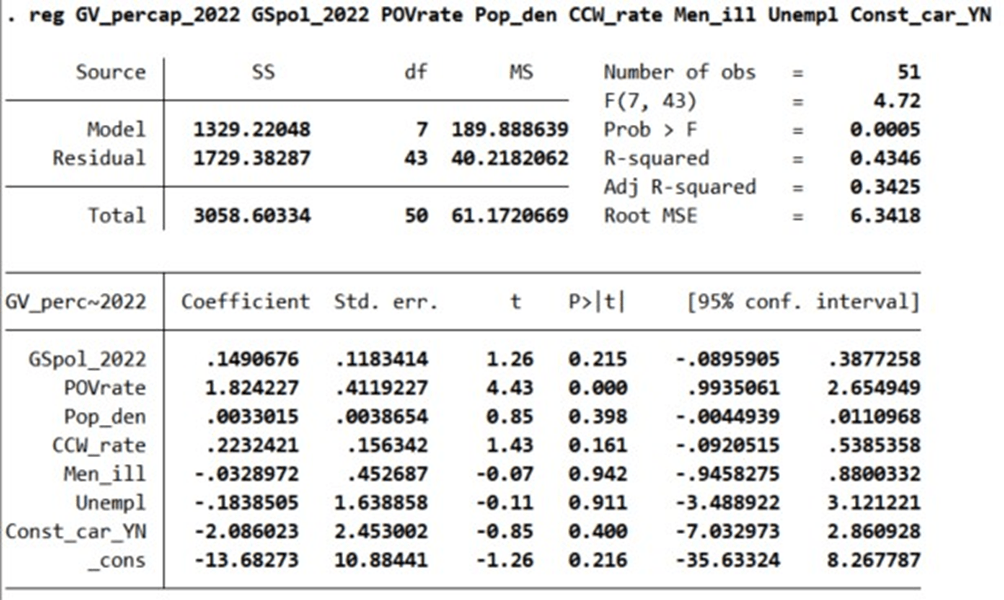
The fourth model is a complete model regressing all six explanatory variables plus a dummy variable for Constitutional Carry against the dependent variable “Gun violence per capita in 2022.” The model has an F-value of 4.72 and a Prob > F of 0.0005 making the model statistically significant at an alpha of .01 (three stars). The R-squared for the full model is 0.4346 indicating that it explains more than 43% of the determinants of gun violence. Of all the regressors, the only one that is statistically significant at any recognized alpha level is the poverty rate with a P > t value of 0.000 (three stars). The coefficient on the poverty rate is 1.824, implying that every 1.824 increase in the per capita poverty rate is associated with a 1-point increase in the per capita gun violence rate, a result that comes with little surprise. The coefficients on gun safety policies, population density, and the concealed carry permit rate were all positive implying that an increase in each of those is associated with an increase in gun violence, though none were statistically significant at any recognized level of alpha (0.215, 0.398, and 0.161 respectively).

The conclusion derived by the models is that increasing gun safety policies does not have a statistically significant negative effect on gun violence rates, and that states that have implemented Constitutional Carry laws have seen no statistically significant increase in gun violence rates greater than those that have not. According to this model, if America wishes to decrease gun violence rates, the most significant efforts should be directed toward reducing the rate of poverty.

Introduction:

Gun violence in America has risen dramatically over the past decade. Between 2014 and 2022, total incidents of gun violence increased by 74.5%, from approximately 25,500 shootings in 2014 to 44,200 shootings in 2022. During that same time period, states increased laws designed to protect against gun violence by an unprecedented 55.2%, from 627 total laws in 2014 to 949 in 2022. These gun law changes were not equally distributed among the states, however. States like Colorado, California, Illinois, Oregon, and Washington implemented significant increases in the number of gun safety laws on their registers, while other states, led by Arkansas, Georgia, Mississippi, and Oklahoma actually decreased the number of gun laws governing firearm ownership and usage in their states.

Much of the attention on incidents of gun violence by both the media and policy-makers is focused on mass shootings, typically defined as four or more dead including the shooter. However, this heinous act, while drawing the attention and wrath of the public, accounts for only about 1% of all gun violence incidents. The overall plague of gun violence is not well represented in the number of mass shootings. The focus of efforts to decrease gun violence in general should have an adverse impact on mass shootings as well, yet most of the policy measures implemented by state legislatures are instead focused on controlling this one-percent event.

There exists in this country a polar divide between liberal and conservative lawmakers on how to handle the gun violence problem. Policymakers on the left are convinced that gun safety legislation and gun control acts will decrease gun violence, while policymakers on the right are convinced that gun violence is a criminal problem brought on by weak prosecution and lax application of law and punishment by liberal prosecutors and a weak criminal justice system. Very little usage is made of the data available on gun violence, and much of that data is misleading or compiled in biased fashion. Most data on gun violence includes instances of suicide by firearm, accidental deaths, and police legal intervention, and these inclusions skew the actual problem of criminal firearm violence that is plaguing the community. Suicide by firearm alone makes up the majority of gun violence in this country, with suicides accounting for 56% of all firearm deaths. While suicide is a serious problem, it is a separate problem from the plague of gun violence, and as such, should be removed from any data sets analyzing firearm violence.

Gun violence continues to inflict devastating costs in lives lost across many parts of the United States. Over recent decades, debates have intensified over potential policy and legislative strategies to curb firearms deaths. Some advocate for stricter state limits on gun purchases, possession regulations, and investing in prevention programs. Others argue additional restrictions fail to impact violent offenders while impeding the rights of law-abiding gun owners. 

Disentangling the complex linkages surrounding gun policies remains imperative but challenging. This study seeks to provide state-level empirical evidence using data regression models evaluating the direction and degree of association between, among other things, stricter gun safety legislation and gun violence rates from 2014 to 2022. Controlling for underlying socioeconomic drivers such as poverty, unemployment, and mental illness rates, this study will test for the factors that influence the rising rates of gun violence. Understanding the trajectories of firearm-related deaths amidst a patchwork of diverging state laws stands essential to move towards solutions balancing individual rights with violence prevention. This analysis investigates the role legal restrictions may play in shaping overall gun violence outcomes across locales providing longitudinal evidence integral to an issue central to public safety and public discourse alike.

Organization:

In this paper, I’ll first discuss the related literature and studies done in the past. The study of the determinants of gun violence has been attempted by numerous scientists in a wide variety of fields. As gun violence grows, trying to solve why it occurs becomes ever more crucial. This paper will examine some of the related studies and the polar conclusions that have come from these varied efforts to understand this phenomenon. I’ll then explore the explanatory variables that I’ve determined are most likely to be important in determining causation for gun violence. After discussing the meaning and significance of the explanatory variables, I’ll go over the models I’ve run.

For this study, I’ve chosen four models that I felt were the best explanatory models for the regression variables. While these four models only begin to scratch the surface of this serious problem in America, they do bring some surprising conclusions that I’ll discuss in depth. Following the outline of the models, I’ll go over the data that I compiled to prepare this paper. This data, grabbed from numerous sources and checked carefully for reliability and accuracy, is extensive but not necessarily thorough, a problem I’ll address in the conclusion. The data and descriptive statistics section will have tables showing the variables and their ranges, followed by a matrix and some scatterplots showing the level and magnitude of correlation between the variables, and then looking at the statistical significance of both the regressors and the models themselves.

Finally, the paper will conclude with a discussion of the purpose of the study, the key findings, the policy implications, and some suggestions of where we need to go from here.

Related Literature:

There have been numerous previous studies regarding gun violence. The Rand Corporation (Rand, 2018) has compiled a list of many of these studies into the determinants of gun violence. One such study by John Lott and David Mustard, (Lott and Mustard, 1997) found that states that had “shall-issue concealed carry” laws observed a decrease in violent crime, murders, rapes, and assaults. Lott would partner with John Whitley and Florenz Plassman a few years later, (Lott and Whitley, 2003) to confirm these findings, specifically that an annual reduction in murder rates between 1.5 and 2.3 percent occurs for each additional year that a right-to-carry law is in effect. Ian Aryes and John Donohue, publishing in the Yale Law School Repository, found that shall-issue states saw an increase in more crime categories than saw a decrease (Aryes and Donohue, 2003), a finding that Lott and Whitley found great fault with, and Donohue alone later found that effects were mixed and sensitive to model specifications and data (Donohue, 2003). According to Rand, nearly all of the early studies into the analysis of shall-issue states failed to control for serial correlation in the panel data set and that led to gross exaggerations of the statistical significance of the study results while elevating the risk of finding effects that were in the opposite direction of the true effect (Rand, 2018).

Mark Gius published a study in the Royal Statistical Society in 2014 that showed that assault weapons bans have no statistically significant effect on gun-related murders, and that permissive concealed carry laws may actually reduce gun-related murders. Gius found that states with more restrictive concealed carry laws had gun-related murder rates that were 10% higher than those states that had less restrictive laws (Gius, 2014). In 2013, Michael Siegel, Craig Ross, and Charles King published a study for the American Public Health Association that found that there was a robust correlation between higher levels of gun ownership and higher firearm homicide rates, although they were not able to determine causation in their study. (Siegel, et al, 2013)

There seems to be little doubt that although there have been dozens of these studies all with similar goals and supposedly similar data sets, much of the research into this phenomenon has been flawed or biased in one way or the other. Inclusion of suicide statistics, accidental deaths, and legal intervention, along with misinterpretations of causation have created flaws in many of the research to date. While it likely exists, I was not able to find any regression analysis using the same or similar explanatory variables to the ones I’ve used for this study.

Descriptive Statistics:

Table 1
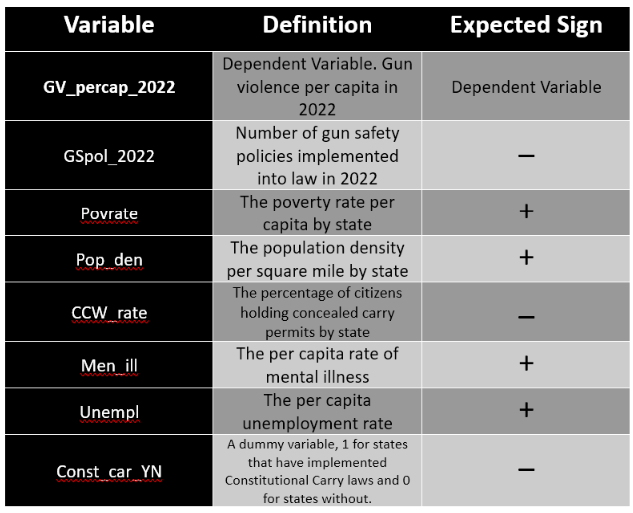
Table 1 shows the descriptions and sign estimates for the variables in my analysis. When looking at gun violence per capita, I’ve collected numbers for all fifty states plus the District of Columbia. The first variable is gun violence per capita in 2022. This is the dependent variable, and the variable for which I’m attempting to find the determinants. The first explanatory variable is the number of gun safety policies by state in 2022. States have the Constitutional right to decide the relative strength or weakness of their own gun laws provided such laws do not violate the Second Amendment to the U.S. Constitution. As such, there is wide disparity in the number of gun safety policies legislated into the laws of each state. For this study, I identified 54 possible gun safety or gun control laws that are present in the laws of the various states. The implementation of those potential laws is widely disparate, with a minimum of just three in Mississippi, to a maximum of 45 in California. These various laws and policies include things such as a ban on “assault weapons,” a ban on high-capacity magazines, background checks, waiting periods for firearm purchases, minimum ages to purchase a handgun, whether or not firearms are allowed on school grounds, in bars, or in state buildings, seizure laws for domestic abusers and felons, castle doctrine, duty to retreat, gun-show loophole closures, and many more. The expected sign of the coefficient for this variable is negative as I expect that states that have taken the greatest efforts to control firearms will see the lowest number of incidents of gun violence per capita.

The second regressor is the poverty rate per capita. This ranges from a low of 7.42 in New Hampshire to a high of 19.58 in Mississippi. As I anticipate that higher poverty is correlated with higher rates of crime, the expected sign of the coefficient for poverty rate is positive. The third regressor in the chart is the population density. Population density ranges from a low of 1.3 persons per square mile in Alaska to a high of 11,295 persons per square mile in Washington D.C. The second highest population density in the United States is in New Jersey, with a density of 1263 people per square mile, making the Washington D.C. figure an outlier in the data. In addition to this outlier, Washington D.C. also showed an outlier in gun violence per capita with a number of 105.388, with the second highest rate being Louisiana at 37.035. To avoid skewing the data with these outliers which are genuine values and not data errors and should be included in the regressions, I chose to treat them by trimming them both under the Winsorisation approach. As I anticipate that more dense populations provide for more opportunities for crime, the expected sign of the coefficient is positive.

The third regressor in the list is the rate of concealed carry licenses issued in the state. States that license their citizens to carry concealed weapons vary widely between “shall issue” and “must issue” states, and courts have repeatedly held that denial of a permit to carry a concealed pistol must be accompanied by specific and justifiable reason. Some states make it very easy to obtain this license, and some make the process as arduous as possible while attempting to avoid being sued. This permit issuance rate varies quite widely from 0% in Vermont and Hawaii up to 32.5% in Alabama. Hawaii issues very few licenses and essentially requires that permit applicants provide a valid reason and qualifiable necessity that has yet to be challenged, while Vermont is at 0% simply because the state has never required a permit to carry a concealed firearm, and thus has never issued such permits. The sign of the coefficient on this variable is rather tricky to estimate as there are two very reasonable schools of thought. The first is that more people carrying concealed firearms makes it less likely that criminals will engage in firearm violence knowing that citizens around them are more likely to be armed and willing to engage them. In this case, I would expect the sign of the coefficient to be negative. However, the other reasonable school of thought is that more people carrying concealed firearms equates to more guns in public and therefore more opportunity for gun violence to occur, a scenario where a positive sign on the coefficient would be expected. For this paper I have estimated that the first scenario is more likely than the second as criminals intent on firearm violence are not dissuaded by laws requiring them to obtain a license, but that beneficent individuals who might stop such gun violence will tend to follow the law and therefore may not be armed without a permit, depending on how arduous the permitting process is. Therefore, the expected sign of the coefficient here is negative.

The next variable is the rate of mental illness. Although I expected mental illness rates to have very little deviation among states, there is significant disparity. The per-capita rate of diagnosed mental illness ranges from a low of 16.37 in New Jersey to a high of 26.86 in Utah. I have anticipated that much gun violence is a result of mental illness, and thus have assigned the expected sign of the coefficient to be positive.

The unemployment rate of the state is the next regressor, and I’ve estimated the sign of the coefficient to once again be positive. The more unemployed people a state has, the greater the chance of gun violence through either necessity or ennui. I also anticipate that unemployment leads more often to increased gang affiliation, particularly among the youth, and since gun violence and gangs are likely to be correlated, I anticipate higher unemployment rates leading to higher incidents of gun violence.

The final coefficient on this list is a dummy variable representing whether or not the state has implemented Constitutional Carry laws—the right to carry a concealed firearm without a state-issued license. For the same reasons outlined in the variable for the rate of concealed carry licenses issued by states, I anticipate the expected sign of the coefficient here to be negative.

Models:

Model 1

Due to the complicated nature of this study, I’ve identified four regression models to use in the analysis. The first is a two-part, partial model that tests for both unconditional and conditional convergence between states from 2014 and 2022. I want to see if states with lower initial levels of gun violence tend to converge with states with higher levels of gun violence both with and without controlling for other factors such as gun safety laws and socioeconomic concerns. For model 1A, I used a log-log model where I took the natural log of the difference in gun violence by state between 2014 and 2022 and regressed that against the natural log of the steady-state gun violence rate in 2014. The model equation is as follows:

where Y is the natural log of gun violence in 2022 minus the natural log of gun violence in 2014, and X1 is the natural log of gun violence in 2014. The regression results are:

In this regression model, convergence between states with lower initial levels of gun violence and those states with higher levels is indicated by a negative coefficient on the natural log of the initial level in 2014. Here we see that the coefficient is actually positive, indicating that we have divergence between these states. The coefficient itself however is close to zero with a value of .01796, meaning that the divergence is marginal if it exists at all. This model tests for unconditional convergence without controlling for any conditional differences in state demographics or efforts toward gun violence prevention. The next model looks at convergence in a conditional sense, controlling for these variables.  The equation of the conditional convergence model is:

where ln Y is again the natural log of gun violence in 2022 minus the natural log of gun violence in 2014, and X1-X5 are the natural logs of the regressors. The regression results are:
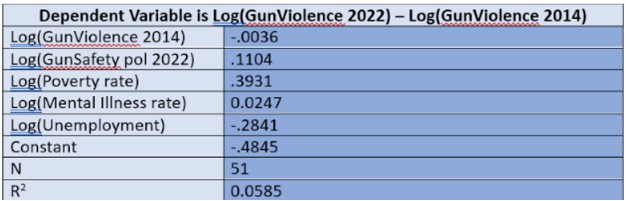
In this model, we see evidence of conditional convergence indicated by the negative coefficient on the variable the initial rate of gun violence in 2014. However, similar to the previous model, the magnitude of the coefficient is very close to zero, even closer to no effect in this model with a measurement of -.0036. This magnitude is small enough that there is little confidence in the statement that states with lower initial levels of gun violence tend to converge with states seeing higher initial levels.

Model 2

Model 2 is a partial model examining the effect of gun safety laws, otherwise known as gun control laws, on the rates of gun violence. For this model I’ve used data from 2014 and from 2022 on both gun safety laws and gun violence. During this eight-year period, gun violence has increased by 74.5% while gun safety policies across the nation have increased by 55.2%. In 2014, American states had a total of 627 gun control laws, a number that grew to 949 in 2022 mostly due to an increase in high profile mass-shooting events like the Aurora theater shooting in Aurora, Colorado in 2012 that killed 12 people, the Orlando nightclub shooting in 2016 that killed 49 people, and the Route 91 Harvest Festival shooting in Las Vegas in 2017 that killed 60 people.

For this database, I relied on gun safety laws identified by Giffords Law Center to Prevent Gun Violence, a non-profit organization that has a charter to prevent gun violence. Giffords scorecard methodology is detailed and transparent, and although their grading of states may be biased, their sourcing of historical data on state law changes is sound. Giffords has identified state gun laws in several policy areas such as background checks, weapons bans, sale and transfer regulations, gun owner accountability, consumer safety, guns in public, and investigative tools for gun violence. In total, Giffords has identified 54 potential gun control laws currently on the books in at least some states. (Giffords, 2022)

Gun control measures have not been uniformly implemented by states, and some states have in fact reduced the number of gun safety laws during this time period. Eleven states in total either reduced or maintained the number of gun control laws between 2014 and 2022, led by Mississippi which had six gun safety laws in 2014 and only three in 2022, a 50% reduction. The remaining 39 states plus Washington D.C. all increased the number of gun safety laws during this time period, led in total number of new laws by Colorado which added 21 laws, and in percentage of new laws by Vermont which legislated an increase from four laws in 2014 to 18 laws in 2022, a 350% increase.

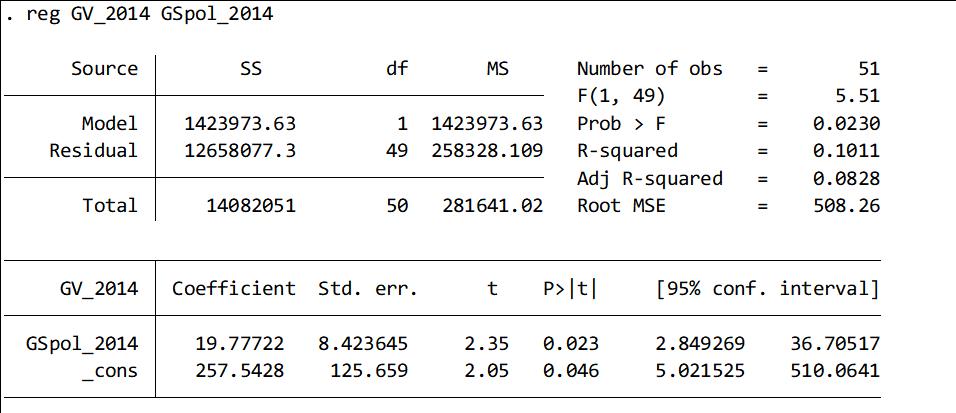
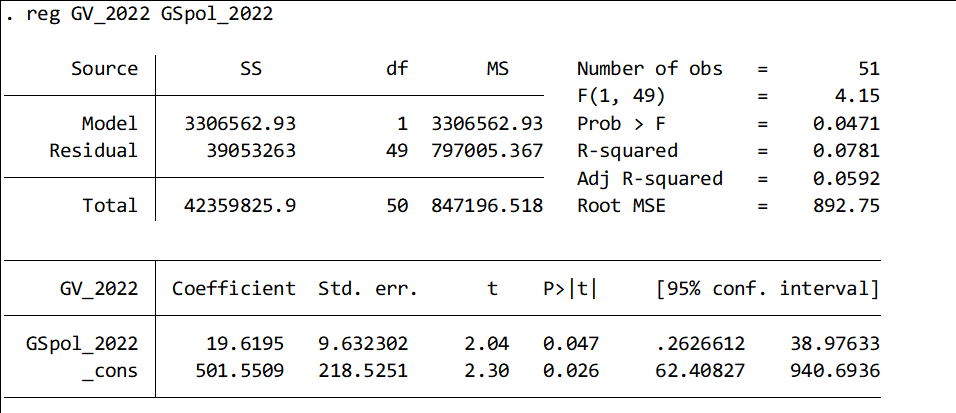
For this model, I first regressed the dependent variable “gun violence rate in 2014” with the explanatory variable “gun safety policies in 2014,” followed by the same regression for 2022 numbers. Both of these models were statistically significant at an alpha of .05 with the 2014 model showing an R-squared of .1011 and the 2022 model an R-squared of .0781. The coefficient on gun safety policies was nearly identical for both years at a value of 19.777 for 2014 and 19.62 for 2022, indicating an increase of a little less than 20 incidents of gun violence for every gun safety measure enacted for both years, the similar coefficients indicating a steady state of gun violence despite the growth of gun safety policies.

Regressing Gun Violence rates in 2014 with Gun Safety Laws in 2014.
Regressing Gun Violence rates in 2022 with Gun Safety Laws in 2022.
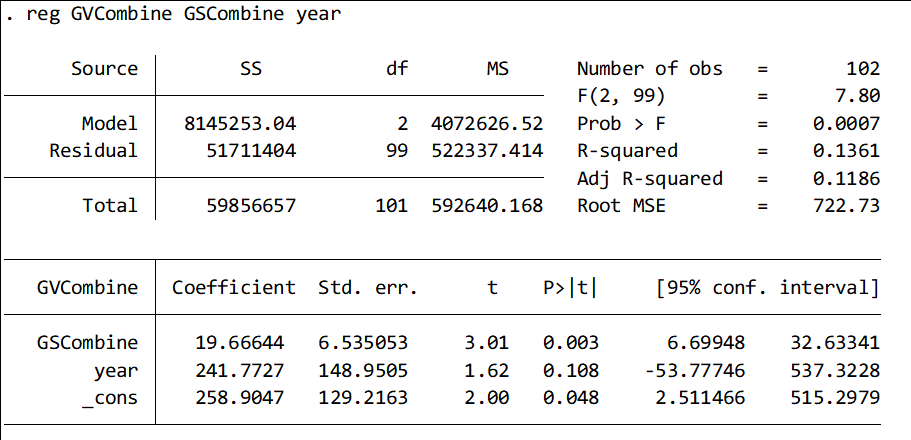
To further test this, I stacked both gun violence incidents and gun safety laws for both years and regressed those stacks with a dummy variable called “year” with a zero representing 2014 and a one for 2022. This model returned an almost identical value on the gun safety coefficient with a value of 19.666. The coefficient on the dummy variable was 241.77. The positive coefficient indicates that gun violence levels in 2022 (dummy=1) are higher by 241.77 cases compared to 2014 levels (dummy=0 baseline) after controlling for differences in gun safety laws, suggesting that gun violence has increased from 2014 to 2022 by around 242 shootings, holding gun laws constant in the model. The size of 242 cases is a meaningful effect size indicating rising gun violence post-2014.

The combined model had an overall P-value of 0.0007, and the P-value of the combined gun safety explanatory variable was 0.003. The model and the explanatory variable are both statistically significant, and the R-squared for the stacked model is 0.136, indicating that gun safety laws explain 13.61% of the variation in gun violence. The positive value of the coefficient on gun safety indicates that for every gun control law implemented between 2014 and 2022 approximately 20 additional gun violence incidents were observed. My initial estimate of this coefficient was that it would be a negative value, so these results were surprising. Although it is unlikely that implementing gun safety regulations causes an increase in gun violence rates, and more likely that states with higher gun violence tend to implement more gun control laws, the model is clear that the null hypothesis must be rejected and there is no evidence to support the notion that gun control laws decrease gun violence.
This conclusion was so surprising that I had to regress a few more things by setting up dummy variables first to test if only states that INCREASED gun control laws saw a decrease in gun violence rates, and second to see if states that increased those laws by 25% or more saw a decrease. In these regressions, both of these coefficients on gun safety policies remain positive with almost identical values of ~15, however the P-values at 0.226 and 0.264 respectively show that they are not statistically significant. Either way, we fail to reject the null hypothesis and have to state that there is no evidence to support the notion that gun control legislation adversely impacts gun violence rates as was anticipated.

Model 3

In model three I wanted to see if states that have implemented Constitutional Carry laws have seen an increase in gun violence incidents over states that have not done so. Constitutional Carry is defined as the rights of the citizens of a state to carry a concealed firearm without a permit. Prior to 2014 only five states granted their citizens this right (AK, AZ, AR, VT, WY). The remaining 45 states had varying laws between “shall issue,” the requirement that providing a citizen isn’t statutorily prohibited from having or carrying a firearm, the state must provide a concealed carry license, which may require testing and training, and “may issue,” which leaves the decision to issue the license up to the discretion of the issuing authority in the state, typically the county sheriff. In “may issue” states, the applicant is typically required to provide supporting evidence to show that they have an actual need to be armed, along with character references and possibly additional documentation that shows good character, while in “shall issue” states the applicant must only pass the background check and occasionally the requirement to attend classroom training and qualification testing on a gun range.

Between 2014 and 2022, twenty additional states changed their laws from either shall issue or may issue to Constitutional Carry, removing the licensing requirements entirely. Two additional states have added this law here in 2023, but since this dataset is for 2022, those states were removed from this model. It should also be noted that the only remaining “may issue” states today are Connecticut and Delaware, and both of them are likely to be forced to remove this discretionary aspect due to the Supreme Court case NYSRPA v. Bruen in 2022 in which the New York State Rifle and Pistol Association challenged the state of New York’s “may issue” law. The Supreme Court held that New York’s 1911 Sullivan Act requiring concealed carry applicants to show “proper cause” to apply for a license was a violation of the rights granted under the Second Amendment (Root, 2022). Prior to this case in 2022, eight states were “may issue” states, and in 2022 there were a total of 27 states with Constitutional Carry laws.
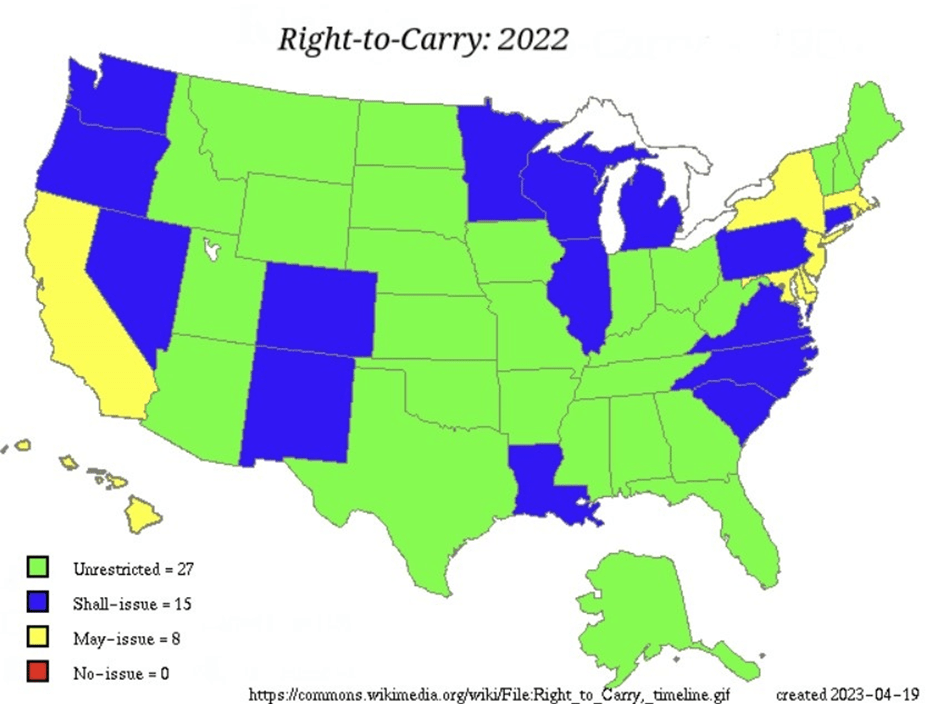
The addition of 20 states to list of Constitutional Carry states between 2014 and 2022 made for an interesting database to determine the effect of this important change of law on the rates of gun violence. Advocates of Constitutional Carry insist that criminals have always carried concealed firearms without regard for the law, and hurdles that make it more difficult for law-abiding citizens to acquire a concealed carry license serves no lawful purpose. Many also insist that law-abiding citizens having concealed firearms will cause criminals to reconsider violent crimes and lessen the potential victim pool. Detractors of these laws claim that adding more firearms to the streets will only increase gun violence incidents. My estimate was that the former was most likely to be true, thus the negative anticipated sign of the coefficient.

For this model, I was interested in the growth rate of gun violence between 2014 and 2022 in those states with Constitutional Carry and those without. I created the dependent variable (logdiffGV) which is the natural logarithm of the difference between gun violence in 2014 and gun violence in 2022, and the independent variable (logGV14) which is the natural logarithm of gun violence in 2014. I then created a dummy regressor variable for the 20 states that added Constitutional Carry during the same time period, using one for those CC states and zero for the 30 states (plus Wa. D.C.) that either already had Constitutional Carry, implemented it in 2023, or do not recognize this still today. The regression results show a coefficient of .009385 on the independent variable (logGV14) indicating that controlling for states with Constitutional Carry, gun violence has increased by less than 0.1%, meaning that while there has been an increase in gun violence in these states over states without Constitutional Carry, the magnitude of the increase is miniscule. The 95% confidence interval for this coefficient is -.0497 to .0685, and the P-value is 0.743, indicating that the regressor is not statistically significant at any level of alpha, nullifying any definitive conclusion.

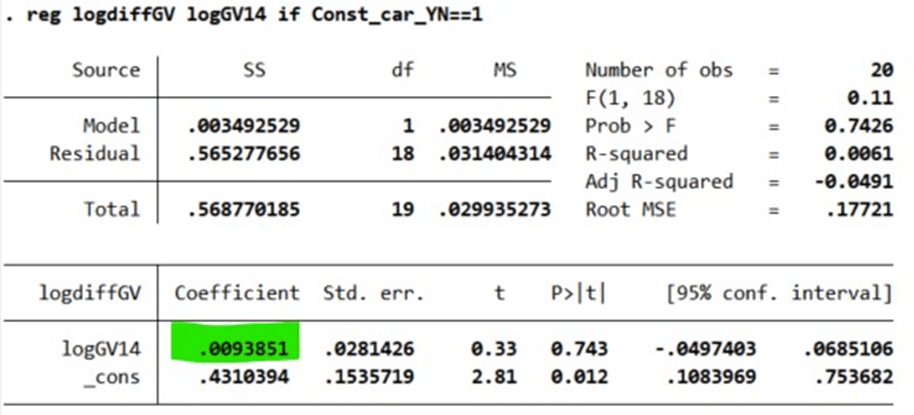
The dismally low R-squared of 0.0061 with an adjusted R-squared of -0.0491 shows that not only is the variable not statistically significant, Constitutional Carry laws have little to no explanatory power for the explosive growth of gun violence between 2014 and 2022. In conclusion, there is no evidence to support the notion that Constitutional Carry laws have any impact (positive or negative) on gun violence rates.

Model 4

The final regression model for this analysis is the full model with all explanatory variables and the rate of gun violence per capita in 2022 as the dependent variable. This model uses the three key variables I identified (gun safety policies in 2022, the poverty rate per capita, and the rate of concealed carry permits or Constitutional Carry) as well as the three lessor explanatory variables (population density, the per capita rate of mental illness, and the unemployment rate). The model has an overall significance level of three stars with a P-value of 0.0005, making the model statistically significant at all levels of alpha. The R-squared for the overall model is 0.4346 indicating that this model explains about 43.5% of the variation in gun violence per capita.

Gun safety policies in 2022, the poverty rate, population density, and the rate of concealed carry permits all have positive coefficients, while the unemployment rate and the dummy variable for Constitutional Carry have negative coefficients. The only variable that is statistically significant at any level of alpha is the poverty rate with a P-value of 0.000. The poverty rate also has the largest positive value at 1.824, indicating that for every unit increase in the poverty rate there is a 1.824 unit increase in the rate of gun violence. Since this variable is the only one that is statistically significant, the poverty rate is the most reliable indicator of gun violence per capita in all states for the explanatory variables in this model.

Data and Descriptive Statistics

Table 2

Table 2 shows the descriptive statistics of the variables used in the preceding regressions. The observations for all variables numbers 51—the 50 U.S. states plus the District of Columbia. An important note about the statistics for the District of Columbia. Washington D.C. is the most population dense variable and also has the highest rate of gun violence per capita, by far. These numbers were so much larger than the next closest number that they were actually outliers in the data. In order to avoid having these outliers adversely impact the standard errors, it was necessary to treat these outliers. There are several scientifically legitimate ways to deal with outliers, and the method I chose was Winsorization—reducing the outliers to their next largest values. The true values for gun violence per capita for Washington D.C. is 105.388. This was reduced to the next largest value, that of Louisiana at 37.05. The true value for the population density of Washington D.C. is 11295 persons per square mile, and this value was reduced to the value for the next largest, New Jersey at 1263 persons.

Table 3
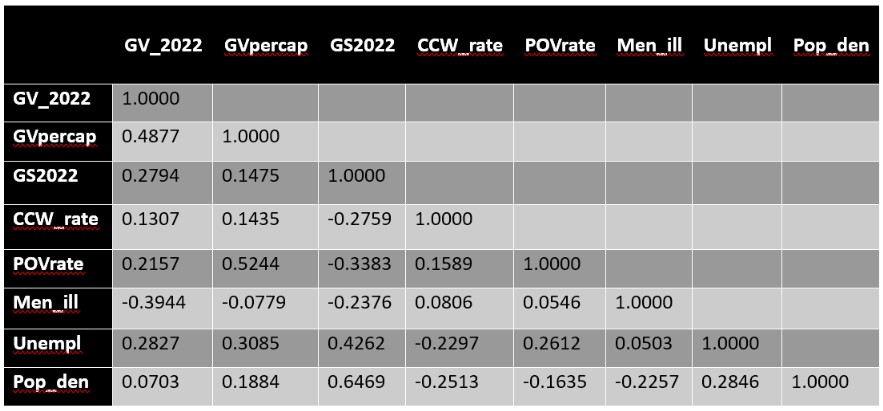
Table 3 is a matrix of correlation coefficients with the primary explanatory regressors used for this analysis. There are several correlation coefficients that are of interest in this matrix. The first is the correlation between gun violence in 2022 (GV_2022), and gun violence per capita in 2022 (Gvpercap). If gun violence was equally spread amongst the states, we would expect perfect correlation between these two regressors, however, the correlation is only 0.4877, indicating that gun violence is somewhat concentrated in some states regardless of population. Another measurement of interest is the correlation between gun violence in 2022 (GV_2022), and the number of gun safety policies embedded into law in 2022 (GS2022). As gun safety laws increase, we hope to see gun violence rates falling, a correlation that would result in a negative number, but here we see a positive correlation, indicating that increased gun safety policies are associated with increased gun violence.

The largest correlation present is with the poverty rate per capita (POVrate) and gun violence per capita in 2022 (Gvpercap). This correlation of 0.5244 would seem to indicate that poverty and gun violence go hand-in-hand, a result that is perhaps not too surprising, but interesting nonetheless. A final item of interest in this correlation matrix is the negative coefficient on the correlation between the number of mentally ill persons per capita (Men_ill) and gun violence in 2022 (GV_2022). This negative number would seem to indicate that increased mental illness is associated with a decrease in gun violence, the opposite of what we might expect. It’s possible that gun laws prohibiting access to firearms by those diagnosed with a mental illness may be effective in curbing a measurable amount of gun violence.

Scatterplots

Scatterplot 1: gun violence per capita and gun safety policies
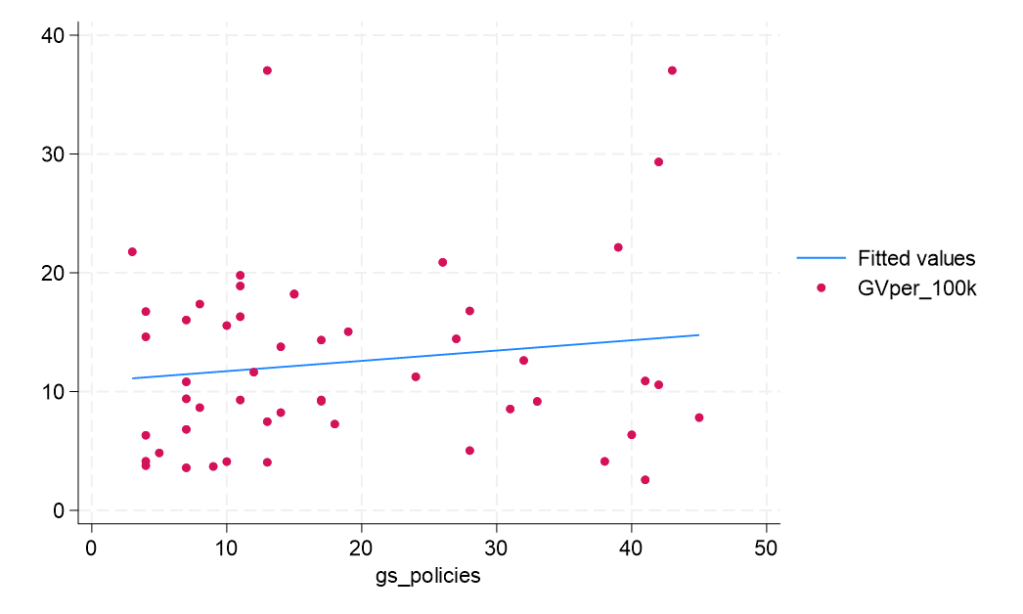
Scatterplots provide a visual depiction of the correlation coefficients matrix. In scatterplot 1, the fitted regression line shows the very slight positive correlation with states that have implemented more gun safety policies seeing higher incidents of gun violence per capita.

Scatterplot 2: gun violence per capita and the poverty rate

Scatterplot 2 shows a strong, positive correlation between the poverty rate and gun violence per capita. This fitted regression line depicts this highly correlated pair, with a small standard error evident in the closely spaced data points.

Scatterplot 3: gun violence per capita and population density
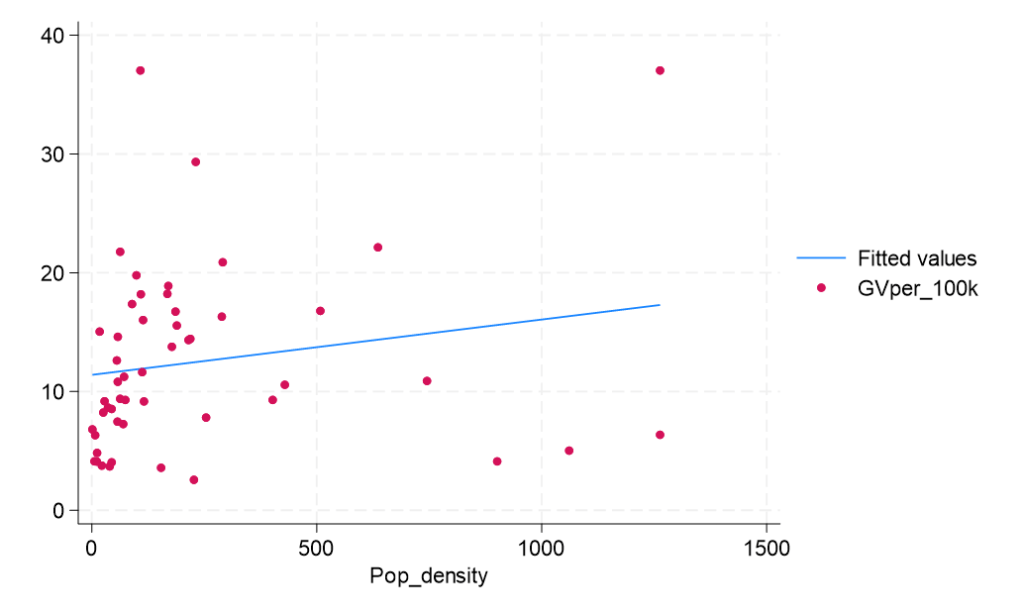
In scatterplot 3, we see the slight positive correlation between the population density and gun violence per capita. There’s a lot of room in America, and as such, the 51 observations are congregated toward the left of the chart. However, there is a clear upward trend in the datapoints that shows that although it’s a small correlation, higher population densities are associated with higher incidents of gun violence.

Scatterplot 4: gun violence per capita and the concealed carry permit rate
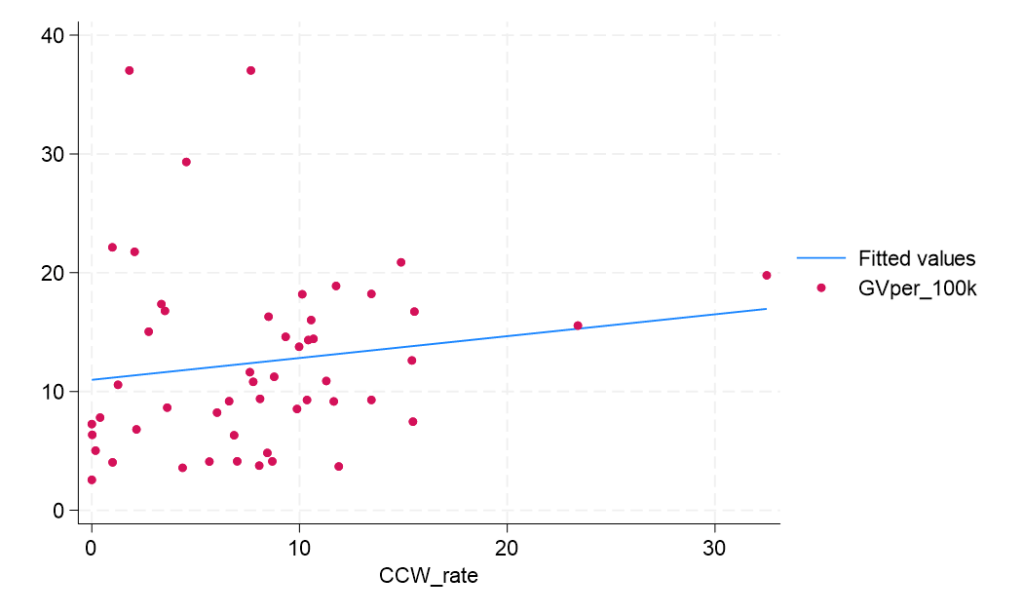
This scatterplot shows the results of the correlation between the rate of concealed firearm carry permits issued and the rates of gun violence per capita. This data may be somewhat misleading or unreliable due to the number of states that don’t require a permit to carry a concealed firearm. Since 2014, 22 states have dropped the requirement of its citizens to endure the process of applying for a permit, allowing concealed carry without any permit.

Scatterplot 5: gun violence per capita and the rate of mental illness

Scatterplot 5 shows the surprising results of the correlation between mental illness and gun violence per capita. My initial anticipation for this regressor was that mental illness would have a positive correlation with gun violence, but this scatterplot clearly shows the reverse is true. Higher incidents of confirmed mental illness are consistent with declining rates of gun violence, a result that may be consistent with the vast majority of states prohibiting gun ownership to anyone diagnosed with serious mental health issues.

Scatterplot 6: gun violence per capita and the unemployment rate
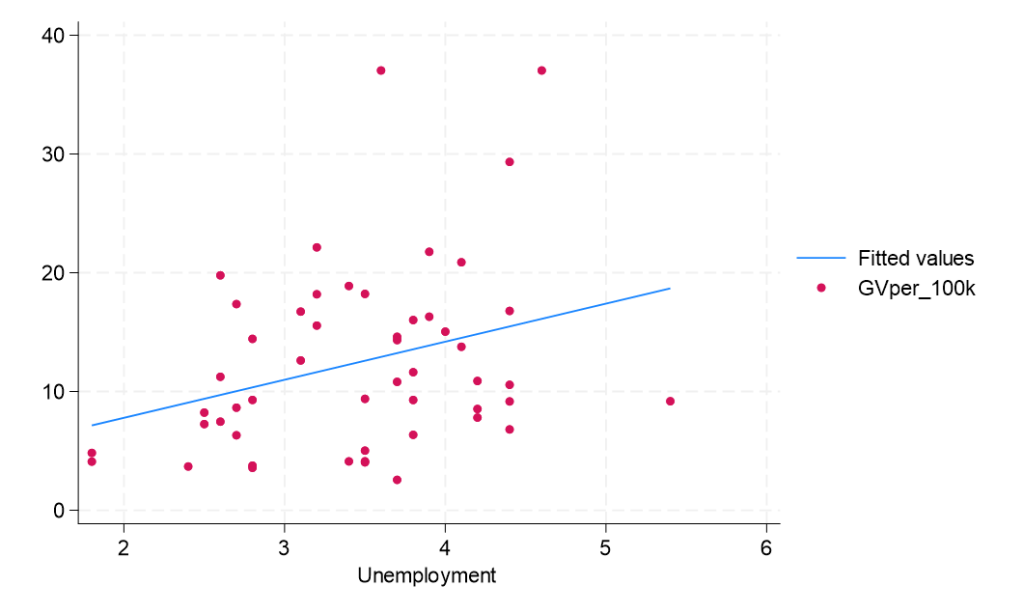
With a positive correlation between the poverty rate and gun violence, it should come as no surprise that we see a similar positive correlation between unemployment and gun violence. Scatterplot 6 depicts that correlation, a medium correlation but undeniably positive.

Empirical Results

Table 4

In table 4 I’ve taken the regression results from the full model (model 4) and placed the explanatory variables into a table to more easily view and understand their values and the meanings and implications of those values.

From this table, it’s easy to see that my initial expectations were vastly different from a few of the results. I fully expected higher numbers of gun safety policies to result in lower incidents of gun violence, but from the coefficient, it’s clear that this is not the case. The rate of concealed carry also shows a different than expected sign, however, I was initially ambivalent about those results as I could see merit in the argument of both gun control advocates and Second Amendment defenders as to how allowing more guns into the public could affect gun violence. For the rate of mental illness and the unemployment rate, I anticipated those to both have a positive correlation toward gun violence with incidents rising as those rates increased, but it’s easy to see that this data shows the opposite, albeit with P-values well outside the bounds of any acceptable statistical significance.

There were 51 observations for this model, all 50 U.S. states plus Washington D.C. The model has an R-squared of 0.4346 indicating that it explains a little more than 43% of the variation in gun violence rates amongst the states. The calculated F-value is 4.72, and the probability of observing a value greater than F is 0.0005 making this model statistically significant at an alpha of 0.01 (three stars).

Conclusion

The purpose of this paper was to examine the alarming increase in gun violence over the past decade and attempt to identify some of the causes of that increase. America is diametrically divided over guns and the root causes of gun violence, particularly the mass shootings that make up such a small percentage of gun violence but capture so much of the attention of the American psyche. Political narratives and talking pundits have only served to further entrench the often mistaken or uneducated viewpoints of the majority of Americans, and social media has become a cesspool of screaming, faux intellectual idealogues who are convinced that their viewpoint is the correct one, despite the nuance of this incredibly complex problem.

Are guns the root cause of gun violence? Well, sure, the same way that cars are the root cause of fatal automobile accidents. The solution to the problem of auto-related fatalities is not to get rid of cars because our society relies too heavily on rapid and reliable transportation to possibly justify eliminating them. And the solution to the problem of firearm violence is not to get rid of guns. Not because we need them, but because we absolutely can not get rid of them. The United States of America is founded on the principles of a Constitution and a Bill of Rights that grants certain rights to its people. The Second Amendment guarantees U.S. citizens the right to “keep and bear arms,” and the political divisions in this country ensure that this amendment will not be repealed in the foreseeable future. In addition, firearms outnumber people in this country. This is what makes laws that attempt to reduce firearm access or ownership so futile. None of these things are going to change, regardless of efforts or attempts to do so. It’s only when we understand and accept that fact that we can attempt to make meaningful progress toward reducing gun violence.

With this research paper, I wanted to take an unbiased approach to the causes of gun violence. Although I have personal biases regarding this subject, as do most people, I did my utmost to set them aside and compile unbiased data and come up with hypotheses that were completely objective. I was fully prepared to discover that gun control laws decrease gun violence, or that Constitutional Carry laws are associated with increased firearm fatalities. The data was derived from unimpeachable sources that are highly respected by both political divides, and I did my best to fact-check or cross-verify every source that I used.

The key finding of this paper is a difficult one for many to accept—gun safety laws do not have a meaningful negative impact on gun violence rates, despite what politicians may claim. Other findings may be surprising as well. Constitutional Carry states, and states with higher numbers of concealed carry permit holders do not see a statistically significant increase or decrease in rates of gun violence. Mental illness rates are not a reliable indicator of gun violence, and in fact, increased mental illness is associated with decreased levels of gun violence. Finally, the most important finding, and the only one that was statistically significant in every regression ran, higher poverty rates per capita are associated with sharp increases in gun violence rates.

One surprising state that has done a great job in controlling the rate of gun violence is California. In 2022, California had a gun violence per capita (100k people) of 7.812. This puts them at 14th in the country, and since 2014, California has seen an increase in gun violence of 47.7%, far below the national average of 74.5%. California also has the most gun control laws of any state in the union at 45. Politicians like Governor Newsom love to soapbox these stats and claim a correlation along with causation, but the results of this study make it clear that increased gun laws are not associated with decreased gun violence. However, it is clear that California is doing something right when it comes to gun violence. The poverty rate in California is 12.58%, putting them right at the national average of 12.595%, so lower poverty is not the cause of California’s gun violence success. It would be a wonderful surprise if the politicians of that state would decide to actually look at the facts and the data and determine what it is they are actually doing right instead of grandstanding with performative speeches associating their highest-in-the-nation gun control laws with lower rates of gun violence.

Washington D.C. has so much gun violence that the number was an outlier that had to be Winsorized to avoid contaminating the regressions. Gun violence per capita in D.C. in 2022 was 105.39, well above the next highest on the list, Louisiana at 37.035. This is in spite of D.C. passing 43 gun control bills, just two fewer than California, and 30 more than gun violence runner-up, Louisiana.

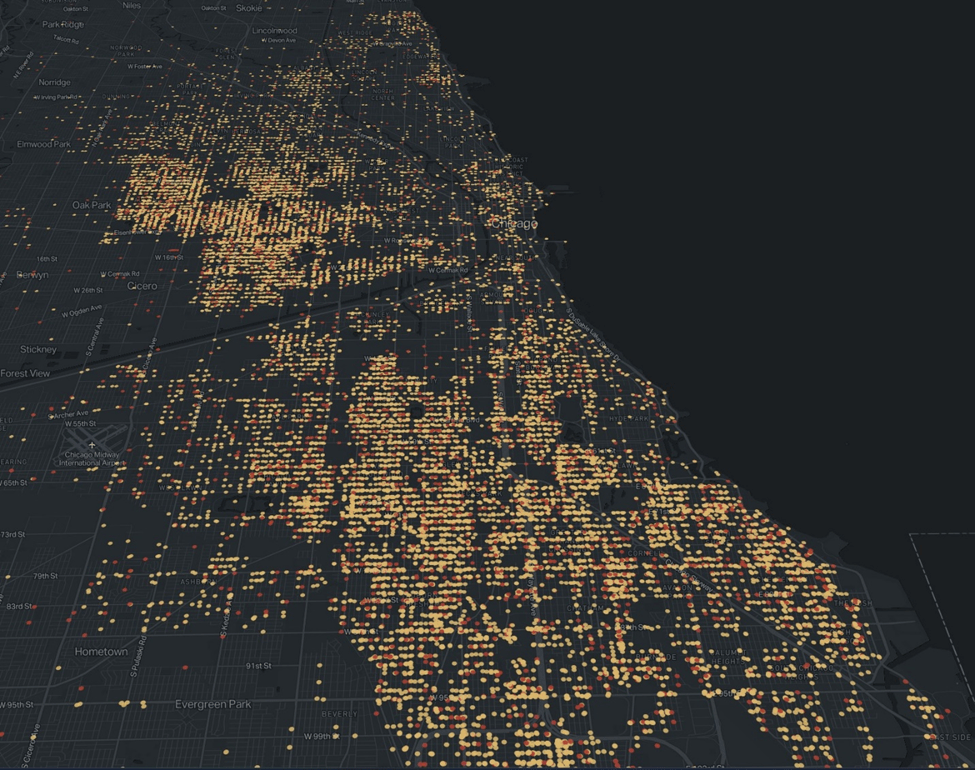
Not all gun violence is equally distributed. Chicago is notorious for its rampant deadly shootings. Illinois has a very high gun violence rate of 29.335 with the third highest number of gun safety laws in the country at 42. But most of Illinois is very safe, with a large percentage of its violence concentrated in Chicago. The gun violence per capita rate in Chicago is higher even than in Washington D.C., at 106.37. This is, however, down from 2021 when the gun violence per capita rate was an eye-popping 128.74. Even in Chicago itself, gun violence is not equally distributed with most incidents congregated in the southside and in the west. This should indicate to us that blanket gun safety laws that are not targeted toward the actual problem can not be expected to solve the problem.

Gun violence in Chicago from 2014-2022. Yellow dots indicate a shooting injury while red dots indicate a shooting death.
I have no doubt that some gun safety laws are useful and, if data could be compiled and regressed successfully on the impact of individual gun control laws, then we could identify the ones that are actually useful in combating gun violence. As of now, with the shotgun approach toward gun legislation, gun safety laws are performative only. They look good to politicians pandering to their liberal bases while accomplishing nothing useful and serving only to distract from any meaningful solution to this deadly problem. My hope is that this paper will serve to disseminate true factual data that will be used to actually combat gun violence and make a meaningful dent in the rising problem. In addition, we need to gather more and better data. Data on gang affiliation is spotty at best or doesn’t exist at worse. I suspect that much gun violence is gang related, but without that data, we can not make meaningful decisions or implement regulations that have a meaningful impact. Domestic violence is another area where I suspect much gun violence results. Although police departments are supposed to identify domestic violence incidents, this often doesn’t happen. While researching the data for this paper, I found many incidents where the association with domestic violence was listed as “unknown.” Clicking on the incident and reading the details, I found numerous incidents that were clearly DV related despite the “unknown” tag, and this is an important statistic. If any gun violence law is going to have a meaningful impact on gun violence rates, it would seem that keeping them out of the hands of convicted domestic abusers would be crucial, but we can’t know this for certain without solid and reliable data. Police departments need to ensure that this type of data is accurate at a much higher rate than it currently is. This type of data would assist in future analysis into the determinants of gun violence, and would allow policymakers to make meaningful changes to impact this persistent and deadly problem.

References:

Number of gun safety policies adopted per state:

https://sightmark.com/blogs/news/states-ranked-by-how-strict-their-gun-laws-are

Number of gun safety polices historical numbers:

Adult prevalence of mental illness:

Population rates for 2022:

https://en.wikipedia.org/wiki/List_of_U.S._states_and_territories_by_population

Historic population rates:

Number of shootings and deaths:

https://www.gunviolencearchive.org

https://www.thetrace.org/2023/02/gun-violence-map-america-shootings

Poverty Rates:

https://en.wikipedia.org/wiki/List_of_U.S._states_and_territories_by_poverty_rate

Population density:

https://en.wikipedia.org/wiki/List_of_states_and_territories_of_the_United_States_by_population_density

Concealed and permitless carry data:

Gang stats:

https://www.fbi.gov/file-repository/stats-services-publications-national-gang-report-2015.pdf/view

Unemployment data:

https://www.bls.gov/information-guide/home.htm

Data on firearm violence from 1993 to 2011:

Suicide rates:

https://everystat.org

Suicide rates by state:

https://www.cdc.gov/nchs/pressroom/sosmap/suicide-mortality/suicide.htm

US population growth by year

https://www.macrotrends.net/countries/USA/united-states/population#:~:text=The%20current%20population%20of%20U.S.,a%200.49%25%20increase%20from%202019

Gun policy research review:

https://www.rand.org/research/gun-policy/analysis.html

Gun death information

Other gun violence studies referenced:

Effects of Concealed-Carry Laws on Violent Crime – Rand Corp, Jan 2023

https://www.rand.org/research/gun-policy/analysis/concealed-carry/violent-crime.html

Paper on firearm ownership and correlation to homicide rates, Siegel, Ross, King:

https://ajph.aphapublications.org/doi/full/10.2105/AJPH.2013.301409

Gius 2014 study on shall issue states

https://rss.onlinelibrary.wiley.com/doi/full/10.1111/j.1740-9713.2014.00732.x

Lott and Mustard 1997

https://www.journals.uchicago.edu/doi/abs/10.1086/467988

Ian Ayres, John Donohue 2003

Wikipedia article on NYSRPA v. Bruen 2022

https://en.wikipedia.org/wiki/New_York_State_Rifle_%26_Pistol_Association,_Inc._v._Bruen#:~:text=In%20a%206%E2%80%933%20decision,guaranteed%20by%20the%20Second%20Amendment

Root, Damon. June, 2022. Reason.com. “SCOTUS Affirms Right To Carry a Handgun for Self-Defense Outside the Home.” https://reason.com/2022/06/23/in-landmark-2nd-amendment-ruling-scotus-affirms-right-to-carry-a-handgun-for-self-defense-outside-the-home/

International Travel in a Covid World (part two)

The first sign that something was amiss was when we pulled into the train station at the border crossing between Denmark and Germany. Danish soldiers dressed in urban camouflage and wearing snappy berets took positions on the platform at each of the doors and stopped travelers from either entering or exiting the train, their faces set in firm expressions of totalitarian authority. Other officers dressed in traditional police garb boarded the train, their faces serious and attentive, their hands staying close to their sidearms as they went seat-to-seat demanding papers, perusing the passports handed over by the wary passengers.

Wait. Firm expressions? Serious faces?

Yes, that’s right. I could see their faces. Those facial features were on full display. Because none of them, neither the soldiers guarding the doors, nor the police officers passing through the train were wearing masks. NO MASKS!

Viva la liberation de masks!

I waited until the officers had made their passport checks and left the train, and then asked an embarking passenger. “No mask requirements in Denmark?” “No,” he replied with a smile, his teeth flashing brilliantly in a display I’d missed over the last week. “No masks required on public transport, or anywhere really.”

What a magnificent sentence to hear.

Tracy and I stripped off our masks and wadded them into a ball, tossing them in the trash. We were free at last. Free of the scourge of idiocy that insisted mask wearing was useful in any way, shape, or form. Free of the performative regulation of clownish government leaders. Finally in a country that believed in science and followed logic in its laws and regulation. The passengers on this train ride were to be the last of the mask wearers that we would see for the next six days. All through our time in Copenhagen we saw next to zero masks. Everywhere we went we were greeted by smiling faces. Smiles. It’s hard to overstate how sucky it is to miss seeing smiles from people.

Far fewer than one in a hundred Danish citizens and visitors wear masks in public. Sure, you still see the occasional mask on someone in the hotel lobby, or in the subway station, or even walking down the street. But it is an anomaly. A curiosity really, something that draws your attention for the simple fact that it’s out of place, and the fact that it’s out of place and unusual is what makes it so divine. And that rare mask is in Copenhagen, the capitol city. I’m sure in smaller communities the number of masks is actually zero. After a couple of days, it actually becomes easy to forget that Covid is even a thing that the rest of the world is suffering. Everything in Copenhagen is just wide open, and the city is thriving.

This undoubtedly has to do with their vaccination status. A very strong 74.1% of the population is fully vaccinated, a number that puts them well into herd immunity status. As we were there, they were reporting only 7600 cases in the entire country, and only 30 people in serious condition in the hospital. The seven-day rolling average number of deaths was somewhere between one and two.

Between one and two deaths per day due to Covid. In the entire country of Denmark. Blissful.

There was some real concern that we wouldn’t be able to go to Sweden. Shortly before we arrived in Copenhagen, the Swedish government announced they were closing the country to all travelers from America. I was reasonably sure that though we were American, we were not considered “travelers from America” as we were certainly travelers from Denmark or possibly travelers from Germany by this point. There was nothing to fear though, as the announcement only applied to travelers arriving into Sweden by air. Our train from Copenhagen to Stockholm stopped for a brief moment at the border, and then continued on with nary an officer in sight checking documents or vaccination cards. Lovely.

We arrived in Stockholm and were once more welcomed by a country with no restrictions regarding masks, or vaccinations, or quarantines. Other than the air travel restrictions against Americans, which seems to be some sort of political gamesmanship as opposed to a serious health-related decision, Sweden was wide-open and welcoming. Sweden has a vaccination rate of 60%, far less than their neighbors to the southwest, but apparently still high enough that they aren’t worried about infections. They currently have 28,900 cases, of which 58 are serious enough to require hospitalization. Despite the higher numbers, their seven-day moving average number of deaths is just as low as Denmark, somewhere around two deaths per day. Again, a lovely number that allows the Swedish people to almost completely ignore the pandemic that is ravaging other parts of the world, the United States in particular.

With no restrictions on travel besides the ban on U.S. air travelers, there’s not much to talk about with regard to things to consider when traveling to the Nordic countries. There just isn’t anything to consider. It’s wide open.

Eventually, it was time to go, and we flew from Stockholm back to Berlin. There was a mask requirement at the airport in Stockholm, however, most travelers were completely ignoring the mandate, and nobody was enforcing it. When we boarded the plane, the flight attendants did request that everyone wear a mask, and they were handing them out to passengers who didn’t have one, a surprisingly high number of them.

For this flight to Berlin, we once again had to meet the entry requirements of Germany, which simply meant showing our proof of vaccination to the agent at the check-in counter. There was no border control, no official exit from Sweden, and no official entry into Germany upon landing at Berlin Brandenburg airport. We were, however, back in the land of masks, and our irritation at them had grown in the week of freedom we’d experienced.

The next day we were flying home, which meant another trip on British Airways through London, and all of the hassle of the UK’s travel restrictions, including proof of vaccination, a negative test, and the filling out of the Passenger Locator Form. We got Covid tested on our last day in Stockholm just to make sure we would have a negative result back in plenty of time for the flight to London, though we needn’t have worried. Our negative results were in our emails within an hour of testing, along with a signed travel certificate stating that we were safe to fly. Their program for providing these certificates was very easy and very smooth. It actually turned out that we didn’t even need to have gone through the very minor hassle of testing in Stockholm. At the Berlin airport, Covid testing was being conducted right in the check-in area, with results in fifteen minutes, a clear and simple path to the required testing for London.

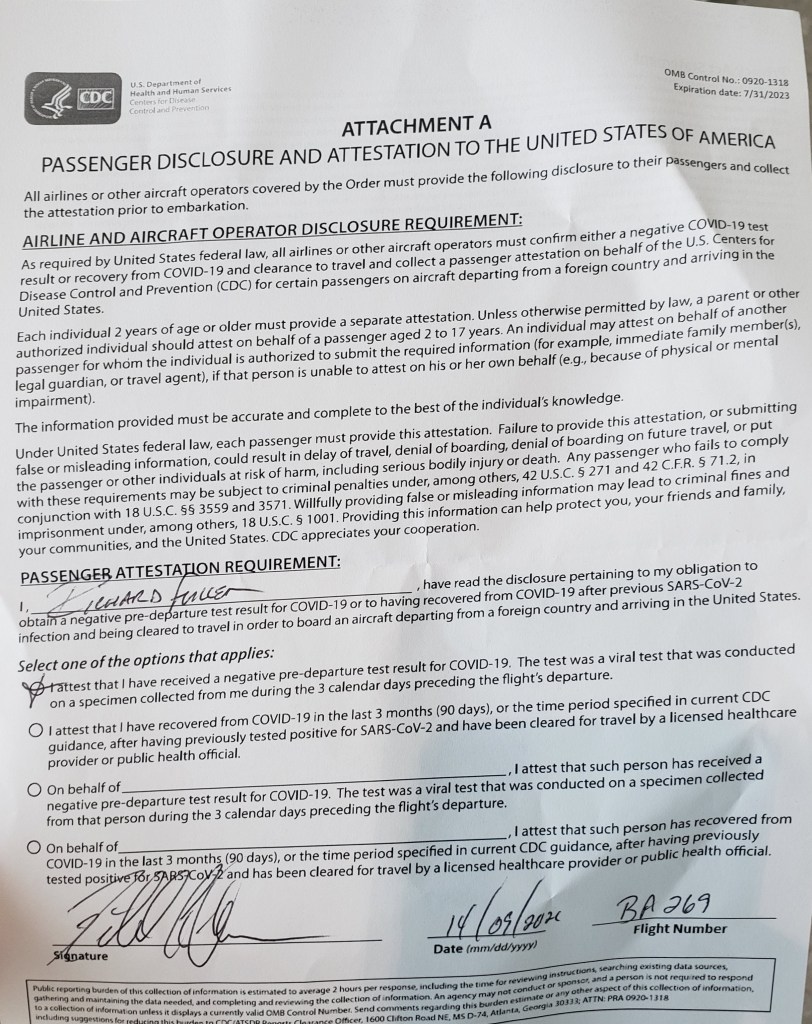
The United States also requires a negative test for all returning travelers by air, so even if we hadn’t been transiting London on our return, we would still have needed the negative test to board any flight headed to the United States. Just prior to boarding our flight from Berlin, we also had to complete a U.S. declaration that stated that we “attest” that we’ve either had a negative Covid test within the preceding three calendar days, or that we’ve recovered from Covid after testing positive within the preceding three months, and that we have documentation to the above. The boarding agent in Berlin collected these attestations from us, so I have no idea of what use they are, or what happens to them. When we landed back in the United States, we both used Global Entry, which simply scans our faces and sends us through. No questions about anything, Covid related or otherwise.

I do so attest, random nonsense government paper creator person.

Covid has undoubtedly made travel tricky, but with a little effort, a lot of research, and a ton of patience, the regulations can be worked out and it is possible to once again enjoy a European vacation.

Now, where did I park my bike?

International Travel in a Covid World (part one)

That vagaries of international travel in a Covid world creates quite a few opportunities for either upside or downside. The upside is that fewer people are traveling, and with fewer travelers come the perks of lighter crowds, better seats, cheaper hotel rooms, and a more pleasant experience in every attraction, museum, restaurant, or historical site. The downside is that the stress and effort of travel has become much more arduous, the planning much more daunting. The real fear that you’ll be turned away at the airport before you even board your flight because your travel documents are not in order, or you’re missing some key piece of required paperwork adds an element of stress to a vacation that hasn’t really existed since the time of the Iron Curtain. Restrictions and requirements are changing constantly, and much of the literature and regulations are confusing and poorly written, very hard to understand and interpret.

For travelers from the United States, things are even more daunting. We aren’t exactly the role-model for the world when it comes to vaccination status, and coronavirus cases here are on the rise as the Delta variant flames its way through our population. This has caused the U.S. to be added to precisely zero “green lists” for international travel, and quite a few “red lists.” Luckily, most countries have U.S. travelers on a “yellow” or “amber list” currently, and the restrictions, while numerous, are manageable with a bit of time, effort, and patience in your planning.

Our trip involved flying to Berlin, Germany, on British Air, with a very quick layover in London. After a few days in Berlin, we would be taking a train to Copenhagen, Denmark, and staying there for a few days, before taking another train to Stockholm, Sweden and staying there a few days. We would then fly back to Berlin for a day or two, and then return to the United States with another layover in London. Save for the roundtrip flights in and out of Berlin, none of this was pre-booked and all subject to change based on our enjoyment of the various cities and the ever-changing regulations around Covid that could cause us to have to cancel or adjust certain legs. Luckily, this is how I prefer to travel anyway, so the uncertain nature of our trip was one I am well-accustomed to and enjoy immensely.

Because our entry-point to Europe was Berlin, I carefully navigated the often-confusing requirements for travel to Germany from the United States, and discovered, much to my delight, that we wouldn’t need a negative Covid test to enter Germany. The requirements for entry were:

1. Full vaccination for at least 14 days, or

2. A negative PCR or Antigen test taken within 72 and 48 hours respectively prior to arrival, or

3. Proof from a doctor of recovery from Covid within the preceding six months.

The “or” on these requirements was a welcome word, and since Tracy and I were both fully vaccinated, we didn’t need to do anything more than remember to bring our vaccination cards to the airport.

Or, so I thought.

It wasn’t until just a few days before our travel that I had a sudden thought that perhaps I should confirm that even though we were only stopping over in London, not leaving the airport or even clearing customs, which meant no official entry into the country, I should probably check to make sure there weren’t any odd rules to be aware of. It was a good thing I checked.

The rules for actually entering Great Britain are arduous and involve things like prescheduling Covid tests on day 2 and again on day 8, quarantines for many travelers, and other nonsense. It turned out, as I dug deeper, that even though we were only laying over, the Brits are quite protective of even their unofficial air, and we would be required to get a Covid test before we would be allowed access to the hallowed aisles of the British Airways 787-10.

The requirements for the specific nature of the test involved immersion rates and accuracy rates and a bunch of other numbers and percentages that nothing in the literature of the various testing sites allows you to confirm. I finally ended up just booking a rapid antigen test because it was the only one where the results would be available within 48 hours. All the testing sites around me were reporting results times of 72 hours or longer, and that wouldn’t work for the flight requirements, so I lied and said I was suffering Covid symptoms just so I could get a rapid test that I wasn’t even sure met the requirements for entry into a country that I wasn’t even officially entering. In addition to the proof of vaccination and negative Covid test, Britain also requires all travelers—even those just passing through—to complete a Passenger Locator Form. This form compiles every bit of information about you, your travel plans—right down to your seat number on all flights—your vaccination and test status, home address, telephone number, passport information, and shoe size.

What a complete pain in the ass.

Anyway, the results of my rapid Covid test came back in about fifteen minutes and were negative, and, shockingly, somehow when I got to the airport, the agent at the ticket counter wasn’t trained to know the difference between an antigen test with soluble rates of 98.7% at a diffusion of 300 grams per milliliter, a PCR test with sensitivity of 91.4% and specificity of 99.6%, and a picture of a cozy rabbit burrow stuffed with cute baby bunnies. It turned out that all she really cared about was the large, bold NEGATIVE stamped halfway down the results page, the vaccination dates on our cards, and that our U.S. passports were valid.

Whew.

On the flight, despite the fact that literally every person is fully vaccinated AND has tested negative within the previous couple of days, masks are still required, which, when you think about it even a little bit, is completely ludicrous. That little self-contained tube in the sky was probably the safest, most Covid-free piece of real estate in the entire world, and yet masks were required to be worn the entire flight. Luckily, we were flying in business class, which has private little cabins where you can’t even see another passenger, and so most of the flight attendants were quite lenient when it came to enforcing the mask mandate. I actually took mine off completely when I laid out my bed and went to sleep for a few hours, and nobody woke me to demand I put a completely useless piece of cloth over my mouth. When we arrived in Berlin, the customs agents wanted to see our passports and our vaccination cards, and that was it, a very simple entry into Germany, and our vacation was underway.

Germany does have some quite strict Covid protocols in place. It’s not just that masks are required everywhere indoors, but they specifically are required to be “medical masks,” which most people in Germany take to mean N95s. Nobody is wearing a bandanna, or a gator, or a scarf over their face like I see all over the U.S. The citizenry are religious maskers in Germany, and every person wears a medical mask, with at least 50% of them of the N95 variety. I rarely saw anybody (other than myself) openly flouting the law and not wearing their masks, and they do apparently levy fines of 50 Euros or more if you are caught willfully violating the mask mandate. It was quite clear that the Germans have received their marching orders from their leaders, and they have fallen in line to snap their heels together, salute, and obey. Hmmm.

I should say here, if my opinion isn’t already clear, mask mandates are stupid. They are performative in nature, designed to make people feel like they’re making a difference and taking steps to be safe while ignoring the science that says that masks, especially the non-N95 variety, are almost entirely useless. In particular, in areas where everybody is required to be vaccinated and test negative, as on the flights, requiring masks in addition to those rules is nothing more than willful disdain for common sense. That being said, N95 masks likely do actually provide some small amount of protection and help to stop the spread of Covid, and if you were going to require a mask mandate in your country the percentage of people wearing the N95 variety is at least encouraging even if it is still ridiculous.

Not only does Germany require and mandate mask wearing indoors, they also require proof of vaccination or a negative test everywhere. I mean everywhere. The hotel requires it at check-in. Many restaurants require it when you go to dinner. Museums, attractions, and tours, all require you to show proof that you are vaccinated or don’t currently have Covid. It’s absolutely nuts to have to show that proof to your maître d’, and then have him also demand you pull your mask up over your nose before he shows you to your table. It’s utter lunacy.

Luckily, all of this idiocy was going to soon come to an end as we boarded a high-speed train for Copenhagen, Denmark, and the start of the Nordic leg of our journey.

Dear President Xi Jinping

Dear Comrade President Xi Jinping,

I’m writing to you today to inform you that there has never been a better time in the last fifty years than right now to mass our mighty forces and invade the island that has been in open rebellion for the last fifty years. The island that we know is part of our great nation, but which has the gall to call itself Taiwan.

During the Tokyo Olympics, many sports announcers and journalists, including some from the host nation of Japan, chose to ignore tradition and to infuse politics into athletics by referring to Chinese Taipei as if it were a sovereign country. This is unacceptable. We have been shamed by these traitorous journalists, and the world now thinks that Chinese Taipei should be recognized in the Olympic Games as a sovereign nation. This is a national embarrassment to our great country, and if we don’t take a stand soon, we will greatly lose face. The Taiwanese have become emboldened by this acknowledgement of their status, and we need to take action to quell it.

Sir, as you know, the only reason we have not invaded this rebellious nation to this point has been because of the great strength of their most important ally, the United States of America. Well, I’m here to tell you now, that the United States has never been weaker than they are right now, and therefore, this is the time to strike!

Last week, the United States of America, on the order of her president, Joe Biden, conducted what was probably the most illogical, ill-thought out, terribly planned and executed withdrawal from a conflict zone in the history of the country. It’s almost inexplicable how they completely turned their backs on friends and allies in some kind of misguided attempt to achieve a total withdrawal by the completely arbitrary date of September 11th so that President Biden could have his grandstanding moment and announce that he was the one to bring an end to the longest war the United States has ever fought.

Sir, the actions and decisions taken by this inept president of the second greatest nation on Earth (to the People’s Republic of China, of course) toward her friends and allies in Afghanistan, leaving them in shocking fashion to fend for themselves against the murderous Taliban barbarians is an action of such callous disregard that it is truly unfathomable. It is quite clear that only six short months into his presidency, Joe Biden is an absolute incompetent fool.

This withdrawal from Afghanistan will certainly become known as Biden’s Folly.

A few days ago, sir, a bomb exploded at the gates to the airport, killing scores of innocents including more than a dozen United States soldiers. I know that here in the PRC, this sort of thing would be shrugged off as collateral damage, but I’m here to tell you that in the United States, where, get this…they value human life (LOL) it was a big deal. The citizenry is up in arms, and moderates on both sides of the political aisle are now upset at this fool of a president. This decision has jolted would-be terrorists from their stupor and completely energized them. There is no doubt that the radicalization of otherwise mild insurgents will thrive, and that there will even be many Americans, both Muslims and Anarchists who will take this opportunity to travel, either in person or virtually through their computers, to a splurge of live and virtual terrorist training camps that are sure to thrive in this new frontier where radicalization is desired above all else.

Joe Biden has proven that he is unsuitable as a president. It’s actually quite difficult for me to come up with an event in recent history that was so poorly handled by a U.S. president. He’s incapable of leading a nation when faced with a crisis, that much is clear. If we invade the country calling themselves Taiwan, the stuttering, doddering old fool with his gee-golly folksy approach will simply stumble around the Oval Office trying to find a corner where he can hide from the press. Biden has succumbed to the worst of his party, the lunatics of the far left. His party doesn’t care one iota about geo-politics, and they already think that the United States should never be involved in any overseas campaigns. They absolutely, positively, will prevent their leader from taking any action whatsoever against our great nation. Biden will simply shirk all responsibility and crumble at the stress we will throw his way. This will inevitably lead to his mental breakdown, followed by his resignation in an attempt to avoid an invocation of the fourth article of their 25th amendment.

Enter President Harris.

Sir, it is my contention that Kamala Harris is a blowhard who will first posture and threaten us while wagging her finger toward us through the camera lens like the arrogant, haughty snob she is. She will be far too fearful though, to take any action against us, military or otherwise. She’ll eventually realize that the extremists who pull the strings of her own party don’t give a rat’s ass about anything that happens beyond its borders. They for sure couldn’t care less about a small island wannabe nation just so long as the eventual ruling party lists their preferred personal pronouns in their bios and admits that 2+2 doesn’t always equal 4. While America used to police the world, they now police only their celebrities, neighbors, and co-workers, making sure to denigrate and destroy anyone who tells a joke that they arbitrarily decide is insensitive or racist.

We’ve long done whatever we wanted in this country with zero sanction or accountability with regard to those loser Uighurs, and, if you agree with my assessment here, we’ll soon be able to do whatever we want with the rebellion leaders in the Republic of China. Just so long as we make sure to funnel a lot of money into their National Basketball Association, we’ll never have to worry about their influencers and celebrities throwing too much of a fuss.

It is patently obvious, Dear Comrade, that the next attack against the United States will be originating in the newly formed terrorist mecca of Afghanistan. The United States is so consumed by bitter infighting and virtue signaling, that they are incapable of seeing the great threat that is building against them. Even if they want to take action against us for our invasion to take what’s rightfully ours, they will not have the heart for it once bombs start exploding on their own soil thanks to the terrorist haven that will soon be thriving due to the actions of their inept president. Biden’s own party will doubtlessly blame white supremacy for the terrorism that’s coming, and many will actually praise the terrorists themselves! This once great nation will crumble to the ground, as so many of its citizens so deeply desire.

Comrade President, the writing is on the wall. Under the “leadership” of this senile clown of a president, the United States is facing dark and deadly times, and now is the time for us to take advantage. Invade Taiwan, sir, and bring the rebels back into the fold.

Sincerely,

All of your advisors, analysts, and military leaders

The Man Who Sowed Irrational Fear and Created MORAL PANIC

On August 12, 1958, Congress passed Public Law 85-623, an “act to prohibit the introduction…into interstate commerce of switchblade knives…” This law became commonly known as the “Federal Switchblade Act,” and it was the culmination of a concerted effort by lawmakers backed by an outpouring of public support that can all be traced back to an article published in Woman’s Home Companion in November, 1950. The author of this article, titled, “The Toy that Kills,” was Jack Harrison Pollack, and he was well-known for his overtly inflammatory articles that preyed on the emotions of his readers, mostly women, tugging at their maternal instincts and unashamedly feeding their base fears.

Jack Harrison Pollack wrote and published more than a thousand articles for numerous magazines and periodicals in the 1950s and 1960s, many of them with inflaming titles like “They’ll Steal Your Vote,” “The Shame of our Local Health Departments,” “Six Ways Your Vote Can Be Stolen,” “Do Drinking Fountains Spread Disease?” and “Too Many Babies Die.”

The Toy that Kills was not written to espouse the dangers of children carrying knives. In fact, Pollack doesn’t seem to have a problem with kids carrying knives in general. He only has an issue with the “threat to our children’s safety,” the switchblade knife. He acknowledges that knives have utility and that society shouldn’t try to stop kids from carrying them. He writes, “(Authorities) don’t want to deny boys their pocket knives. They know that a knife to a growing boy is as important as a lipstick to a young lady.” In just one of the many quotes in the article that are attributed to some vague, unidentified figure, such as this one that he says is from “one of the nation’s top law-enforcement officers,” (whatever that means) he writes, “In a person’s pocket, a switchblade knife is a deadly concealed weapon—as dangerous as a dagger and at close quarters as lethal as a loaded revolver.” The article, which is filled with unsourced, vaguely attributed, unidentifiable quotes like the one above, was clearly meant to inflame its readers and to drive them to action.

In one paragraph Pollack claims to have witnessed an actual switchblade murder on the mean streets of Philly:

“I had no idea myself until I saw a youth stabbed with one on a Philadelphia street. Two young men were fighting with their fists. Suddenly one of them reached into his pocket. A second later his hand held an open knife. He jabbed the gleaming blade into his opponent’s chest. As the blood flowed, women onlookers screamed.”

In another, he has a direct quote from a deceased victim of knife violence:

“Recently—in more innocent spirits—two teen-age boys at a high school dance in a Newark, New Jersey, suburb were playfully showing off with a three-inch switchblade. Accidentally one was shoved against the tip of the knife, which pierced his heart. “You punctured me, Jim, please take me to a drugstore,” the wounded youth moaned and collapsed. His seventeen-year-old companion was aghast. But his sorrow couldn’t bring his best friend back to life.”

The article is filled with anecdotal stories from all over the country that are completely unsourced with no names attached and no references listed. Stories that have direct quotes from one subject to another as if the author witnessed the interaction first-hand. Stories that are quite obviously completely fabricated by Pollack who knows there is no way for his 1950s readers to verify or dispute these stories.

“At almost the same time, in Newark, New Jersey, a thirty-five-year-old woman accused her husband of being unfaithful. Before he had a chance to explain, she angrily yanked a switchblade from her stocking and stabbed her husband in the heart. The next day he died. “If she had only hit her husband with a dish or a rolling pin instead!” mused a police official. “A switchblade isn’t something for anybody with a temper to have.””

Immediately after publication of the article, with nobody of intelligence able to discern the obvious lies and fabrications throughout it, U.S. states began to take action, with New York becoming the first to ban these dangerous weapons. Other states followed suit, and after the federal ban against importation in 1958, the mass hysteria spread around the globe, with countries all through Europe, Asia, and the Americas taking their own steps to pass laws banning switchblade knives. And none of it was based on any sort of reality, data, science, or even logic.

In case you haven’t seen an actual switchblade knife before, I happen to own one. Here is a regular, modern pocket knife, completely legal throughout the country, side-by-side with a dangerous and scary switchblade knife:

And here is a video where I show the difference in the way these knives open:

Warning: Graphic content not suitable to the faint of heart!

As you can see, these two knives are nearly indistinguishable. Why did Pollack feel the need to fabricate his way through a story attempting to rouse his readers to take action against switchblade knives? It’s hard to say. Perhaps he was simply inspired to grow his readership in any way possible, or maybe the editors of Woman’s Home Companion preferred sensationalism to journalism. It’s quite obvious from this article that there was a clear and shocking lack of journalistic integrity in those days, at least in the magazines where Pollack’s articles flourished, his audience apparently enraptured by his histrionic prose. Whatever his intent, the article worked. After its publication, and with the release of films like Rebel Without a Cause, 12 Angry Men, and the musical, Westside Story, the public had seen enough of switchblade knives to know that they were a menace to society. Driven with fear by Pollack’s closing statement, “…don’t wait, either, until a youngster—it could be yours—is murdered with a “toy” pocketknife” the entire world went crazy.

Representative Sidney R. Yates, speaking to Congress before passing the switchblade act, was clearly taken in by the national hysteria surrounding the “deadly” knives:

“Vicious fantasies of omnipotence, idolatry… barbaric and sadistic atrocities, and monstrous violations of the accepted values spring from the cult of the weapon, and the switchblade knife is included in this. Minus switchblade knives and distorted feeling of power they beget – power that is swaggering, reckless, and itching to express itself in violence – our delinquent adolescents would be shorn of one of their most potent means of incitement to crime.” 

There’s no doubt that youth violence was a problem in the fifties, however, the switchblade knife was nothing more than a symbolism of that violence, a simple tool embodied in bloodshed by the media, and as such, it was targeted by activists who reacted on emotion rather than common sense.

When considering the Moral Panic created by Pollack against switchblade knives, it’s rather difficult to not draw comparisons to the current state of affairs with society’s Moral Panic about AR-15s. The AR-15 has become the weapon of choice for many of the most heinous mass shootings our country has witnessed in the last couple of decades, and as such, it has become bastardized by society. And yet, the AR-15 is nothing more than a symbol of gun violence. It’s not even the best choice of weapon if you want to create the most bloodshed, death, fear, and violence. A typical AR-15 shoots a tiny .223 round that, in many of its iterations, causes little damage when it strikes a human body. However, because the AR-15 has been used by so many shooters, it has become the target of activists and politicians who think that the murder problem of our country will disappear if the AR-15 is banned. They seem to have lost sight of the same logic missing in society in the 1950s. Banning switchblades didn’t curb youth violence, youths just continued to carry what were now illegal knives, or they just switched to similar knives that were legal. Banning AR-15s will just mean that shooters will choose a different type of weapon for their killing sprees. If I was writing this article sixty years in the future, I might write the previous paragraph this way:

There’s no doubt that gun violence was a problem during the turn of the century, however, the AR-15 was nothing more than a symbolism of that violence, a simple tool embodied in bloodshed by the media, and as such, it was targeted by activists who reacted on emotion rather than common sense.

Gersh Kuntzman is today’s version of Jack Harrison Pollack. In an article in the New York Daily News a few years ago titled, What is it like to fire an AR-15? It’s horrifying, menacing, and very, very loud, he writes the following lines:

The recoil bruised my shoulder, which can happen if you don’t know what you’re doing. The brass shell casings disoriented me as they flew past my face. The smell of sulfur and destruction made me sick. The explosions — loud like a bomb — gave me a temporary form of PTSD. For at least an hour after firing the gun just a few times, I was anxious and irritable.

Even in semi-automatic mode, it is very simple to squeeze off two dozen rounds before you even know what has happened. If illegally modified to fully automatic mode, it doesn’t take any imagination to see dozens of bodies falling in front of your barrel.

If you’ve ever fired an AR-15 you know what complete and utter nonsense this is. Squeezing off two dozen rounds requires a high-capacity magazine and 24 distinct and separate trigger pulls along with the corresponding “bruising” shoulder kicks, “disorienting” brass casings “flying past your face,” and “bomb-like” explosions. I’m pretty sure you can’t accomplish that “before you even know what has happened.” The AR-15 has one of the lightest kicks—a gentle tap to the shoulder—of any rifle you’ll ever fire. Youtube is full of videos of girls and boys under the age of 10 firing AR-15s with smiles on their faces, apparently unperturbed by this alleged bruising this full-grown man suffered from. The AR-15 is almost certainly quieter than every one of the handguns he claims to have fired, (loud like a bomb???) and definitely quieter than most other rifles, and his theatrical, melodramatic claim that he suffered PTSD after firing the weapon…let’s just say that did not sit well with members of our armed forces who took some issue with that, as seen in his retraction statement that was added to the bottom of the article.

Kuntzman’s attempt to summon the spirit of Pollack’s malicious writings through his hammy, histrionically contrived description of his experience firing the AR-15 have only one goal…to raise the ire of the ignorant readers of the New York Daily News by creating an emotionally distorted Moral Panic that will drive them to take action to ban these types of weapons that he sees as unnecessary and dangerous. His efforts to instill the image of “dozens of bodies falling in front of your barrel” should be completely transparent, yet a constant flow of disinformation and fear mongering about AR-15s by journalists and politicians alike would seem to indicate that it is not.

Magazines that publish articles like those by Pollack in the 1950s and Kuntzman today are blurring the lines between established and respected periodicals and sensationalist tabloids by their lack of editorial oversight or journalistic integrity. They care about nothing more than readership, and sensationalism-driven clicks and sales.

Moral Panic has reared its ugly head in numerous examples of legislation since Pollack started the trend. In the 1950s, Dr. Frederic Wertham went on a crusade to warn America about the dangers of comic book violence. He penned numerous articles, including “Seduction of the Innocent,” and “What Parents Don’t Know about Comic Books” in Ladies Home Journal. His completely unbased and unscientific, speculative assertions that comic books were a corrupting influence on youth, a public health problem, and a leading cause of juvenile delinquency created a Moral Panic that spread across the country. The Senate convened a special subcommittee to explore the matter, and legislation was enacted that forced government comic book censorship and “approval” stickers before they could be legally sold. At no time were any serious, scientific studies conducted; the subcommittee members relied almost exclusively on anecdotal evidence and “expert” testimony before coming to their conclusions.

In recent times, the media narrative that police kill minorities, particularly black men, at a higher rate than others, even that they have set out to intentionally murder black men as part of a racist crusade, has created a massive Moral Panic that is currently inflaming the public and dividing the country. This is a narrative that has been thoroughly and completely debunked by numerous scientific studies, and yet groups like Black Lives Matter and far-left media outlets continue to spew it, intentionally keeping America in internal strife as a means of forwarding their own nefarious agenda.  

Most of the Moral Panic in society today seems driven by the political left, however, the right is just as guilty. After the 1 October shooting at the Route 91 festival in Las Vegas, bump stocks became the new Moral Panic of society. A device designed to help disabled veterans and target shooters enjoy their passion was bastardized by a murderer and society reacted in sadly typical fashion. President Trump quickly blamed Obama for the legalization of such a deadly and dangerous device, and ordered the Department of Justice to ban them. This ban was issued in 2018 and went into effect in 2019, requiring owners to destroy them or turn them in to the ATF under penalty of ten years imprisonment and a $250,000 fine. And why? Because one person misusing something that was designed to be simply a tool created a nation-wide hysterical Moral Panic and politicians reacted. This ban was only struck down as unconstitutional a few months ago by the Sixth Circuit Court of Appeals, and the legal battle is still ongoing.

Is there a difference between a spring-assisted-opening knife and a switchblade? Sure. The blade on a switchblade deploys a small fraction of a second quicker. The switchblade requires a very slightly less dexterous movement to open. And, it makes a slightly louder and scarier “snap” when it opens. (I get a form of PTSD every time I open mine, as well as visions of dozens of bodies falling under my deftly slashing hand as I cut my way through a crowd while the song, “Gee, Officer Krupke” plays in my head.) But are these differences great enough to justify one of the knives being completely legal while possessing the other one gets you sent to jail? That is quite hard to fathom yet that is our reality, thanks to the moral panic riled up by Jack Pollack’s article.

It’s really not until recently, more than 60 years later, that this fugue of nonsensical hysteria has finally begun to unravel. Although switchblades are still federally illegal to import or sell over state lines, most states have now repealed laws against them and made them completely legal to own and carry. I believe they are still illegal to own in 11 states (including Washington) with a couple others having some restrictions on blade length or concealed carry.

Moral Panic causes our society to react emotionally rather than logically to problems our nation faces. It causes us to legislate by fear, to act impetuously and impulsively when confronted with real, germane and critical issues. Whenever we make hasty, impassioned decisions based on an emotional reaction rather than a well-thought-out, logical, data-driven response to an issue, we are much more likely to get the solution wrong, and quite possibly to exacerbate the problem. So, what can we do about the detrimental effects of our emotional reaction to Moral Panic? The first step is recognizing and crushing the driving force behind this plague, namely the media and their incessant drive to generate clicks at any cost. By calling out and demanding an end to the nonsense of histrionic articles like the ones by Pollack and Kuntzman, we can calm the fear they’re attempting to inseminate in our psyche.

The second step is by electing more logical, intelligent leaders to Congress and the Presidency. Political media whores like Alexandria Ocasio-Cortez, Marjorie Taylor Green, Bernie Sanders, and Donald Trump who thrive on bombastic speech and the susceptibility of their audience to Moral Panic need to be soundly defeated. We need a Congress that passes laws and reacts to situations by using logic, data, and a careful evaluation of facts rather than legislating through Moral Panic. Emotional reactiveness has been a massive detriment to our society and our country. It is the malevolent fiend that has fatefully led us through things like the Red Scare, wars on drugs and in Vietnam, Iraq, and Afghanistan, the implication of a stolen election and widespread voter fraud, and uncountable examples of unnecessary and detrimental Congressional legislation.

It’s time we defeated the sixty-year-old demon known as Moral Panic that was summoned by Pollack and nourished by panicky, emotional simpletons through the decades. It’s time we moved on from the era of reactionary politics and to an era of logic, science, and data helping us drive all of our laws and our decisions.

Pollack, Jack, “The Toy that Kills,” Woman’s Home Companion, November, 1950. https://docplayer.net/209786811-The-toy-that-kills-woman-s-home-companion-november-1950.html 

The New York Times, Obituaries, October 2, 1984 https://www.nytimes.com/1984/10/02/obituaries/jack-h-pollack-69-author-of-books-and-1000-articles.html

Whitmore, Zac, “Why are Switchblades Illegal?” Blade Magazine. https://blademag.com/knife-history/why-are-switchblades-illegal

https://onlinelibrary.wiley.com/doi/abs/10.1002/ncr.4110450704

Kuntzman, Gersh, “What is it like to fire an AR-15? It’s horrifying, menacing, and very very loud.” New York Daily News July 14, 2016 https://www.nydailynews.com/news/crime/firing-ar-15-horrifying-dangerous-loud-article-1.2673201

https://en.wikipedia.org/wiki/Bump_stock

History of Comics Censorship, Part 1

8 minutes and 46 seconds that changed the nation?

On May 25th, 2020, at approximately 2025 hours, George Floyd, an African-American citizen, was killed by Officer Derek Chauvin of the Minneapolis Police Department. The incident was captured on multiple cell phone videos and body-worn cameras and widely distributed. The images are disturbing: Officer Chauvin with his knee pressed on the back of the neck of Mr. Floyd while Mr. Floyd moans and complains that he can’t breathe, begging the officers for relief.

In an incredibly swift and judicious action, the Minneapolis Police Department fired Derek Chauvin and three other officers who were at the scene the very next day. This wouldn’t be enough to mollify the public though, as rioting, looting, and burning would commence that night and for the next several nights, turning downtown Minneapolis into a war zone, protestors even capturing and burning the MPD 3rd precinct where the four officers were assigned. Protests and riots would spread across the country in cities large and small. The protestors’ demands? The arrest and charging of the four officers involved.

The clear video and facts of this case are indisputable. Or are they?

On May 29, 2020, four days after the killing, former Officer Derek Chauvin was finally arrested by the BCA—the Minnesota Bureau of Criminal Apprehension, an agency with which fans of novelist John Sandford will be very familiar. The BCA is a state police force, tasked with investigating the actions of the officers involved. In addition to the BCA, the FBI and the Justice Department are running parallel investigations into potential federal charges under the “color of law” statutes.

The charges filed against Chauvin are: 1) Murder – 3rd degree, and, 2) Manslaughter – 2nd degree. The charges were filed by Michelle Frascone, a Special Agent with the BCA, and Amy Sweasy, a prosecuting attorney for the State of Minnesota.

Upon filing the charges, the public erupted in anger once again, insisting that the charges were too lenient, in what would seem at first glance to be a rather humorous flip of the normal complaint that prosecutors tend to overcharge suspects.

Was the charging appropriate? Let’s take a look at the specific Minnesota statutes involved here.

609.195 MURDER IN THE THIRD DEGREE.

(a) Whoever, without intent to effect the death of any person, causes the death of another by perpetrating an act eminently dangerous to others and evincing a depraved mind, without regard for human life, is guilty of murder in the third degree and may be sentenced to imprisonment for not more than 25 years.

At first glance, this seems a completely appropriate charge. I had to look up what “evincing a depraved mind” means because I’ve never heard that term, however, it’s apparently a fairly common term in several Midwest states. Here is what it means, according to the Minnesota Supreme Court: “The phrase “evincing a depraved mind, regardless of human life” as used in these instructions means conduct demonstrating an indifference to the life of others, that is not only disregard for the safety of another but a lack of regard for the life of another.”

There is little doubt that Officer Chauvin’s actions showed a complete indifference to Mr. Floyd’s life, as we’ll see a little later, so after some review, this charge seems completely appropriate. As a prosecuting attorney, you definitely want to charge as high as possible. This gives you maximum flexibility, lending strength to your negotiating platform for plea bargains, and giving juries and judges maximum flexibility during sentencing. When the arresting officer and the prosecutor decide on charges, even though this charge seems to fit the crime, they definitely want to take a look at the next higher charge to see if that one might possibly fit. So, let’s take a look at the statute for Murder – 2nd degree.

609.19 MURDER IN THE SECOND DEGREE.

Subdivision 1. Intentional murder; drive-by shootings.

Whoever does either of the following is guilty of murder in the second degree and may be sentenced to imprisonment for not more than 40 years:

(1) causes the death of a human being with intent to effect the death of that person or another, but without premeditation; or

(2) causes the death of a human being while committing or attempting to commit a drive-by shooting in violation of section 609.66, subdivision 1e, under circumstances other than those described in section 609.185, paragraph (a), clause (3).

Under subsection (1) we see that the key word “intent” comes into play once you charge murder in the 2nd degree (as well as murder 1st degree.) Subsection 2 doesn’t apply here, obviously, nor does Subdivision 2 which deals with protection orders and other felonies, but you can read them HERE if you’d like.

So, the question becomes, did Officer Chauvin intend to murder George Floyd?

Despite the outrage of the public, despite mayors, governors, and dozens of other elected officials calling this murder, implying or outright stating that this was blatant, intentional murder, objectively this seems absolutely ridiculous. In order to believe that Chauvin intended to murder Floyd, you would have to think that a cop—someone who ABSOLUTELY, DESPERATELY, under all possible circumstances wants to avoid the inside of a prison, where really bad things tend to happen to cops, decided, with multiple cameras rolling, in broad daylight, “Fuck it. I’m just going to go ahead and murder this dude right now.” This seems so completely implausible that it’s laughable, yet that is what “intent” would require. Even if you’re somehow allowing emotion to cloud your judgement and you think that’s exactly what happened, as a prosecutor, you still have to PROVE this in a court of law. You have to prove that Officer Chauvin thought exactly that, that his full intention was to murder. A defense attorney would have a field day with this charge, and the prosecutors know it, so it would seem that Murder – 3rd degree is absolutely the appropriate charge.

Now, prosecutors like to stack charges, and they like to be comprehensive and thorough, so they also tacked on the charge of Manslaughter – 2nd degree. Let’s take a look at that statute:

609.205 MANSLAUGHTER IN THE SECOND DEGREE.

A person who causes the death of another by any of the following means is guilty of manslaughter in the second degree and may be sentenced to imprisonment for not more than ten years or to payment of a fine of not more than $20,000, or both:

(1) by the person’s culpable negligence whereby the person creates an unreasonable risk, and consciously takes chances of causing death or great bodily harm to another; 

Culpable negligence. Negligence that is deserving of blame. Negligence that creates an unreasonable risk and consciously takes chances of causing death to another. Yeah. I think this is pretty clear, and the video would seem to indicate that Officer Chauvin definitely acted in this manner. So, Manslaughter – 2nd degree seems like a good charge, particularly if Murder – 3rd degree doesn’t end up holding up. By charging both, prosecutors can hope for a conviction on Manslaughter if the defense gets an acquittal on Murder. Could they have charged Manslaughter – 1st degree? Let’s take a look at that charge.

609.20 MANSLAUGHTER IN THE FIRST DEGREE.

Whoever does any of the following is guilty of manslaughter in the first degree and may be sentenced to imprisonment for not more than 15 years or to payment of a fine of not more than $30,000, or both:

(1) intentionally causes the death of another person in the heat of passion provoked by such words or acts of another as would provoke a person of ordinary self-control under like circumstances, provided that the crying of a child does not constitute provocation;

(2) violates section 609.224 and causes the death of another or causes the death of another in committing or attempting to commit a misdemeanor or gross misdemeanor offense with such force and violence that death of or great bodily harm to any person was reasonably foreseeable, and murder in the first or second degree was not committed thereby;

(3) intentionally causes the death of another person because the actor is coerced by threats made by someone other than the actor’s coconspirator and which cause the actor reasonably to believe that the act performed by the actor is the only means of preventing imminent death to the actor or another;

(4) proximately causes the death of another, without intent to cause death by, directly or indirectly, unlawfully selling, giving away, bartering, delivering, exchanging, distributing, or administering a controlled substance classified in Schedule III, IV, or V; or

(5) causes the death of another in committing or attempting to commit a violation of section 609.377 (malicious punishment of a child), and murder in the first, second, or third degree is not committed thereby.

As used in this section, a “person of ordinary self-control” does not include a person under the influence of intoxicants or a controlled substance.

None of these sections would seem to apply to this scenario save section (1). You might be able to argue that Mr. Floyd’s actions provoked Officer Chauvin in such a way that it caused him to retaliate by maliciously killing him. However, this is a slippery slope for the prosecution. This argument would require the prosecution to shine Mr. Floyd in a negative light, something that would be detrimental to the prosecution and favorable to the defense, so this seems like a poor prosecutorial strategy. Which means that Manslaughter – 1st degree would be a poor choice of charges, which means that it seems they charged appropriately here as well.

Let’s go back to the statement above that shining Mr. Floyd in a negative light is detrimental to the prosecution. This seems really obvious, right? The prosecution should be attempting to downplay his criminal background, his crimes at this scene, his efforts to resist arrest. The defense will want to bring all of these things up; it will be their job to paint Mr. Floyd in as poor a light as possible, to vilify him in subtle ways that may turn jury opinion to the favor of the defendant. This is super clear to everybody, right? Apparently it’s not that clear to the Minnesota Prosecutor’s Office.

Let’s take a look at the Probable Cause charging document for the arrest warrant for Officer Chauvin.

This document was likely prepared as a coordinated effort between the prosecutor, Amy Sweasy, and the BCA agent, Michelle Frascone. They should be stating the facts of the case and establishing probable cause for the issuance of an arrest warrant for Chauvin. That’s it. This document does not need to be lengthy. Extraneous information is not necessary. It needs only to establish probable cause.

So, what does it say? Let’s pull a couple passages from the document. You can read the entire thing HERE if you choose.

BWC (this is body worn camera) video obtained by the Minnesota Bureau of Criminal Apprehension shows that the officers approached the car, Lane on the driver’s side and Kueng on the passenger side. Three people were in the car; George Floyd was in the driver’s seat, a known adult male was in the passenger seat and a known adult female was sitting in the backseat. As Officer Lane began speaking with Mr. Floyd, he pulled his gun out and pointed it at Mr. Floyd’s open window and directed Mr. Floyd to show his hands. When Mr. Floyd put his hands in the steering wheel, Lane put his gun back in its holster.

Here, prosecutors are laying out the facts of the case. They’re using footage not yet available to the public to establish their probable cause. At this point in the document, Officer Chauvin hasn’t even arrived onscene. So, why are they describing actions taken by other officers prior to his arrival? Why are they outlining that another officer, Officer Lane, drew his gun and pointed it in the direction of Mr. Floyd, in a document to establish probable cause for the arrest of Officer Chauvin? This is extraneous information. It’s irrelevant to the probable cause. The only purpose that I can ascertain for its inclusion would be to shine the light that Mr. Floyd was a dangerous subject, whose very presence, or the nature of his crime, or actions in the vehicle caused enough alarm in Officer Lane that he felt the need to draw his weapon. This is a bizarre inclusion in a probable cause statement. It would seem to be something the defense would draw attention to during trial, actions they would be trying to get included in their evidence, actions that the prosecution might object to on the grounds of relevance since the defendant wasn’t even present at the scene at this point. Why is it included in the probable cause document?

Let’s look at another section.

Once handcuffed, Mr. Floyd became compliant and walked with Officer Lane to the sidewalk and sat on the ground at Officer Lane’s direction. In a conversation that lasted just under two minutes, Officer Lang asked Mr. Floyd for his name and identification. Officer Lane asked Mr. Lloyd if he was “on anything” and explained that he was arresting Mr. Lloyd for passing counterfeit currency.

Officers Kueng and Lane stood Mr. Floyd up and attempted to walk Mr. Floyd to their squad car (MPD 320) at 8:14 p.m. Mr. Floyd stiffened up, fell to the ground, and told the officers he was claustrophobic.

MPD Officers Derek Chauvin (the defendant) and Tou Thoa then arrived in a separate squad car.

The officers made several attempts to get Mr. Floyd in the backseat of squad 320 from the driver’s side.

Mr. Floyd did not voluntarily get in the car and struggled with the officers by intentionally falling down, saying he was not going in the car, and refusing to stand still. Mr. Floyd is over six feet tall and weighs more than 200 pounds.

In the first paragraph, the state points out that Officer Lane asked Mr. Floyd (sic for the original) if he was “on anything.” Again, the defendant, Officer Chauvin is not even on the scene at this point. Why is the prosecution establishing a basis for the defense to argue that Mr. Floyd may have been acting under the influence of drugs? This is such a bizarre inclusion in a probable cause document that is supposed to be concise and brief. In the last paragraph, the prosecution points out Mr. Floyd’s resistance to being placed into the patrol car. This is not that unusual as they’re establishing a basis for him being proned out on the ground where the incident occurred. What is odd though, is that they describe him as “over six feet tall and weighs more than 200 pounds.” Why are they including this line? Once again it seems like they’re trying to establish a basis that the officers’ actions were appropriate, that they were dealing with a large, strong, bull of a man, and that they had no choice but to elevate to the level of force they used. This is such an odd description to put in the PC document. It seems like a point the defense would want to make at trial, not something the prosecution would want to point out, and certainly not something necessary for the establishment of probable cause for Chauvin’s arrest.

The rest of the PC document is very telling. It describes how Chauvin refused to turn Mr. Floyd onto his side, even when Officer Lang suggested they should do just that. It describes how he kept his knee on his neck through multiple pleas that he was suffering. This plea is not too terribly unusual, by the way. Defendants often complain they can’t breathe, even when they can clearly breathe. However, positional asphyxiation is incredibly dangerous, and I suspect that Mr. Floyd could breathe just fine, however, he could feel the asphyxiation building, and that was the feeling he was trying to describe when he used the term, “I can’t breathe.”

The most sickening part of the PC document is this paragraph:

BWC video shows Mr. Floyd continue to move and breathe. At 8:24:24, Mr. Floyd stopped moving. At 8:25:31 the video appears to show Mr. Floyd ceasing to breathe or speak. Lane said, “want to roll him on his side.” Kueng checked Mr. Floyd’s right wrist for a pulse and said, “I couldn’t find one.” None of the officers moved from their positions. At 8:27:24, the defendant removed his knee from Mr. Floyd’s neck. An ambulance and emergency medical personnel arrived, the officers placed Mr. Floyd on a gurney, and the ambulance left the scene. Mr. Floyd was pronounced dead at Hennepin County Medical Center.

At 8:24:24, BWC video shows that Mr. Floyd stopped moving. At this point, how does Chauvin keep applying a neck hold to him? The suspect had quit resisting many minutes earlier. The neck hold should have been released at the latest when the resisting ended. De-escalation as the suspect de-escalates is just as critical, lawful, and important, as appropriate escalation is. Officer Lane again asks to roll him on his side. Apparently, this again doesn’t happen. Officer Kueng checks for a pulse and can’t find one. What do the officers do at this point?

“None of the officers moved from their positions.”

WHAT? They can’t find a pulse and Chauvin (I’m done using the title Officer Chauvin here, he doesn’t deserve it) continues to use the knee to neck hold??? Nobody starts CPR? Nobody takes responsibility for a suspect in their custody who doesn’t have a pulse!?

At 8:27:24, exactly three minutes after he stops moving, Derek Chauvin finally removes his knee from Mr. Floyd’s neck. Why? Because an ambulance has arrived and it’s time to roll him onto a gurney.

This video, and the statements in the PC document that describe video not yet released, is sickening. It’s so disturbing. As a former cop, I’m appalled and saddened. As a human, I’m disheartened and repugnated. The actions of Chauvin in particular, and the other officers in general, are vile, abhorrent, and so unworthy of the badge that so many officers take so much pride in.

So, what will happen to Derek Chauvin? You’re not going to like this…

I don’t think he will be convicted of either of the crimes to which he’s charged. I would lay money that he won’t be convicted of murder. There are many reasons for this, and I’ll outline a few:

For starters, as I have shown in the PC document, it really seems that the fix is in here. The statements made by the prosecution in that warrant application are bizarre, and I’m struggling to find a beneficent reason behind their inclusion. Additionally, neck holds are authorized uses of force in the Minneapolis Police Department. This will change obviously, and probably like next week, but as of this moment, they are completely legal holds. From that point of view, Chauvin did nothing wrong by applying the hold. Where he went wrong was the length of time he applied it, and his wanton disregard for the life of Mr. Floyd. But this is going to be so difficult to prove. Once the defense is granted a change of venue, away from the jury pool immersed in this scene, once they go through a rigorous voir dire process, where they will weed through jury members who might have any knowledge of the incident, once enough time has passed for people to forget, years down the road, they will be able to argue so many points in their favor. They will be able to include Mr. Floyd’s criminal record, his history of resisting arrest, his size, his demeanor. By the time they’re done, they will make him look worse than Hannibal Lector. They will make it seem as if extraordinary measures were necessary for the safety of the police officers and the public. They will villainize Mr. Floyd and elevate Chauvin to the status of guardian hero. They will point out Chauvin’s commendations and his awards. They will exemplify his nineteen years of service to the community.

Here is the second to last paragraph in the Probable Cause document, in my opinion, the biggest smoking gun for my theory that the prosecutor really doesn’t want to try this case and is simply acceding to public pressure:

The Hennepin County Medical Examiner (ME) conducted Mr. Floyd’s autopsy on May 26, 2020. The full report of the ME is pending but the ME has made the following preliminary findings. The autopsy revealed no physical findings that support a diagnosis of traumatic asphyxia or strangulation. Mr. Floyd had underlying health conditions including coronary artery disease and hypertensive heart disease. The combined effects of Mr. Floyd being restrained by the police, his underlying health conditions and any potential intoxicants in his system likely contributed to his death.

What?? Why is this paragraph in a document whose sole purpose is to establish probable cause for the arrest of the officer? THIS IS THE OPPOSITE OF PROBABLE CAUSE! THIS SAYS THAT IT REALLY WASN’T CHAUVIN’S FAULT AT ALL! Once again, this seems like ammunition for the defense. It feels like the prosecution is trying to help them make their case! I have NEVER seen a statement like this in a probable cause document. With this statement in the PC document, I’m kind of surprised the judge even approved the warrant!

The prosecution is always facing an uphill battle when they charge a police officer. When they start that battle in what seems to be a completely half-hearted, almost seditious manner with the most simple and basic of documents, it feels like they will completely blow the prosecution, intentionally or apathetically.

Don’t be surprised if Derek Chauvin ends up being convicted of some lessor charge. Something like Assault in the third degree, or Misconduct of a Public Officer. When this happens, get ready for cities to burn again. Because if this happens, they should burn. We need change, and there’s another article coming sometime soon that will describe what I think needs to happen to effect that change.

Let’s hope George Floyd’s death has meaning. Let’s hope his 8 minutes and 46 seconds of suffering results in meaningful change. Let’s hope America can finally rise to the challenges of racism and brutality. Let’s hope police departments can throw aside the heavy net cast upon them by the tiny percentage of officers who give all the good ones such a bad name. Let’s hope Derek Chauvin gets a fair trial followed by swift and appropriate justice. Let’s hope this never happens again.

***edit — The prosecutors later caved to public pressure and added a charge of Murder 2nd degree, something that is complete and utter nonsense. As I outlined above, there is absolutely no basis in my opinion for this charge, and the only possible reasoning for adding it later was that the DA was beginning to hear the tolling bells of his career if he didn’t add it. Disgusting politics at its finest right there.